



Question: 1. Consider the following game. Two workers A and B simultaneously choose to either work on project 1 (P1) or project 2 (P2). The payoffs
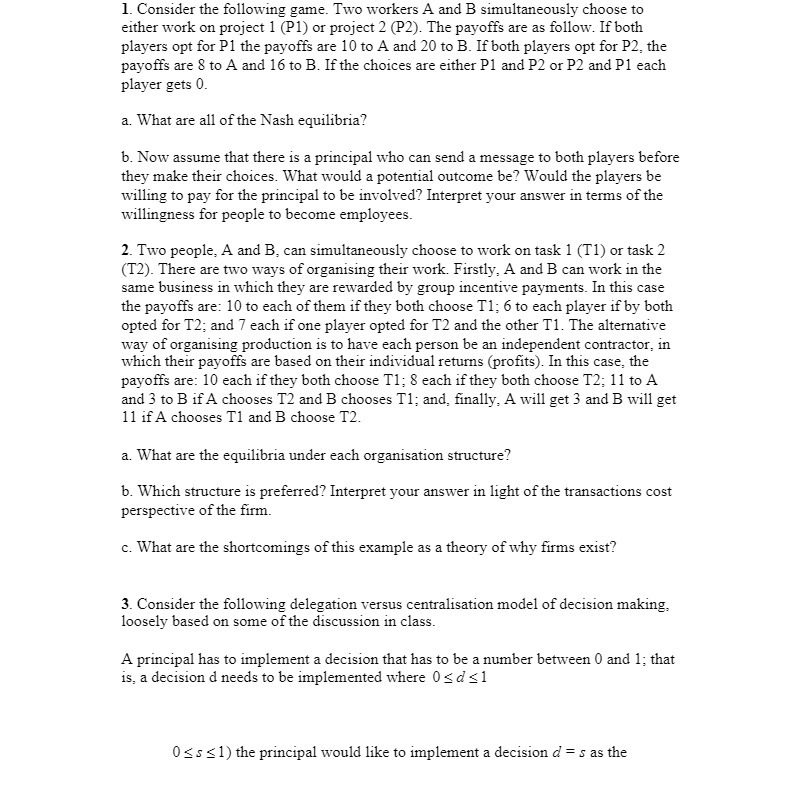
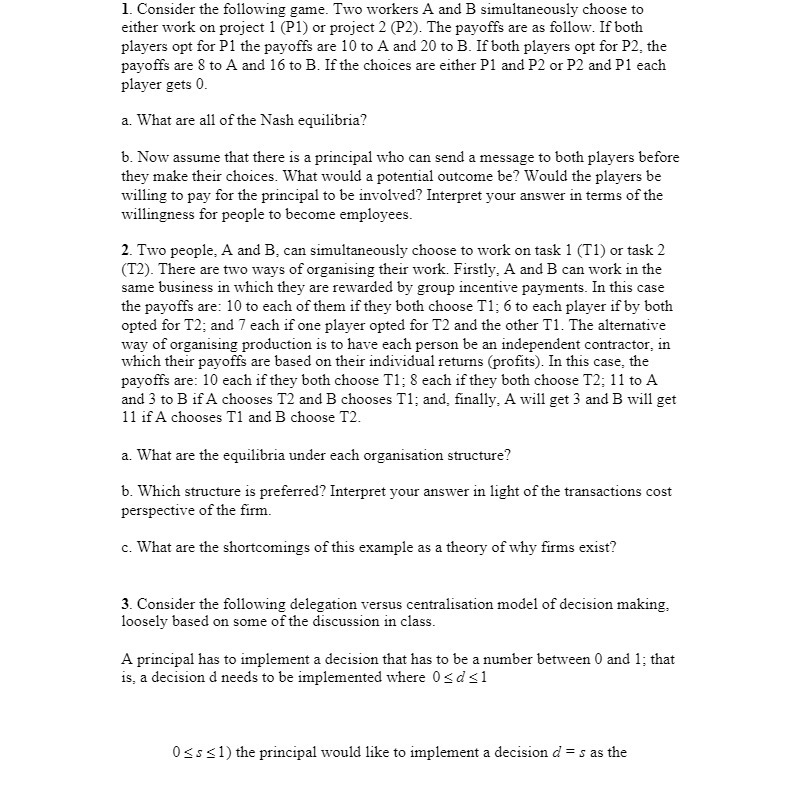
1. Consider the following game. Two workers A and B simultaneously choose to either work on project 1 (P1) or project 2 (P2). The payoffs are as follow. If both players opt for Pl the payoffs are 10 to A and 20 to B. If both players opt for P2, the payoffs are 8 to A and 16 to B. If the choices are either Pl and P2 or P2 and Pl each player gets 0. a. What are all of the Nash equilibria? b. Now assume that there is a principal who can send a message to both players before they make their choices. What would a potential outcome be? Would the players be willing to pay for the principal to be involved? Interpret your answer in terms of the willingness for people to become employees. 2. Two people, A and B, can simultaneously choose to work on task 1 (T1) or task 2 (T2). There are two ways of organising their work. Firstly, A and B can work in the same business in which they are rewarded by group incentive payments. In this case the payoffs are: 10 to each of them if they both choose T1; 6 to each player if by both opted for T2; and 7 each if one player opted for T2 and the other T1. The alternative way of organising production is to have each person be an independent contractor, in which their payoffs are based on their individual returns (profits). In this case, the payoffs are: 10 each if they both choose T1; 8 each if they both choose T2; 11 to A and 3 to B if A chooses T2 and B chooses T1; and, finally, A will get 3 and B will get 11 if A chooses T1 and B choose T2. a. What are the equilibria under each organisation structure? b. Which structure is preferred? Interpret your answer in light of the transactions cost perspective of the firm. c. What are the shortcomings of this example as a theory of why firms exist? 3. Consider the following delegation versus centralisation model of decision making loosely based on some of the discussion in class. A principal has to implement a decision that has to be a number between 0 and 1; that is, a decision d needs to be implemented where 0 s d s1 0
Step by Step Solution
There are 3 Steps involved in it

Get step-by-step solutions from verified subject matter experts