







Question: 1. Consider the following production function: Y = AKL, where Y is production, A is productivity, all that apply)? K is capital, and L is
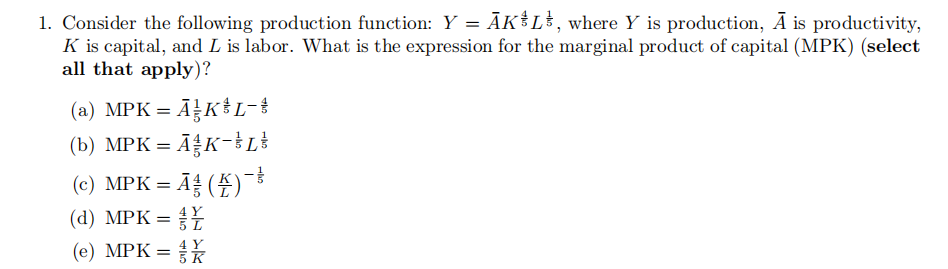
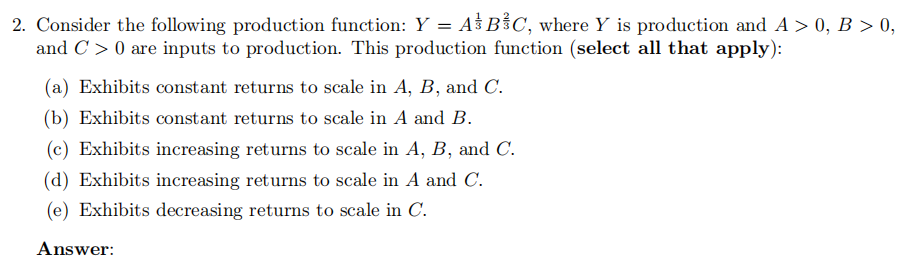
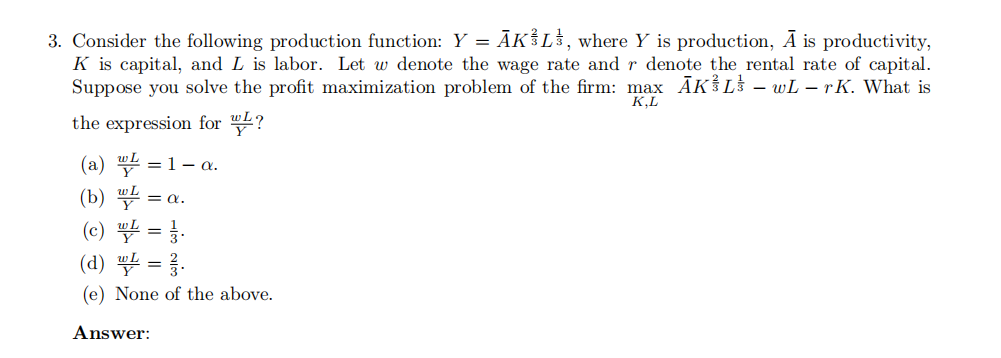
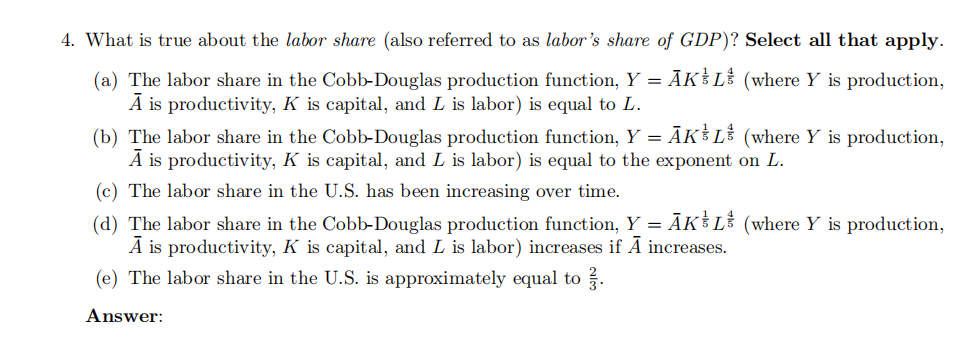
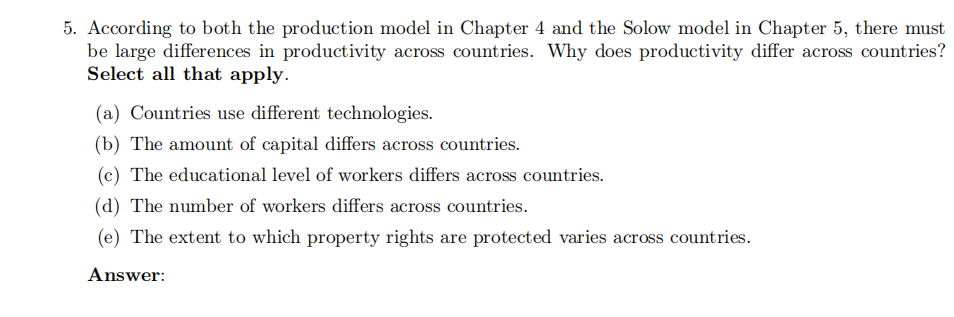
1. Consider the following production function: Y = AKL, where Y is production, A is productivity, all that apply)? K is capital, and L is labor. What is the expression for the marginal product of capital (MPK) (select (a) MPK = AKL- (b) MPK = AK-L (c) MPK = A4 (K) - (d) MPK = 4Y 5 L (e) MPK = 4Y 5 K2. Consider the following production function: Y = ABCL where Y is production and A > U, B > {1, and C > {J are inputs to production. This production function [select all that apply): (a) Exhibits constant returns to scale in A, B , and C. [b] Exhibits oonstant returns to scale in A and B. (c) Exhibits increasing returns to scale in A, B, and C. (d) Exhibits increasing returns to scale in A and C. l {e Exhibits decreasing returns to scale in 0. Answer: . Consider the following production function: Y = KgLi, where Y is production, xi is productivity, K is capital, and L is labor. Let n: denote the wage rate and 3" denote the rental rate of capital. Suppose you solve the prot maximization problem of the rm: mag: EX 15; wL rK. What is E? y. the exprasion for (a) wL = 1 or. (b) wL = (c) wL = (d) wL = (e) None of the above. who wIH Q Answer: 4. What is true about the labor share {also referred to as labor's share of GDP)? Select all that apply. (a) The labor share in the Cobb-Douglas production function, Y = HKL {where Y is production, 11 is productivity, K is capital, and L is labor) is equal to L. (b) The labor share in the Cobb-Douglas production function, Y = KL {where Y is production, 21 is productivity, K is capital, and L is labor) is equal to the exponent on L. (c) The labor share in the US. has been increasing over time. (d) The labor share in the Cobb-Douglas production function, Y = 11K %L% {where Y is production, 21 is productivity, K is capital, and L is labor) increases if .3 increases. (e) The labor share in the US. is approximately equal to %. Answer: 5. According to both the production model in Chapter 4 and the Solow model in Chapter 5, there must be large differences in productivity across countries. Why does productivity differ across countries? Select all that apply. (a) Countries use different technologies. (b) The amount of capital differs across countries. (c) The educational level of workers differs across countries. (d) The number of workers differs across countries. (e) The extent to which property rights are protected varies across countries
Step by Step Solution
There are 3 Steps involved in it

Get step-by-step solutions from verified subject matter experts
 Study Help