







Question: 1 . Consider the following three - period inventory problem. At the beginning of each period a firm must determine how many units should be
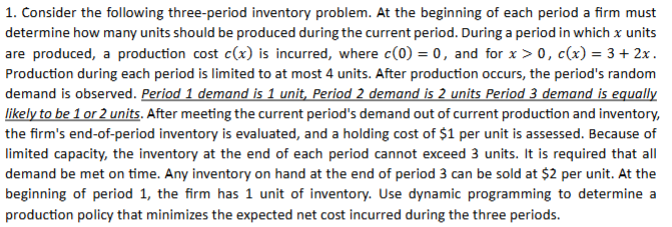
Consider the following threeperiod inventory problem. At the beginning of each period a firm must determine how many units should be produced during the current period. During a period in which x units are produced, a production cost cx is incurred, where c and for x cx x Production during each period is limited to at most units. After production occurs, the period's random demand is observed. Period demand is unit, Period demand is units Period demand is equally likely to be or units. After meeting the current period's demand out of current production and inventory, the firm's endofperiod inventory is evaluated, and a holding cost of $ per unit is assessed. Because of limited capacity, the inventory at the end of each period cannot exceed units. It is required that all demand be met on time. Any inventory on hand at the end of period can be sold at $ per unit. At the beginning of period the firm has unit of inventory. Use dynamic programming to determine a production policy that minimizes the expected net cost incurred during the three periods.
Step by Step Solution
There are 3 Steps involved in it
1 Expert Approved Answer
Step: 1 Unlock

Question Has Been Solved by an Expert!
Get step-by-step solutions from verified subject matter experts
Step: 2 Unlock
Step: 3 Unlock
 Study Help