







Question: 1. Consider the function f(x) = x2. (a) Find the slope of the tangent line to the graph of f at a = 1. (b)
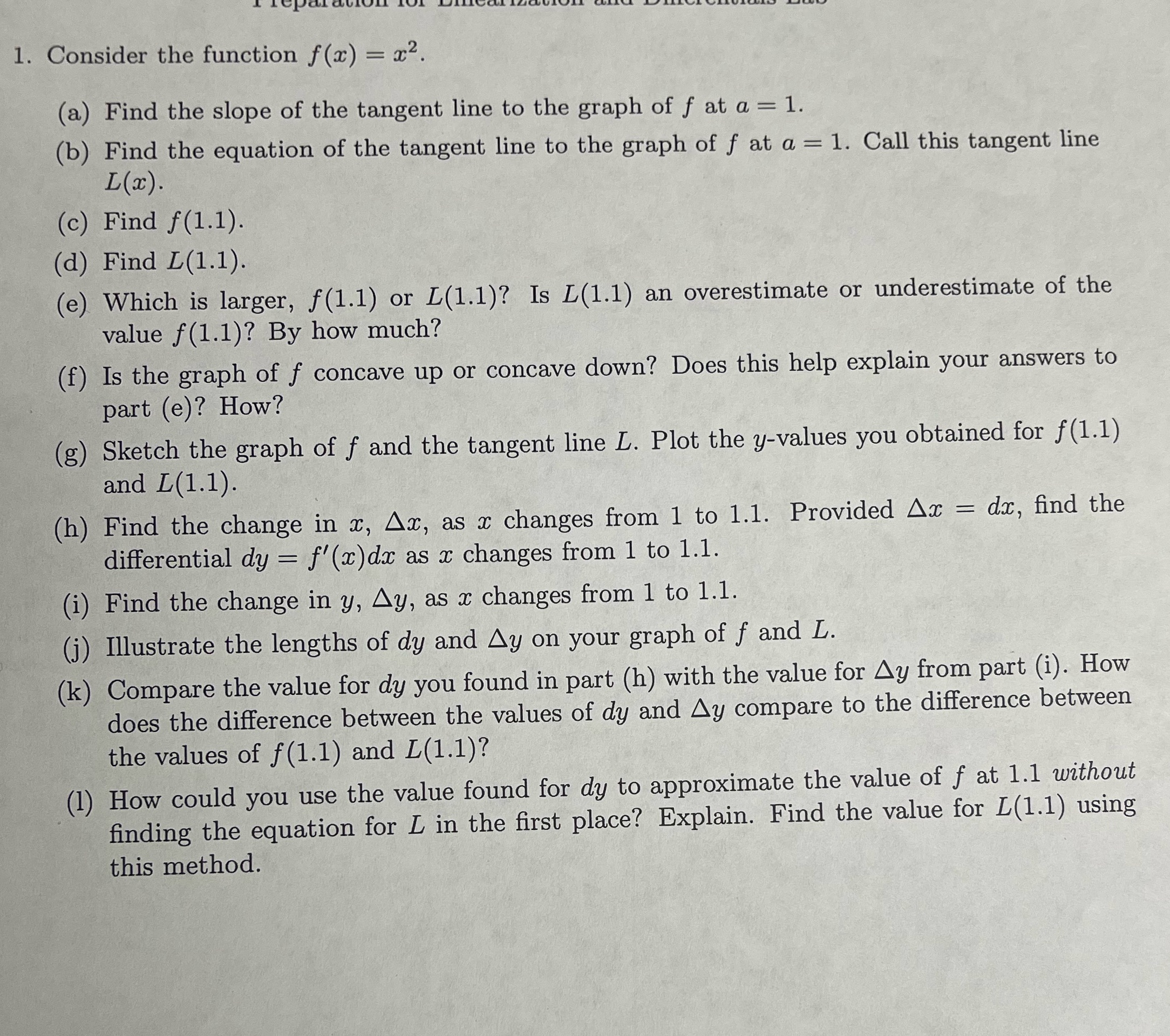
1. Consider the function f(x) = x2. (a) Find the slope of the tangent line to the graph of f at a = 1. (b) Find the equation of the tangent line to the graph of f at a = 1. Call this tangent line L(x) . (c) Find f(1.1). (d) Find L(1.1). (e) Which is larger, f(1.1) or L(1.1)? Is L(1.1) an overestimate or underestimate of the value f(1.1)? By how much? (f) Is the graph of f concave up or concave down? Does this help explain your answers to part (e)? How? g) Sketch the graph of f and the tangent line L. Plot the y-values you obtained for f (1.1) and L(1.1). (h) Find the change in x, Ax, as x changes from 1 to 1.1. Provided Ax = dx, find the differential dy = f'(x)dx as x changes from 1 to 1.1. (i) Find the change in y, Ay, as x changes from 1 to 1.1. (j) Illustrate the lengths of dy and Ay on your graph of f and L. (k) Compare the value for dy you found in part (h) with the value for Ay from part (i). How does the difference between the values of dy and Ay compare to the difference between the values of f(1.1) and L(1.1)? (1) How could you use the value found for dy to approximate the value of f at 1.1 without finding the equation for L in the first place? Explain. Find the value for L(1.1) using this method
Step by Step Solution
There are 3 Steps involved in it

Get step-by-step solutions from verified subject matter experts
 Study Help