







Question: 1. Consider the function f(x, y) = (y 2x) 2 . (a) Draw the level curves of this function for levels c = 0, 1,
1. Consider the function f(x, y) = (y 2x) 2 . (a) Draw the level curves of this function for levels c = 0, 1, 2. Please clearly label each level curve with the appropriate value of c. (b) Use the previous answer to sketch the graph z = f(x, y). (c) Find all first and second order derivatives of this function. (Please label all your derivatives clearly.) (d) Find the equation of the tangent plane to z = f(x, y) at (x, y) = (2, 1). 2. Let f(x, y) = 4 y 2 x 2 + y 2 . (a) Show that lim(x,y)(0,0) f(x, y) does not exist. (b) Show that lim(x,y)(0,0) yf(x, y) does exist and find the limit. For Questions 3-7 below, let f(x, y) = x + 1 x 2 + y 1 be a function f : R 2 7 R. 3. (a) What is the natural domain of f(x, y)? Draw the x, y-plane and indicate the domain. (b) What is the range of f(x, y)? (Assume f is defined in its natural domain). 4. (a) Compute the partial derivatives fx(x, y) and fy(x, y). (b) Evaluate the partial derivatives fx and fy at the point (x, y) = (0, 0) 5. Write the equation of the plane tangent to f(x, y) at the point (x, y) = (0, 0). 6. (a) Draw the level curves of f(x, y) for c {2, 1, 0, 1, 2}. Indicate the value of c of each curve. (b) Can level curves of functions intersect each other? What happens at the point (x, y) = (1, 0)? Justify your reasoning. 7. For the points (x, y) = (a, b) given below, compute lim (x,y)7(a,b) f(x, y) or show that the limit does not exist. (a) (a, b) = (1, 1) (b) (a, b) = (1, 0) (c) (a, b) = (1, 0)
all the things in the 2 images below
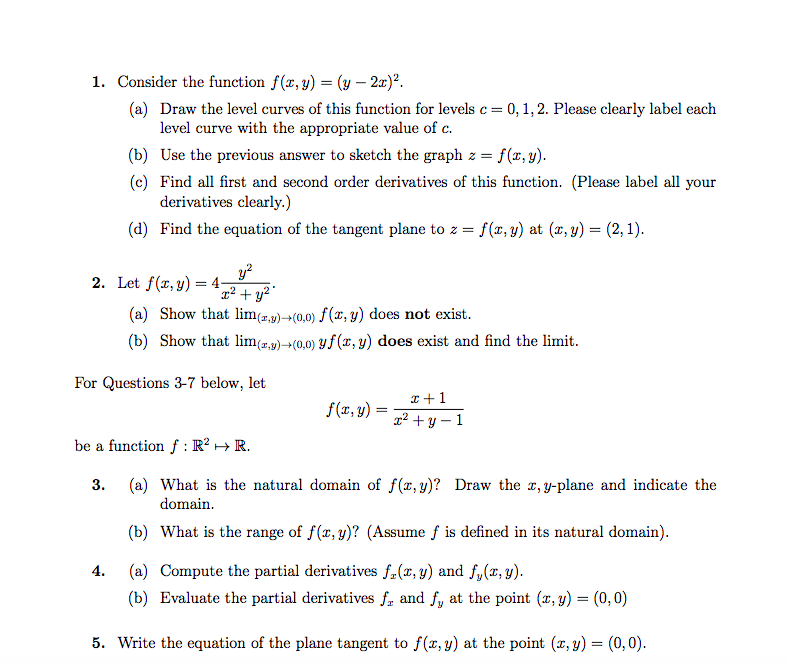
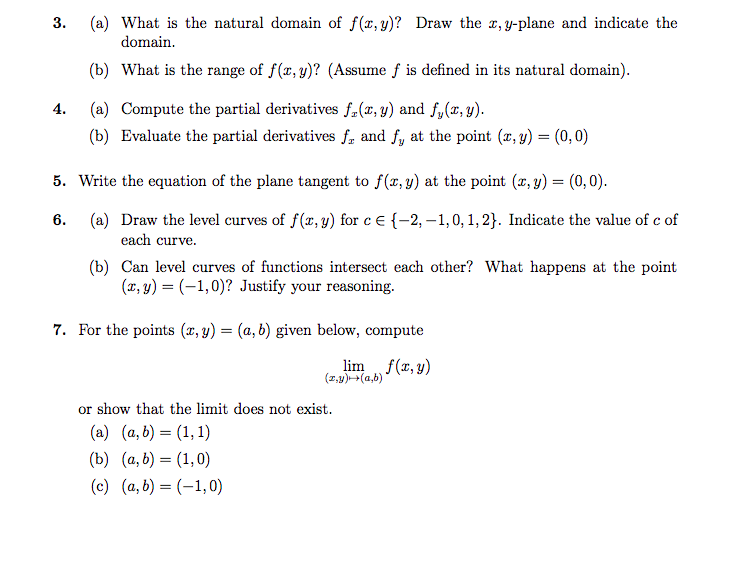
1. Consider the function f(x, y) = (y - 2x). (a) Draw the level curves of this function for levels c = 0, 1, 2. Please clearly label each level curve with the appropriate value of c. (b) Use the previous answer to sketch the graph z = f (x, y). (c) Find all first and second order derivatives of this function. (Please label all your derivatives clearly.) (d) Find the equation of the tangent plane to z = f(x, y) at (x, y) = (2, 1). 2. Let f(x, y) = 4- yz x2 + yz (a) Show that lim(z, ) +(0,0) f (x, y) does not exist. (b) Show that lim(r, )-+(0,0) yf(r, y) does exist and find the limit. For Questions 3-7 below, let + +1 f(r, y) =2ty- 1 be a function f : R' R. 3. (a) What is the natural domain of f(x, y)? Draw the z, y-plane and indicate the domain. (b) What is the range of f(x, y)? (Assume f is defined in its natural domain). 4. (a) Compute the partial derivatives fr(r, y) and fy(x, y). (b) Evaluate the partial derivatives f, and f, at the point (x, y) = (0, 0) 5. Write the equation of the plane tangent to f(r, y) at the point (x, y) = (0, 0).3. (a) What is the natural domain of f(x, y)? Draw the z, y-plane and indicate the domain. (b) What is the range of f(x, y)? (Assume f is defined in its natural domain). 4. (a) Compute the partial derivatives f,(r, y) and f, (x, y). (b) Evaluate the partial derivatives f, and f, at the point (x, y) = (0, 0) 5. Write the equation of the plane tangent to f(z, y) at the point (z, y) = (0, 0). 6. (a) Draw the level curves of f(x, y) for ce {-2, -1, 0, 1, 2}. Indicate the value of c of each curve. (b) Can level curves of functions intersect each other? What happens at the point (x, y) = (-1,0)? Justify your reasoning. 7. For the points (x, y) = (a, b) given below, compute lim (z,y) (a,b) f (I, y ) or show that the limit does not exist. (a) (a, b) = (1, 1) (b) (a, b) = (1,0) (c) (a, b) = (-1,0)
Step by Step Solution
There are 3 Steps involved in it

Get step-by-step solutions from verified subject matter experts
 Study Help