







Question: 1. Consider the Grammar G = {V, T, E, P), where V = (E, I) and T = {a, b, c, +,*, (, )).
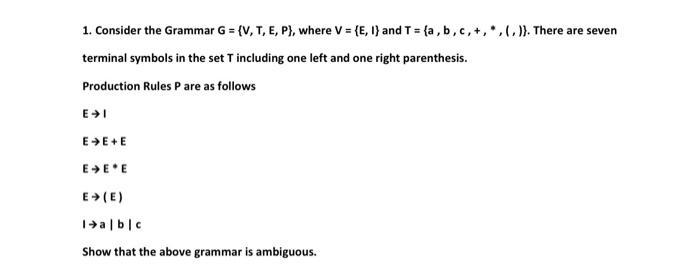
1. Consider the Grammar G = {V, T, E, P), where V = (E, I) and T = {a, b, c, +,*, (, )). There are seven terminal symbols in the set T including one left and one right parenthesis. Production Rules P are as follows EI EE+E E E E E (E) 1a|b|c Show that the above grammar is ambiguous.
Step by Step Solution
There are 3 Steps involved in it
1 Expert Approved Answer
Step: 1 Unlock

To show that the given grammar is ambiguous we need to find ... View full answer
Question Has Been Solved by an Expert!
Get step-by-step solutions from verified subject matter experts
Step: 2 Unlock
Step: 3 Unlock
 Study Help