





Question: 1. Consider the graph of the function f(x) below. Calculate (in any way you wish) an estimate for the total area under the curve, f(r),
1. Consider the graph of the function f(x) below.1. Consider the graph of the function f(x) below.1. Consider the graph of the function f(x) below.
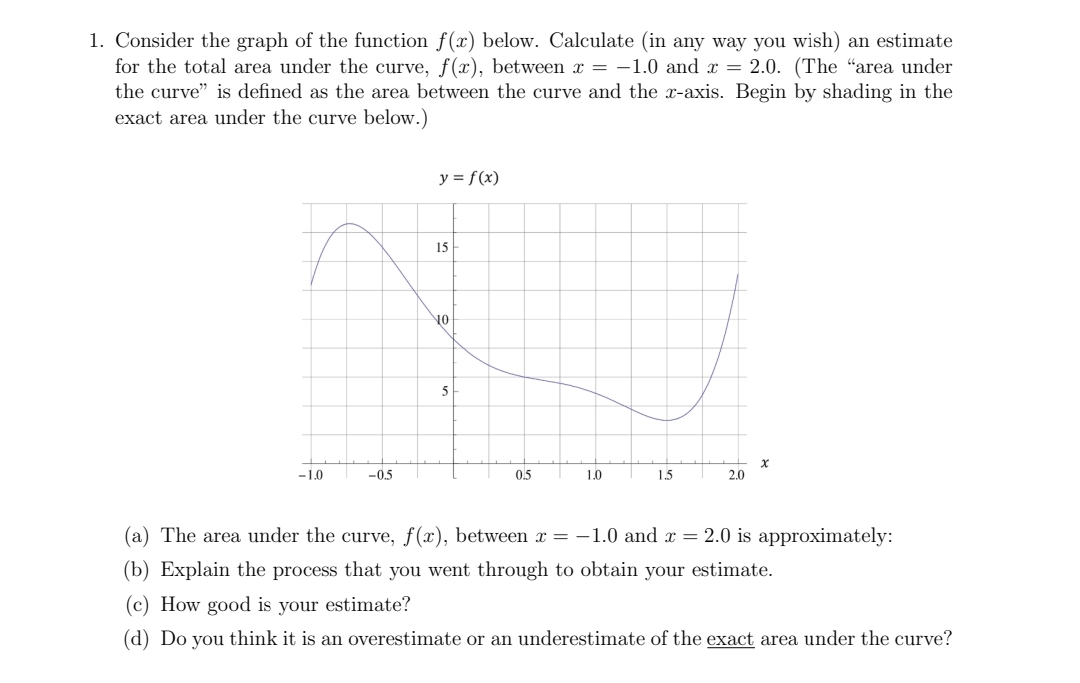
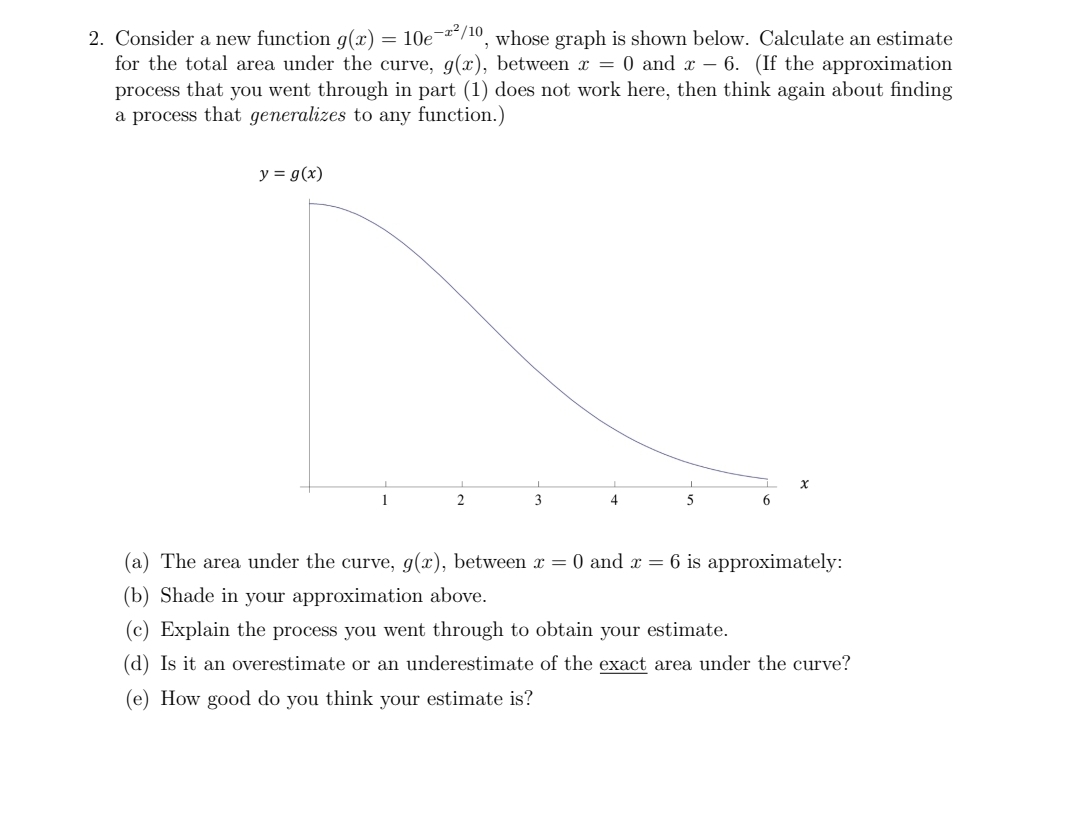
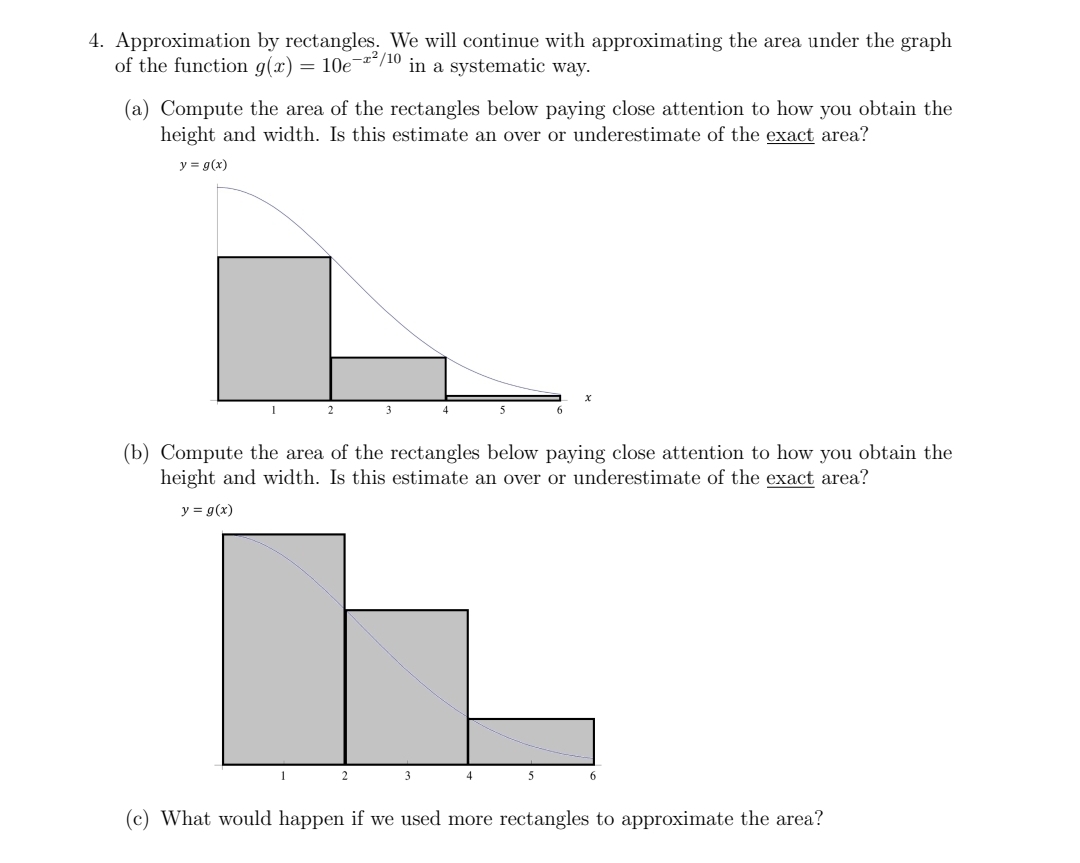
1. Consider the graph of the function f(x) below. Calculate (in any way you wish) an estimate for the total area under the curve, f(r), between x = -1.0 and x = 2.0. (The "area under the curve" is defined as the area between the curve and the r-axis. Begin by shading in the exact area under the curve below.) y = f(x) 15 5 X -1.0 -0.5 0.5 1.0 1.5 2.0 (a) The area under the curve, f(x), between r = -1.0 and r = 2.0 is approximately: (b) Explain the process that you went through to obtain your estimate. (c) How good is your estimate? (d) Do you think it is an overestimate or an underestimate of the exact area under the curve?2. Consider a new function g(z) = 10e="/1 whose graph is shown below. Calculate an estimate for the total area under the curve, g(z), between = 0 and z 6. (If the approximation process that you went through in part (1) does not work here, then think again about finding a process that generalizes to any function.) y=g(x) e (a) The area under the curve, g(x), between = = 0 and = = 6 is approximately: d (e) How good do you think your estimate is? (b) Shade in your approximation above. ( ) Explain the process you went through to obtain your estimate. ) Is it an overestimate or an underestimate of the exact area under the curve? 4. Approximation by rectanglaa We will continue with approximating the area under the graph of the function g(z) = 10e* /1" in a systematic way. (a) Compute the area of the rectangles below paying close attention to how you obtain the height and width. Is this estimate an over or underestimate of the exact area? y=4glx) x 1 2 3 4 5 6 (b) Compute the area of the rectangles below paying close attention to how you obtain the height and width. Is this estimate an over or underestimate of the exact area? y=g(x) 1 2 3 4 5 6 () What would happen if we used more rectangles to approximate the area
Step by Step Solution

There are 3 Steps involved in it

1 Expert Approved Answer
Step: 1 Unlock blur-text-image
Question Has Been Solved by an Expert!

Get step-by-step solutions from verified subject matter experts

Step: 2 Unlock
Step: 3 Unlock

Students Have Also Explored These Related Mathematics Questions!