Question: 1. Consider the nonlinear program min xy + 2x1 10x1 + xz - 822 s.t. X1 + x2 0. (a) Make a graphic illustration of
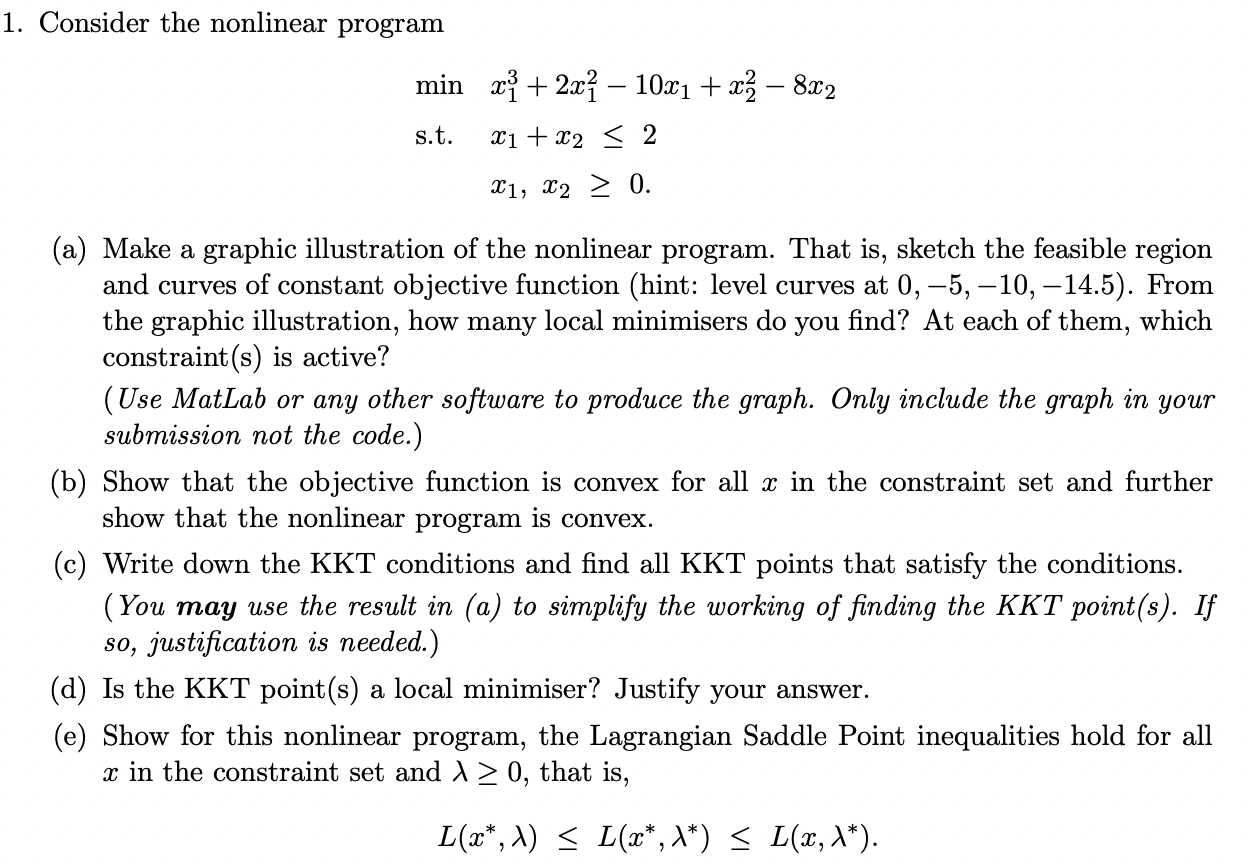
1. Consider the nonlinear program min xy + 2x1 10x1 + xz - 822 s.t. X1 + x2 0. (a) Make a graphic illustration of the nonlinear program. That is, sketch the feasible region and curves of constant objective function (hint: level curves at 0, -5, -10, -14.5). From the graphic illustration, how many local minimisers do you find? At each of them, which constraint(s) is active? (Use MatLab or any other software to produce the graph. Only include the graph in your submission not the code.) (b) Show that the objective function is convex for all x in the constraint set and further show that the nonlinear program is convex. (c) Write down the KKT conditions and find all KKT points that satisfy the conditions. (You may use the result in (a) to simplify the working of finding the KKT point(s). If so, justification is needed.) (d) Is the KKT point(s) a local minimiser? Justify your answer. (e) Show for this nonlinear program, the Lagrangian Saddle Point inequalities hold for all x in the constraint set and > 0, that is, L(x*, 1) = L(2*, \*) 0. (a) Make a graphic illustration of the nonlinear program. That is, sketch the feasible region and curves of constant objective function (hint: level curves at 0, -5, -10, -14.5). From the graphic illustration, how many local minimisers do you find? At each of them, which constraint(s) is active? (Use MatLab or any other software to produce the graph. Only include the graph in your submission not the code.) (b) Show that the objective function is convex for all x in the constraint set and further show that the nonlinear program is convex. (c) Write down the KKT conditions and find all KKT points that satisfy the conditions. (You may use the result in (a) to simplify the working of finding the KKT point(s). If so, justification is needed.) (d) Is the KKT point(s) a local minimiser? Justify your answer. (e) Show for this nonlinear program, the Lagrangian Saddle Point inequalities hold for all x in the constraint set and > 0, that is, L(x*, 1) = L(2*, \*)









 Study Help