







Question: 1. Consider the one-to-one function f(x) = vx + 4. a) Find the inverse of the function. b) Graph both the function and its inverse
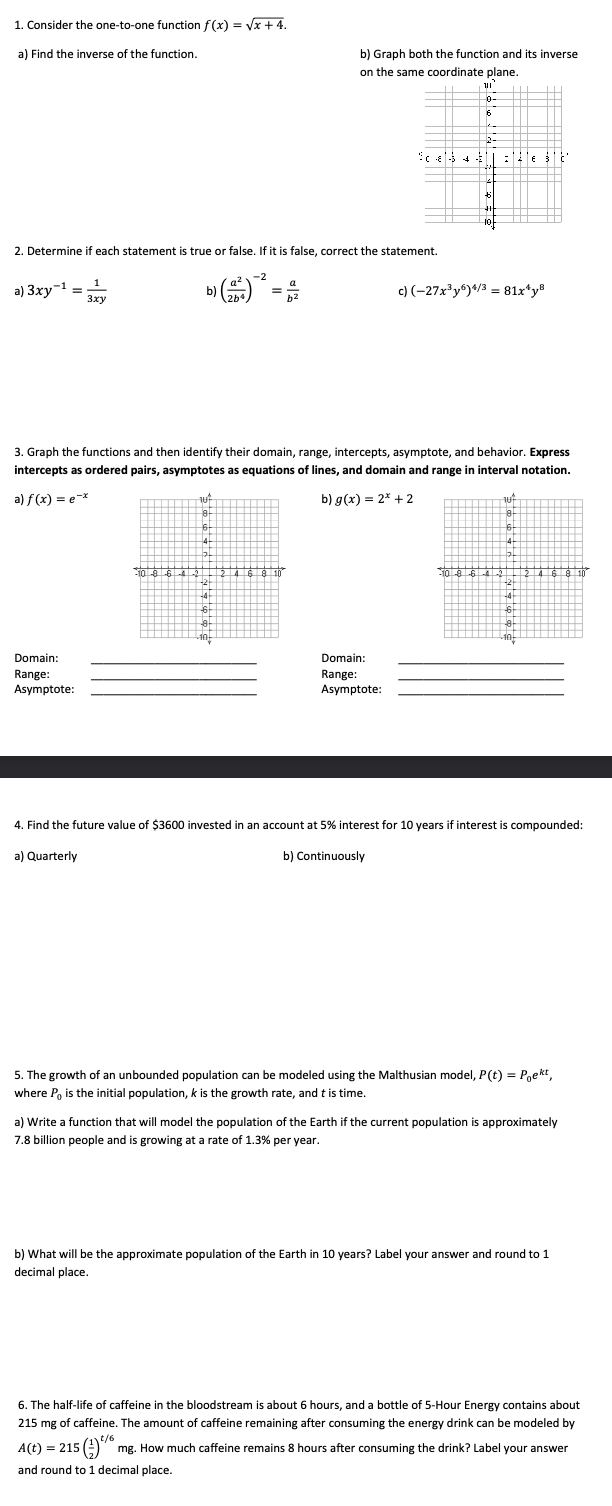
1. Consider the one-to-one function f(x) = vx + 4. a) Find the inverse of the function. b) Graph both the function and its inverse on the same coordinate plane. m o 2. Determine if each statement is true or false. If it is false, correct the statement. =z - 1 : a)3xy~t = o b () =iz o) (27x3y5)3 = Blxty 3. Graph the functions and then identify their domain, range, intercepts, asymptote, and behavior. Express intercepts as ordered pairs, asymptotes as equations of lines, and domain and range in interval notation. a)f(x)=e* ik al 73 s BF Br An Domain: Range: Asymptote: b)g(x)=2"+2 wh BT Br 2 b BF Bt A Domain: Range: Asymptote: 4, Find the future value of 53600 invested in an account at 5% interest for 10 years if interest is compounded: a) Quarterly b) Continuously 5. The growth of an unbounded population can be modeled using the Malthusian model, P(t) = P et, where P, is the initial population, k is the growth rate, and t is time. a) Write a function that will model the population of the Earth if the current population is approximately 7.8 billion people and is growing at a rate of 1.3% per year. b) What will be the approximate population of the Earth in 10 years? Label your answer and round to 1 decimal place. 6. The half-life of caffeine in the bloodstream is about 6 hours, and a bottle of 5-Hour Energy contains about 215 mg of caffeine. The amount of caffeine remaining after consuming the energy drink can be modeled by 1\\ A(t) = 215 (z) mg. How much caffeine remains 8 hours after consuming the drink? Label your answer and round to 1 decimal place
Step by Step Solution
There are 3 Steps involved in it

Get step-by-step solutions from verified subject matter experts
 Study Help