







Question: 1. Consider the same consumer from Assignment 2a whose preferences can be described by the utility function U = 9x(y 5). Consider only x >
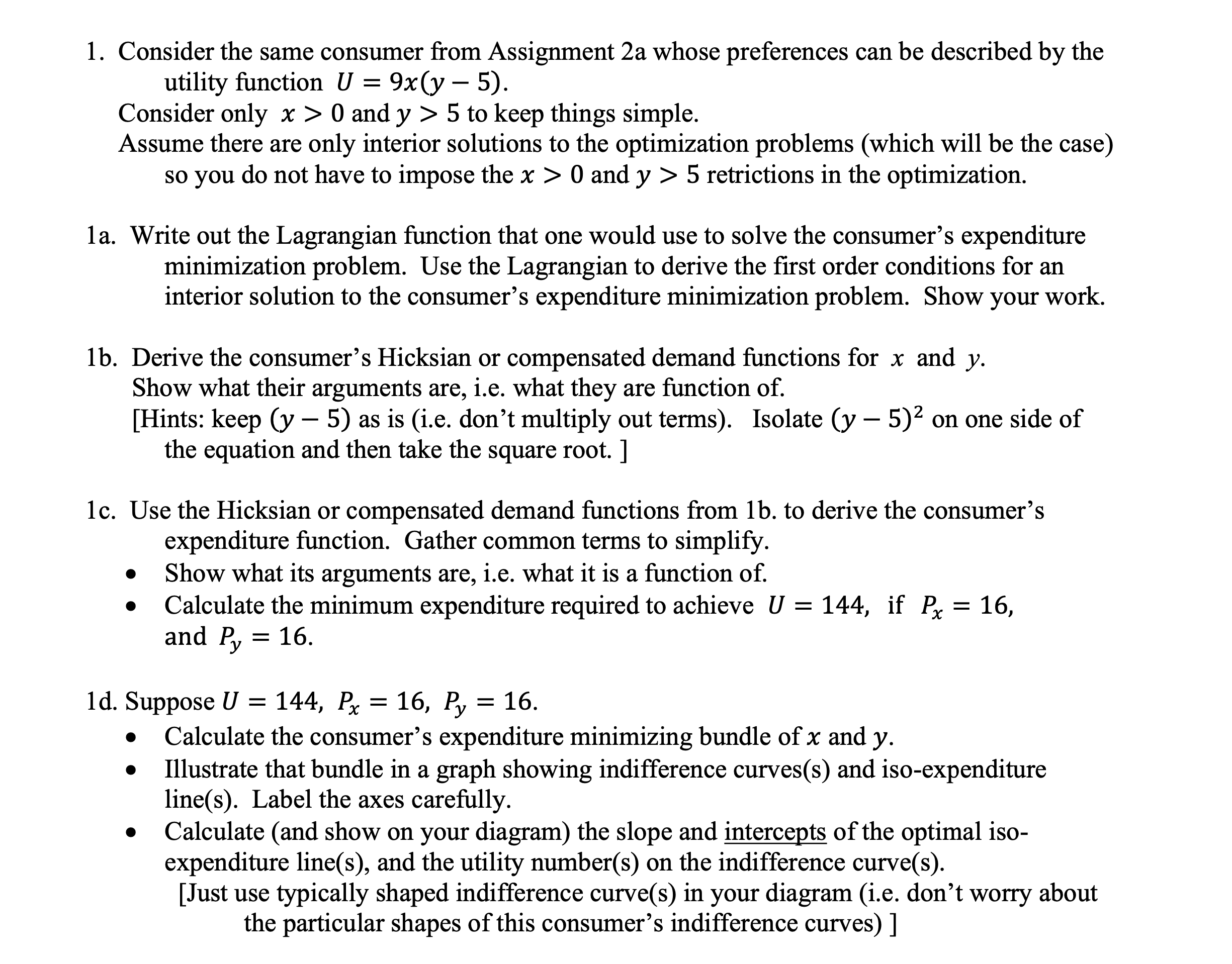
1. Consider the same consumer from Assignment 2a whose preferences can be described by the utility function U = 9x(y 5). Consider only x > 0 and y > 5 to keep things simple. Assume there are only interior solutions to the optimization problems (which will be the case) so you do not have to impose the x > 0 and y > 5 retrictions in the optimization. 1a. Write out the Lagrangian function that one would use to solve the consumer's expenditure minimization problem. Use the Lagrangian to derive the rst order conditions for an interior solution to the consumer's expenditure minimization problem. Show your work. lb. Derive the consumer's Hicksian or compensated demand mctions for x and y. Show what their arguments are, i.e. what they are function of. [Hintsz keep (y 5) as is (i.e. don't multiply out terms). Isolate (y 5)2 on one side of the equation and then take the square root. ] 1c. Use the Hicksian or compensated demand mctions from lb. to derive the consumer's expenditure function. Gather common terms to simplify. - Show what its arguments are, i.e. what it is a function of. 0 Calculate the minimum expenditure required to achieve U = 144, if Px = 16, and Py = 16. 1d. Suppose U = 144-, Px = 16, Py = 16. 0 Calculate the consumer's expenditure minimizing bundle of x and y. o Illustrate that bundle in a graph showing indifference curves(s) and iso-expenditure 1ine(s). Label the axes carefully. 0 Calculate (and show on your diagram) the slope and intercepts of the optimal iso- expenditure 1ine(s), and the utility number(s) on the indifference curve(s). [Just use typically shaped indifference curve(s) in your diagram (i.e. don't worry about the particular shapes of this consumer's indifference curves) ]
Step by Step Solution
There are 3 Steps involved in it

Get step-by-step solutions from verified subject matter experts
 Study Help