







Question: 1. Consider the set (a) List the elements o fX that are less than 100. (b) Give an inductive definition of the set X.(Hint: How
1. Consider the set 
(a) List the elements o fX that are less than 100.
(b) Give an inductive definition of the set X.(Hint: How can you get from one element of X to the next larger element?)

(a) Give three elements of N which are elements of X, explaining for each one why it is an element.
(b) Give three elements of N which are not elements of X, explaining for each one why it is not an element.
(c) Give a complete description of the set X using set building notation.
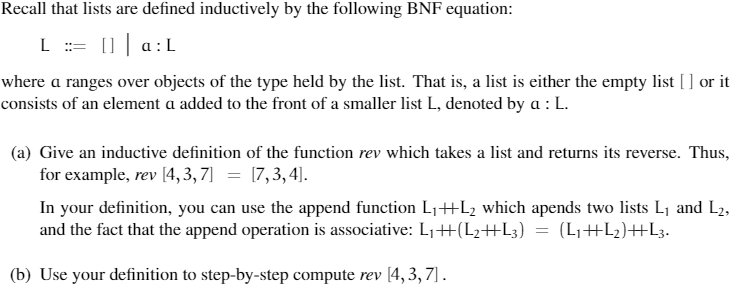
X = {2" 1: nen} Consider the set X CN defined inductively as follows. Basis Clause: 2 X and 5 X. Inductive Clause: If n eX and keX and nk then n+k EX. Extremal Clause: Nothing is in X unless its membership can be established from the above. Recall that lists are defined inductively by the following BNF equation: L = na:L where a ranges over objects of the type held by the list. That is, a list is either the empty list [] or it consists of an element a added to the front of a smaller list L, denoted by a: L. (a) Give an inductive definition of the function rev which takes a list and returns its reverse. Thus, for example, rev [4,3,7] = [7,3,4). In your definition, you can use the append function L, HL, which apends two lists L, and L2, and the fact that the append operation is associative: L1 (L2 +L3) = (L1H1L2) ++L3. (b) Use your definition to step-by-step compute rev (4,3,7)
Step by Step Solution
There are 3 Steps involved in it

Get step-by-step solutions from verified subject matter experts
 Study Help