







Question: = 1. Consider the system function :-1 H(E)= (: - 2)2 for a causal system. Draw a pole-zero diagram for the system, and indicate the
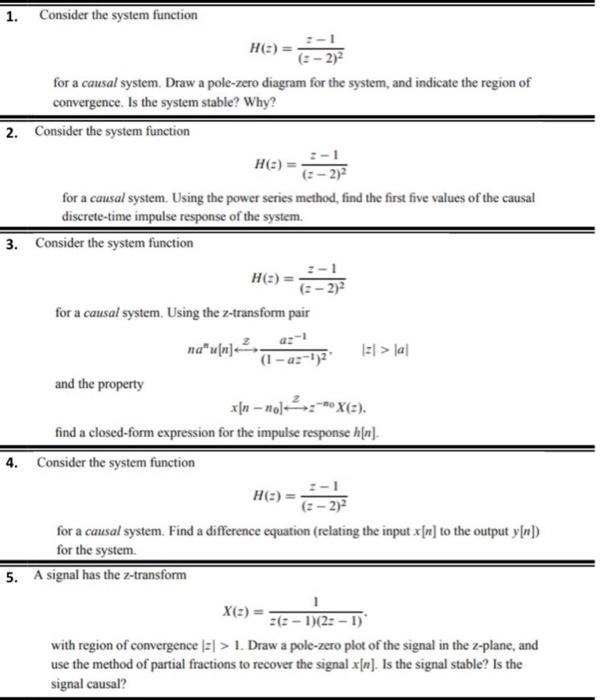
= 1. Consider the system function :-1 H(E)= (: - 2)2 for a causal system. Draw a pole-zero diagram for the system, and indicate the region of convergence. Is the system stable? Why? 2. Consider the system function :-1 H(3) (3-2)2 for a causal system. Using the power series method, find the first five values of the causal discrete-time impulse response of the system. 3. Consider the system function :-1 H) = (3-2) for a causal system. Using the Z-transform pair and the property x[n-no-X(:) find a closed-form expression for the impulse response h[n] 4. Consider the system function HE) :-1 :-2) for a causal system. Find a difference equation (relating the input x[n] to the output y[n]) for the system. 5. A signal has the Z-transform 1 X(2) 2:- 1) (2:- 1) with region of convergence |=| > 1. Draw a pole-zero plot of the signal in the 2-plane, and use the method of partial fractions to recover the signal x[m). Is the signal stable? Is the signal causal? = 1. Consider the system function :-1 H(E)= (: - 2)2 for a causal system. Draw a pole-zero diagram for the system, and indicate the region of convergence. Is the system stable? Why? 2. Consider the system function :-1 H(3) (3-2)2 for a causal system. Using the power series method, find the first five values of the causal discrete-time impulse response of the system. 3. Consider the system function :-1 H) = (3-2) for a causal system. Using the Z-transform pair and the property x[n-no-X(:) find a closed-form expression for the impulse response h[n] 4. Consider the system function HE) :-1 :-2) for a causal system. Find a difference equation (relating the input x[n] to the output y[n]) for the system. 5. A signal has the Z-transform 1 X(2) 2:- 1) (2:- 1) with region of convergence |=| > 1. Draw a pole-zero plot of the signal in the 2-plane, and use the method of partial fractions to recover the signal x[m). Is the signal stable? Is the signal causal
Step by Step Solution
There are 3 Steps involved in it

Get step-by-step solutions from verified subject matter experts
 Study Help