







Question: 1. Convert the following Pseudo-code to actual coding in any of your preferred programming Language (C/C++/Java will be preferable from my side!) declare integer
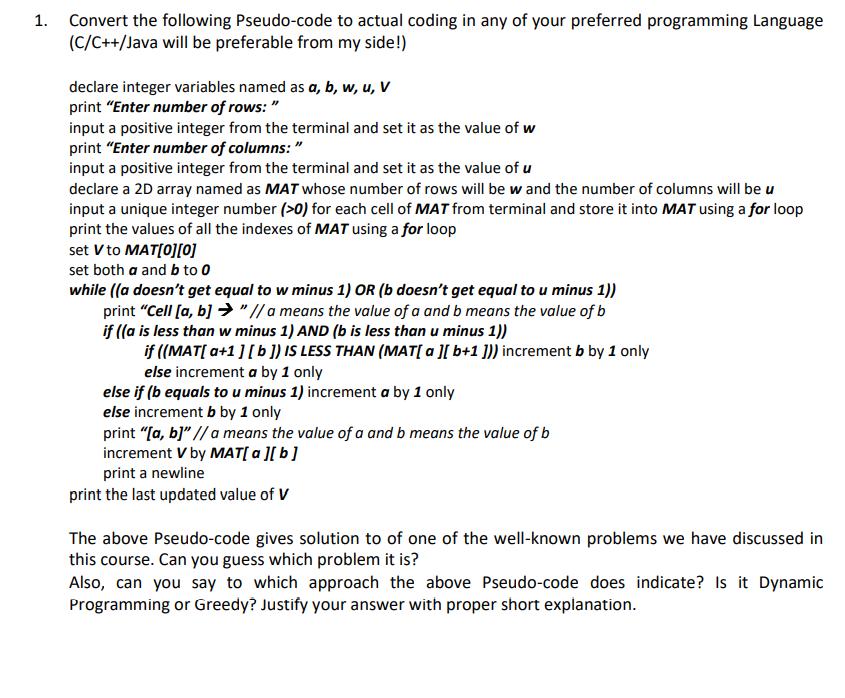
1. Convert the following Pseudo-code to actual coding in any of your preferred programming Language (C/C++/Java will be preferable from my side!) declare integer variables named as a, b, w, u, V print "Enter number of rows: " input a positive integer from the terminal and set it as the value of w print "Enter number of columns: " input a positive integer from the terminal and set it as the value of u declare a 2D array named as MAT whose number of rows will be w and the number of columns will be u input a unique integer number (>0) for each cell of MAT from terminal and store it into MAT using a for loop print the values of all the indexes of MAT using a for loop set V to MAT[0][0] set both a and b to 0 while ((a doesn't get equal to w minus 1) OR (b doesn't get equal to u minus 1)) print "Cell [a, b] > "// a means the value of a and b means the value of b if ((a is less than w minus 1) AND (b is less than u minus 1)) if ((MAT[ a+1 ] [b]) IS LESS THAN (MAT[ a ][ b+1 ])) increment b by 1 only else increment a by 1 only else if (b equals to u minus 1) increment a by 1 only else increment b by 1 only print "la, b]" // a means the value of a and b means the value of b increment V by MAT[ a ][ b] print a newline print the last updated value of V The above Pseudo-code gives solution to of one of the well-known problems we have discussed in this course. Can you guess which problem it is? Also, can you say to which approach the above Pseudo-code does indicate? Is it Dynamic Programming or Greedy? Justify your answer with proper short explanation.
Step by Step Solution
3.46 Rating (162 Votes )
There are 3 Steps involved in it
implement in c programcpp include using nam... View full answer

Get step-by-step solutions from verified subject matter experts
 Study Help