Question: 1. Create a total landed cost model that (a) provides a logical build-up of costs as the concentrate flows across the supply chain, (b), identifies
1. Create a total landed cost model that (a) provides a logical build-up of costs as the concentrate flows across the supply chain, (b), identifies the costs for each cost element and its expected per unit cost, and (c) identi- fies the total estimated landed cost per pound of the concentrate. .2. Graphically.map the supply chain for this item, including where different costs are incurred. Identify. ways to take costs out of the supply chain. .. 3. Are there any costs missing from your model? If so, what are those costs?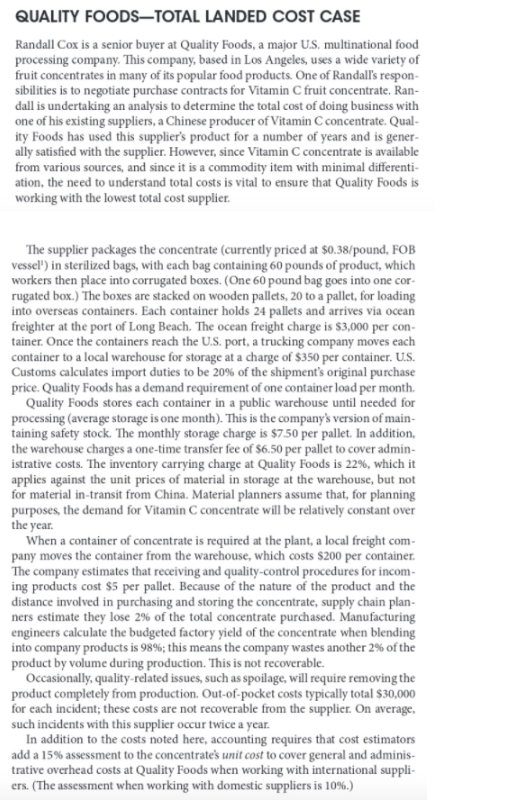
QUALITY FOODS-TOTAL LANDED COST CASE Randall Cox is a senior buyer at Quality Foods, a major U.S. multinational food processing company. This company, based in Los Angeles, uses a wide variety of fruit concentrates in many of its popular food products. One of Randall's respon sibilities is to negotiate purchase contracts for Vitamin C fruit concentrate. Ran- dall is undertaking an analysis to determine the total cost of doing business with one of his existing suppliers, a Chinese producer of Vitamin C concentrate. Qual ity Foods has used this supplier's product for a number of years and is gener- ally satisfied with the supplier. However, since Vitamin C concentrate is available from various sources, and since it is a commodity item with minimal differenti- ation, the need to understand total costs is vital to ensure that Quality Foods is working with the lowest total cost supplier. The supplier packages the concentrate (currently priced at $0.38/pound, FOB vessel') in sterilized bags, with each bag containing 60 pounds of product, which workers then place into corrugated boxes. (One 60 pound bag goes into one cor- rugated box.) The boxes are stacked on wooden pallets, 20 to a pallet, for loading into overseas containers. Each container holds 24 pallets and arrives via ocean freighter at the port of Long Beach. The ocean freight charge is $3,000 per con- tainer. Once the containers reach the U.S. port, a trucking company moves each container to a local warehouse for storage at a charge of $350 per container. U.S. Customs calculates import duties to be 20% of the shipment's original purchase price. Quality Foods has a demand requirement of one container load per month Quality Foods stores each container in a public warehouse until needed for processing (average storage is one month). This is the company's version of main- taining safety stock. The monthly storage charge is $7.50 per pallet. In addition, the warehouse charges a one-time transfer fee of $6.50 per pallet to cover admin- istrative costs. The inventory carrying charge at Quality Foods is 22%, which it applies against the unit prices of material in storage at the warehouse, but not for material in-transit from China. Material planners assume that, for planning purposes, the demand for Vitamin C concentrate will be relatively constant over the year. When a container of concentrate is required at the plant, a local freight com- pany moves the container from the warehouse, which costs $200 per container. The company estimates that receiving and quality control procedures for incom- ing products cost $5 per pallet. Because of the nature of the product and the distance involved in purchasing and storing the concentrate, supply chain plan- ners estimate they lose 2% of the total concentrate purchased. Manufacturing engineers calculate the budgeted factory yield of the concentrate when blending into company products is 98%; this means the company wastes another 2% of the product by volume during production. This is not recoverable. Occasionally, quality-related issues, such as spoilage, will require removing the product completely from production. Out-of-pocket costs typically total $30,000 for each incident, these costs are not recoverable from the supplier. On average, such incidents with this supplier occur twice a year. In addition to the costs noted here, accounting requires that cost estimators add a 15% assessment to the concentrate's unit cost to cover general and adminis- trative overhead costs at Quality Foods when working with international suppli- ers. (The assessment when working with domestic suppliers is 10%.) QUALITY FOODS-TOTAL LANDED COST CASE Randall Cox is a senior buyer at Quality Foods, a major U.S. multinational food processing company. This company, based in Los Angeles, uses a wide variety of fruit concentrates in many of its popular food products. One of Randall's respon sibilities is to negotiate purchase contracts for Vitamin C fruit concentrate. Ran- dall is undertaking an analysis to determine the total cost of doing business with one of his existing suppliers, a Chinese producer of Vitamin C concentrate. Qual ity Foods has used this supplier's product for a number of years and is gener- ally satisfied with the supplier. However, since Vitamin C concentrate is available from various sources, and since it is a commodity item with minimal differenti- ation, the need to understand total costs is vital to ensure that Quality Foods is working with the lowest total cost supplier. The supplier packages the concentrate (currently priced at $0.38/pound, FOB vessel') in sterilized bags, with each bag containing 60 pounds of product, which workers then place into corrugated boxes. (One 60 pound bag goes into one cor- rugated box.) The boxes are stacked on wooden pallets, 20 to a pallet, for loading into overseas containers. Each container holds 24 pallets and arrives via ocean freighter at the port of Long Beach. The ocean freight charge is $3,000 per con- tainer. Once the containers reach the U.S. port, a trucking company moves each container to a local warehouse for storage at a charge of $350 per container. U.S. Customs calculates import duties to be 20% of the shipment's original purchase price. Quality Foods has a demand requirement of one container load per month Quality Foods stores each container in a public warehouse until needed for processing (average storage is one month). This is the company's version of main- taining safety stock. The monthly storage charge is $7.50 per pallet. In addition, the warehouse charges a one-time transfer fee of $6.50 per pallet to cover admin- istrative costs. The inventory carrying charge at Quality Foods is 22%, which it applies against the unit prices of material in storage at the warehouse, but not for material in-transit from China. Material planners assume that, for planning purposes, the demand for Vitamin C concentrate will be relatively constant over the year. When a container of concentrate is required at the plant, a local freight com- pany moves the container from the warehouse, which costs $200 per container. The company estimates that receiving and quality control procedures for incom- ing products cost $5 per pallet. Because of the nature of the product and the distance involved in purchasing and storing the concentrate, supply chain plan- ners estimate they lose 2% of the total concentrate purchased. Manufacturing engineers calculate the budgeted factory yield of the concentrate when blending into company products is 98%; this means the company wastes another 2% of the product by volume during production. This is not recoverable. Occasionally, quality-related issues, such as spoilage, will require removing the product completely from production. Out-of-pocket costs typically total $30,000 for each incident, these costs are not recoverable from the supplier. On average, such incidents with this supplier occur twice a year. In addition to the costs noted here, accounting requires that cost estimators add a 15% assessment to the concentrate's unit cost to cover general and adminis- trative overhead costs at Quality Foods when working with international suppli- ers. (The assessment when working with domestic suppliers is 10%.)









 Study Help