



Question: 1. Create an entity relationship diagram for the conceptual design using UML notation. The diagram can be created by hand or via some modeling tool.
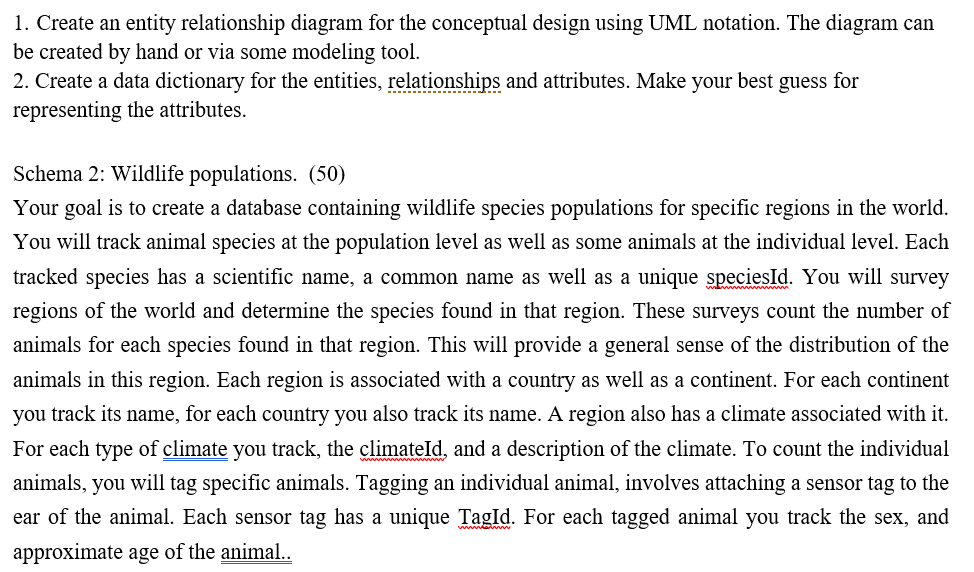
1. Create an entity relationship diagram for the conceptual design using UML notation. The diagram can be created by hand or via some modeling tool. 2. Create a data dictionary for the entities, relationships and attributes. Make your best guess for representing the attributes. Schema 2: Wildlife populations. (50) Your goal is to create a database containing wildlife species populations for specific regions in the world. You will track animal species at the population level as well as some animals at the individual level. Each tracked species has a scientific name, a common name as well as a unique speciesId. You will survey regions of the world and determine the species found in that region. These surveys count the number of animals for each species found in that region. This will provide a general sense of the distribution of the animals in this region. Each region is associated with a country as well as a continent. For each continent you track its name, for each country you also track its name. A region also has a climate associated with it. For each type of climate you track, the climateId, and a description of the climate. To count the individual animals, you will tag specific animals. Tagging an individual animal, involves attaching a sensor tag to the ear of the animal. Each sensor tag has a unique TagId. For each tagged animal you track the sex, and approximate age of the animal.. 1. Create an entity relationship diagram for the conceptual design using UML notation. The diagram can be created by hand or via some modeling tool. 2. Create a data dictionary for the entities, relationships and attributes. Make your best guess for representing the attributes. Schema 2: Wildlife populations. (50) Your goal is to create a database containing wildlife species populations for specific regions in the world. You will track animal species at the population level as well as some animals at the individual level. Each tracked species has a scientific name, a common name as well as a unique speciesId. You will survey regions of the world and determine the species found in that region. These surveys count the number of animals for each species found in that region. This will provide a general sense of the distribution of the animals in this region. Each region is associated with a country as well as a continent. For each continent you track its name, for each country you also track its name. A region also has a climate associated with it. For each type of climate you track, the climateId, and a description of the climate. To count the individual animals, you will tag specific animals. Tagging an individual animal, involves attaching a sensor tag to the ear of the animal. Each sensor tag has a unique TagId. For each tagged animal you track the sex, and approximate age of the animal
Step by Step Solution
There are 3 Steps involved in it

Get step-by-step solutions from verified subject matter experts