







Question: 1 - Define the five basic relational algebra operations. Define the Join, Intersection, and Division operations in terms of these five basic operations. 2 -
Define the five basic relational algebra operations. Define the Join, Intersection, and
Division operations in terms of these five basic operations.
Discuss the differences between the five Join operations: Theta join, Equijoin, Natural
join, Outer join, and Semijoin. Give examples to illustrate your answer.
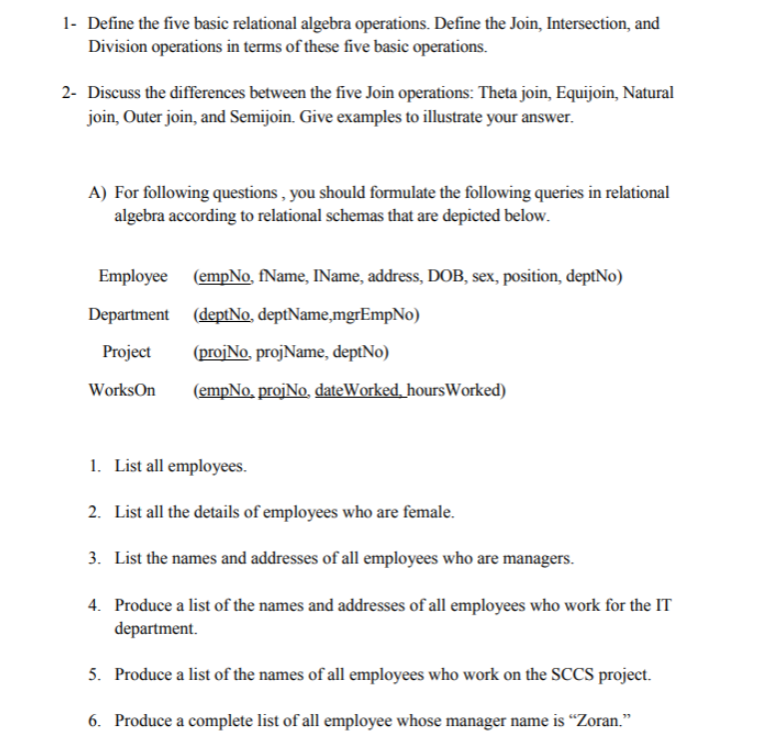
A For following questions, you should formulate the following queries in relational
algebra according to relational schemas that are depicted below.
Employee empNo fName, IName, address, DOB, sex, position, deptNo
Department deptNo deptName,mgrEmpNo
Project projNo projName, deptNo
WorksOn empNo projNo, dateWorked, hoursWorked
List all employees.
List all the details of employees who are female.
List the names and addresses of all employees who are managers.
Produce a list of the names and addresses of all employees who work for the IT
department.
Produce a list of the names of all employees who work on the SCCS project.
Produce a complete list of all employee whose manager name is "Zoran."
B What are the results of following relational algebra operations?
Tables: student
OR codecp subject
student
student student
student enrolledln. enrolledIn
student :
subject :
Who teaches cp
Step by Step Solution
There are 3 Steps involved in it
1 Expert Approved Answer
Step: 1 Unlock

Question Has Been Solved by an Expert!
Get step-by-step solutions from verified subject matter experts
Step: 2 Unlock
Step: 3 Unlock
 Study Help