







Question: 1. Defined-benefit versus defined-contribution pension plans Consider two pension plans for Kenji, who works for Hydropower Corporation, and Manuel, who works for SolarNet company. Plan
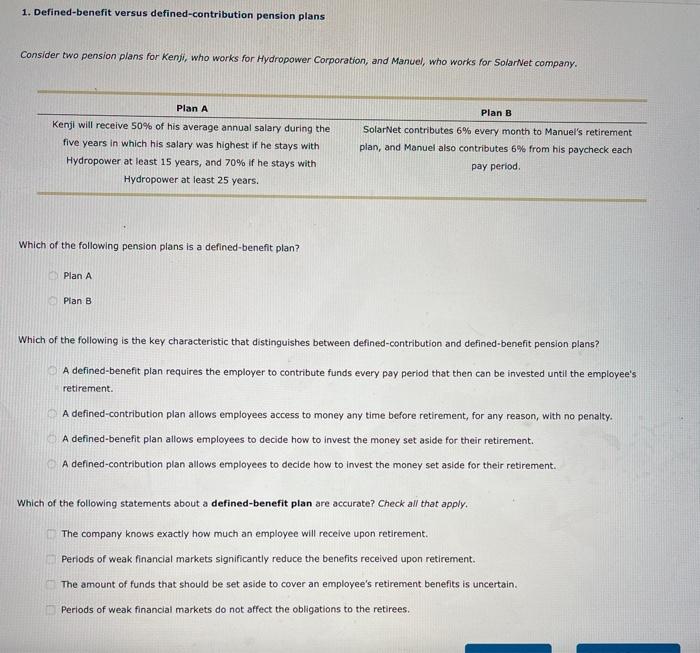
1. Defined-benefit versus defined-contribution pension plans Consider two pension plans for Kenji, who works for Hydropower Corporation, and Manuel, who works for SolarNet company. Plan A Kenji will receive 50% of his average annual salary during the five years in which his salary was highest if he stays with Hydropower at least 15 years, and 70% If he stays with Hydropower at least 25 years. Plan B SolarNet contributes 6% every month to Manuel's retirement plan, and Manuel also contributes 6% from his paycheck each pay period. Which of the following pension plans is a defined benefit plan? Plan A Plan B Which of the following is the key characteristic that distinguishes between defined-contribution and defined-benefit pension plans? A defined-benefit plan requires the employer to contribute funds every pay period that then can be invested until the employee's retirement. A defined-contribution plan allows employees access to money any time before retirement, for any reason, with no penalty. A defined-benefit plan allows employees to decide how to invest the money set aside for their retirement. A defined-contribution plan allows employees to decide how to invest the money set aside for their retirement Which of the following statements about a defined-benefit plan are accurate? Check all that apply. The company knows exactly how much an employee will receive upon retirement. Periods of weak financial markets significantly reduce the benefits received upon retirement. The amount of funds that should be set aside to cover an employee's retirement benefits is uncertain. Periods of weak financial markets do not affect the obligations to the retirees
Step by Step Solution
There are 3 Steps involved in it

Get step-by-step solutions from verified subject matter experts
 Study Help