







Question: 1. Derive eqn. 1 from eqn. 0, using the expressions for the components of initial magnetization (MMOxx, MMOyy, MMOzz), components of magnetic field (BBxx, BByy,
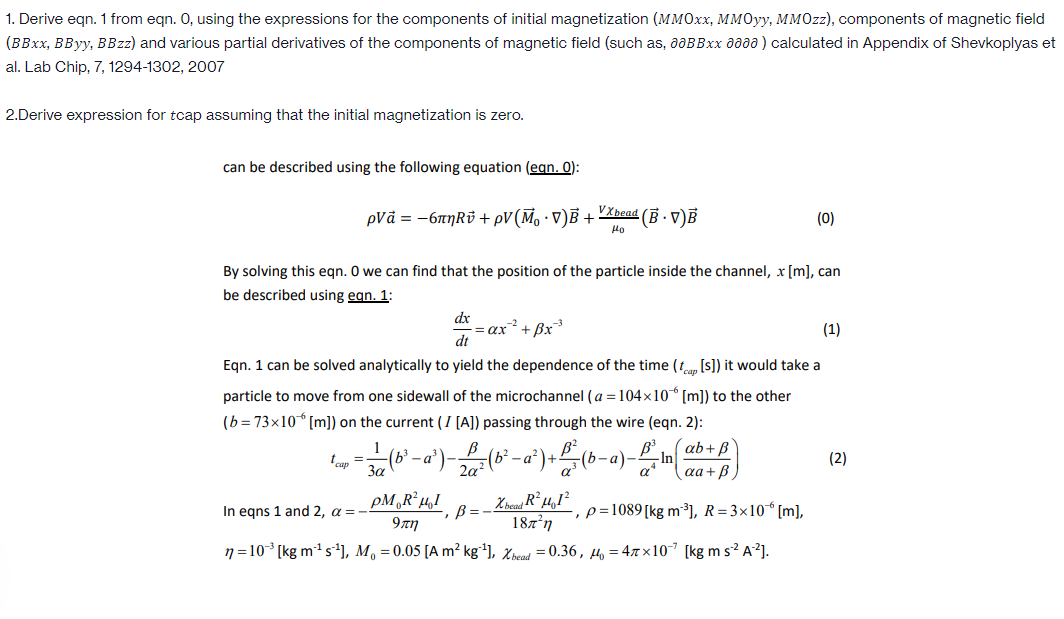
1. Derive eqn. 1 from eqn. 0, using the expressions for the components of initial magnetization (MMOxx, MMOyy, MMOzz), components of magnetic field (BBxx, BByy, BBzz) and various partial derivatives of the components of magnetic field (such as, daBBxx 8aaa ) calculated in Appendix of Shevkoplyas et al. Lab Chip, 7, 1294-1302, 2007 2.Derive expression for tcap assuming that the initial magnetization is zero. can be described using the following equation (egn. 0): pVa = -6unRu + PV(Mo . V)B + VXbead (B . V)B (0) Ho By solving this eqn. O we can find that the position of the particle inside the channel, x [m], can be described using egn. 1: dx -= ax + Bx-3 (1) Eqn. 1 can be solved analytically to yield the dependence of the time ( , [s]) it would take a particle to move from one sidewall of the microchannel (a = 104x10 * [m]) to the other (b =73x10 *[m]) on the current ( / [A]) passing through the wire (eqn. 2): cap (b' - a") B ( b2 - a? ) + = ( b- a) - B In ab+ B (2) 3a 202 ( aa + B In eqns 1 and 2, a = _PMOR u, I B = _ Xbend R2 ugl? 18x n -, P= 1089 [kg m 3], R= 3x10* [m], 1=10" [kg mil s"]], M. =0.05 [Am? kg ]], Xbead = 0.36, /4 = 4x x107 [kg m s ? A-2]
Step by Step Solution
There are 3 Steps involved in it

Get step-by-step solutions from verified subject matter experts
 Study Help