



Question: 1. Derive the long-run equilibrium for the dynam- contradict or reinforce the Taylor principle as a ic ADAS model. Assume there are no shocks guideline
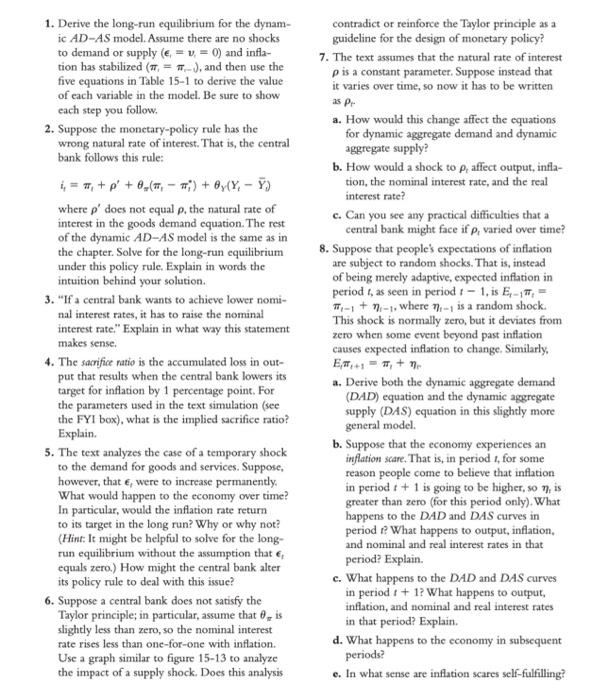
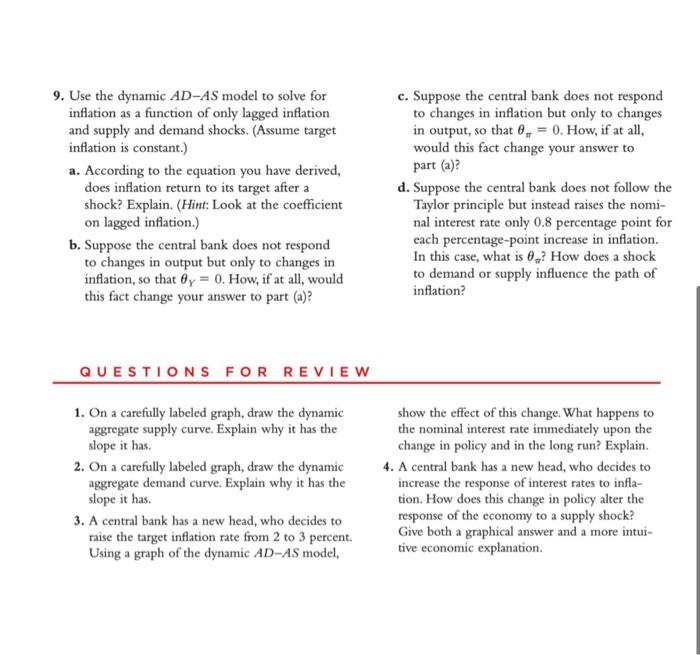
1. Derive the long-run equilibrium for the dynam- contradict or reinforce the Taylor principle as a ic ADAS model. Assume there are no shocks guideline for the design of monetary policy? to demand or supply (1=v1=0) and infla- 7. The text assumes that the natural rate of interest tion has stabilized (1=r), and then use the is a constant parameter. Suppose instead that five equations in Table 15-1 to derive the value it varies over time, so now it has to be written of each variable in the model. Be sure to show as r each step you follow, a. How would this change affect the equations 2. Suppose the monetary-policy rule has the for dynamic aggregate demand and dynamic wrong natural rate of interest. That is, the central aggregate supply? bank follows this rule: b. How would a shock to t affect output, infla- i1=1++m(1i)+Y(YiYj) tion, the nominal interest rate, and the real interest rate? where does not equal , the natural rate of c. Can you see any practical difficulties that a interest in the goods demand equation. The rest of the dynamic ADAS model is the same as in central bank might face if t varied over time? the chapter. Solve for the long-run equilibrium 8. Suppose that people's expectations of inflation under this policy rule. Explain in words the are subject to random shocks. That is, instead intuition behind your solution. of being merely adaptive, expected inflation in 3. "If a central bank wants to achicve lower nomiperiod t, as seen in period t1, is Er1t= nal interest rates, it has to raise the nominal i1+i1, where t1 is a random shock. This shock is normally zero, but it deviates from interest rate." Explain in what way this statement makes sense. zero when some event beyond past inflation causes expected inflation to change. Similarly, 4. The sacrifice natio is the accumulated loss in outE1i+1=i+r put that results when the central bank lowers its a. Derive both the dynamic aggregate demand target for inflation by 1 percentage point. For (DAD) equation and the dynamic aggregate the parameters used in the text simulation (see the FYI box), what is the implied sacrifice ratio? supply (DAS) equation in this slightly more Explain. general model. b. Suppose that the economy experiences an 5. The text analyzes the case of a temporary shock inflation scare. That is, in period t, for some to the demand for goods and services. Suppose, however, that , were to increase permanently. reason people come to believe that inflation What would happen to the economy over time? in period t+1 is going to be higher, so t is In particular, would the inflation rate return greater than zero (for this period only). What happens to the DAD and DAS curves in to its target in the long run? Why or why not? (Hint: It might be helpful to solve for the longperiod t ? What happens to output, inflation, run equilibrium without the assumption that 1 and nominal and real interest rates in that equals zero.) How might the central bank alter period? Explain. its policy rule to deal with this issuc? its policy rule to deal with this issuc? c. What happens to the DAD and DAS curves in period t+1 ? What happens to output, 6. Suppose a central bank does not satisfy the inflation, and nominal and real interest rates Taylor principle; in particular, assume that is slightly less than zero, so the nominal interest in that period? Explain. rate rises less than one-for-one with inflation. d. What happens to the economy in subsequent Use a graph similar to figure 15-13 to analyze periods? the impact of a supply shock. Does this analysis e. In what sense are inflation scares self-fulfilling? 9. Use the dynamic ADAS model to solve for c. Suppose the central bank does not respond inflation as a function of only lagged inflation to changes in inflation but only to changes and supply and demand shocks. (Assume target in output, so that =0. How, if at all, inflation is constant.) would this fact change your answer to a. According to the equation you have derived, part (a)? does inflation return to its target after a d. Suppose the central bank does not follow the shock? Explain. (Hint: Look at the coefficient Taylor principle but instead raises the nomion lagged inflation.) nal interest rate only 0.8 percentage point for b. Suppose the central bank does not respond each percentage-point increase in inflation. to changes in output but only to changes in In this case, what is ? How does a shock inflation, so that Y=0. How, if at all, would to demand or supply influence the path of this fact change your answer to part (a)? inflation? QUESTIONS FOR REVIEW 1. On a carefully labeled graph, draw the dynamic show the effect of this change. What happens to aggregate supply curve. Explain why it has the the nominal interest rate immediately upon the slope it has. change in policy and in the long run? Explain. 2. On a carefully labeled graph, draw the dynamic 4. A central bank has a new head, who decides to aggregate demand curve. Explain why it has the increase the response of interest rates to inflaslope it has. tion. How does this change in policy alter the 3. A central bank has a new head, who decides to response of the economy to a supply shock? raise the target inflation rate from 2 to 3 percent. Give both a graphical answer and a more intuiUsing a graph of the dynamic ADAS model, tive economic explanation. 1. Derive the long-run equilibrium for the dynam- contradict or reinforce the Taylor principle as a ic ADAS model. Assume there are no shocks guideline for the design of monetary policy? to demand or supply (1=v1=0) and infla- 7. The text assumes that the natural rate of interest tion has stabilized (1=r), and then use the is a constant parameter. Suppose instead that five equations in Table 15-1 to derive the value it varies over time, so now it has to be written of each variable in the model. Be sure to show as r each step you follow, a. How would this change affect the equations 2. Suppose the monetary-policy rule has the for dynamic aggregate demand and dynamic wrong natural rate of interest. That is, the central aggregate supply? bank follows this rule: b. How would a shock to t affect output, infla- i1=1++m(1i)+Y(YiYj) tion, the nominal interest rate, and the real interest rate? where does not equal , the natural rate of c. Can you see any practical difficulties that a interest in the goods demand equation. The rest of the dynamic ADAS model is the same as in central bank might face if t varied over time? the chapter. Solve for the long-run equilibrium 8. Suppose that people's expectations of inflation under this policy rule. Explain in words the are subject to random shocks. That is, instead intuition behind your solution. of being merely adaptive, expected inflation in 3. "If a central bank wants to achicve lower nomiperiod t, as seen in period t1, is Er1t= nal interest rates, it has to raise the nominal i1+i1, where t1 is a random shock. This shock is normally zero, but it deviates from interest rate." Explain in what way this statement makes sense. zero when some event beyond past inflation causes expected inflation to change. Similarly, 4. The sacrifice natio is the accumulated loss in outE1i+1=i+r put that results when the central bank lowers its a. Derive both the dynamic aggregate demand target for inflation by 1 percentage point. For (DAD) equation and the dynamic aggregate the parameters used in the text simulation (see the FYI box), what is the implied sacrifice ratio? supply (DAS) equation in this slightly more Explain. general model. b. Suppose that the economy experiences an 5. The text analyzes the case of a temporary shock inflation scare. That is, in period t, for some to the demand for goods and services. Suppose, however, that , were to increase permanently. reason people come to believe that inflation What would happen to the economy over time? in period t+1 is going to be higher, so t is In particular, would the inflation rate return greater than zero (for this period only). What happens to the DAD and DAS curves in to its target in the long run? Why or why not? (Hint: It might be helpful to solve for the longperiod t ? What happens to output, inflation, run equilibrium without the assumption that 1 and nominal and real interest rates in that equals zero.) How might the central bank alter period? Explain. its policy rule to deal with this issuc? its policy rule to deal with this issuc? c. What happens to the DAD and DAS curves in period t+1 ? What happens to output, 6. Suppose a central bank does not satisfy the inflation, and nominal and real interest rates Taylor principle; in particular, assume that is slightly less than zero, so the nominal interest in that period? Explain. rate rises less than one-for-one with inflation. d. What happens to the economy in subsequent Use a graph similar to figure 15-13 to analyze periods? the impact of a supply shock. Does this analysis e. In what sense are inflation scares self-fulfilling? 9. Use the dynamic ADAS model to solve for c. Suppose the central bank does not respond inflation as a function of only lagged inflation to changes in inflation but only to changes and supply and demand shocks. (Assume target in output, so that =0. How, if at all, inflation is constant.) would this fact change your answer to a. According to the equation you have derived, part (a)? does inflation return to its target after a d. Suppose the central bank does not follow the shock? Explain. (Hint: Look at the coefficient Taylor principle but instead raises the nomion lagged inflation.) nal interest rate only 0.8 percentage point for b. Suppose the central bank does not respond each percentage-point increase in inflation. to changes in output but only to changes in In this case, what is ? How does a shock inflation, so that Y=0. How, if at all, would to demand or supply influence the path of this fact change your answer to part (a)? inflation? QUESTIONS FOR REVIEW 1. On a carefully labeled graph, draw the dynamic show the effect of this change. What happens to aggregate supply curve. Explain why it has the the nominal interest rate immediately upon the slope it has. change in policy and in the long run? Explain. 2. On a carefully labeled graph, draw the dynamic 4. A central bank has a new head, who decides to aggregate demand curve. Explain why it has the increase the response of interest rates to inflaslope it has. tion. How does this change in policy alter the 3. A central bank has a new head, who decides to response of the economy to a supply shock? raise the target inflation rate from 2 to 3 percent. Give both a graphical answer and a more intuiUsing a graph of the dynamic ADAS model, tive economic explanation
Step by Step Solution
There are 3 Steps involved in it

Get step-by-step solutions from verified subject matter experts