





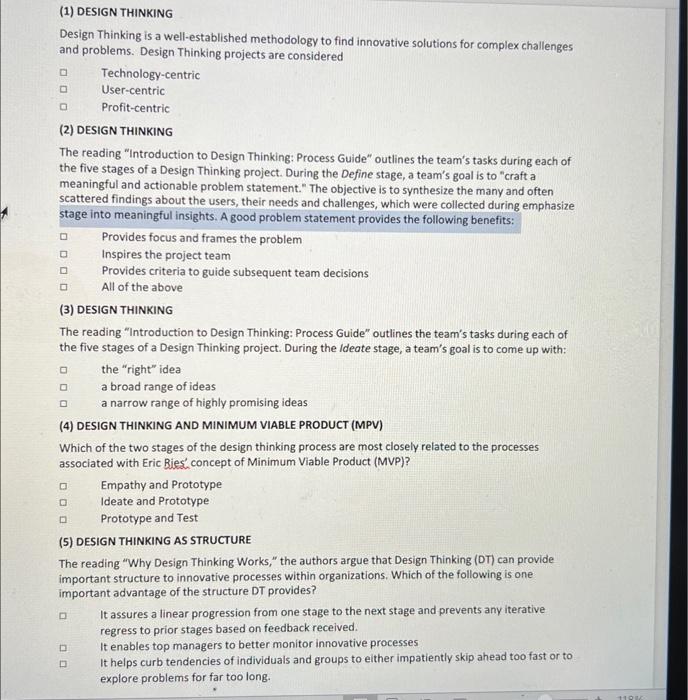
Question: (1) DESIGN THINKING Design Thinking is a well-established methodology to find innovative solutions for complex challenges and problems. Design Thinking projects are considered Technology-centric User-centric
(1) DESIGN THINKING Design Thinking is a
(1) DESIGN THINKING Design Thinking is a well-established methodology to find innovative solutions for complex challenges and problems. Design Thinking projects are considered Technology-centric User-centric Profit-centric (2) DESIGN THINKING The reading "Introduction to Design Thinking: Process Guide" outlines the team's tasks during each of the five stages of a Design Thinking project. During the Define stage, a team's goal is to "craft a meaningful and actionable problem statement." The objective is to synthesize the many and often scattered findings about the users, their needs and challenges, which were collected during emphasize stage into meaningful insights. A good problem statement provides the following benefits: Provides focus and frames the problem Inspires the project team Provides criteria to guide subsequent team decisions All of the above (3) DESIGN THINKING The reading "Introduction to Design Thinking: Process Guide" outlines the team's tasks during each of the five stages of a Design Thinking project. During the ideate stage, a team's goal is to come up with: the "right" idea a broad range of ideas a narrow range of highly promising ideas (4) DESIGN THINKING AND MINIMUM VIABLE PRODUCT (MPV) Which of the two stages of the design thinking process are most closely related to the processes associated with Eric Bie concept of Minimum Viable Product (MVP)? Empathy and Prototype Ideate and Prototype Prototype and Test (5) DESIGN THINKING AS STRUCTURE The reading "Why Design Thinking Works," the authors argue that Design Thinking (DT) can provide important structure to innovative processes within organizations. Which of the following is one important advantage of the structure DT provides? It assures a linear progression from one stage to the next stage and prevents any iterative regress to prior stages based on feedback received. It enables top managers to better monitor innovative processes It helps curb tendencies of individuals and groups to either impatiently skip ahead too fast or to explore problems for far too long

Step by Step Solution

There are 3 Steps involved in it

1 Expert Approved Answer
Step: 1 Unlock blur-text-image

Question Has Been Solved by an Expert!

Get step-by-step solutions from verified subject matter experts

Step: 2 Unlock
Step: 3 Unlock

Students Have Also Explored These Related General Management Questions!