



Question: 1. Determine the radius and interval of convergence for E.= (- 1) k k (x-4)k 2k 2. Give a power series representation for f (x)
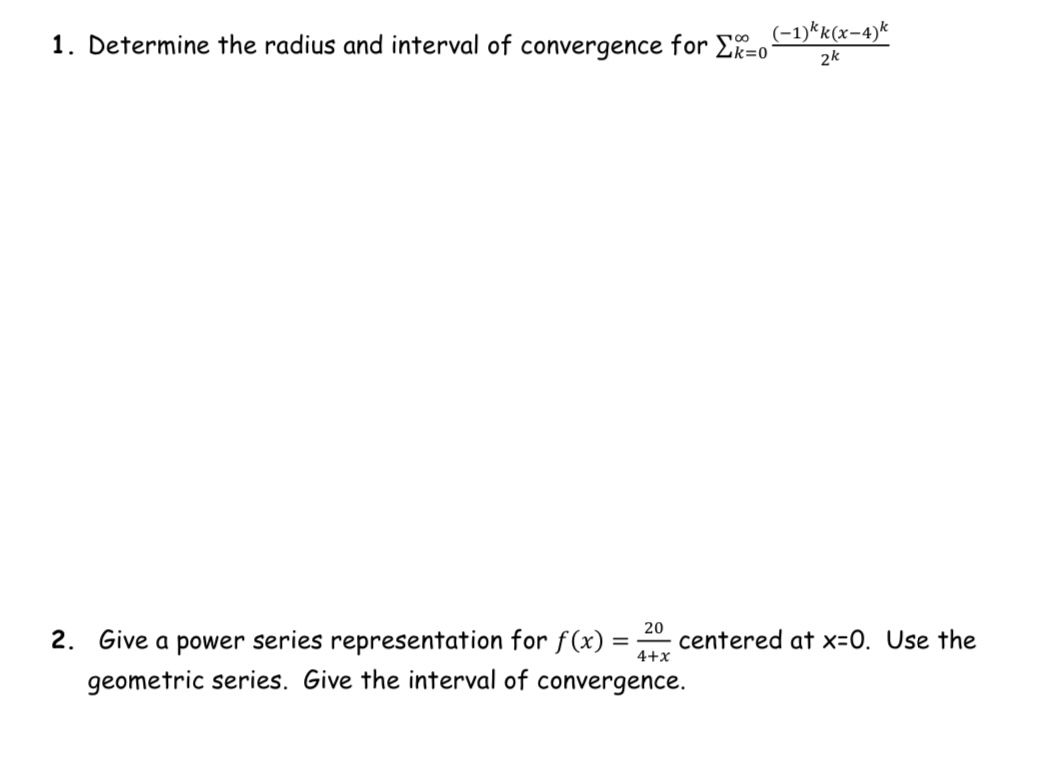
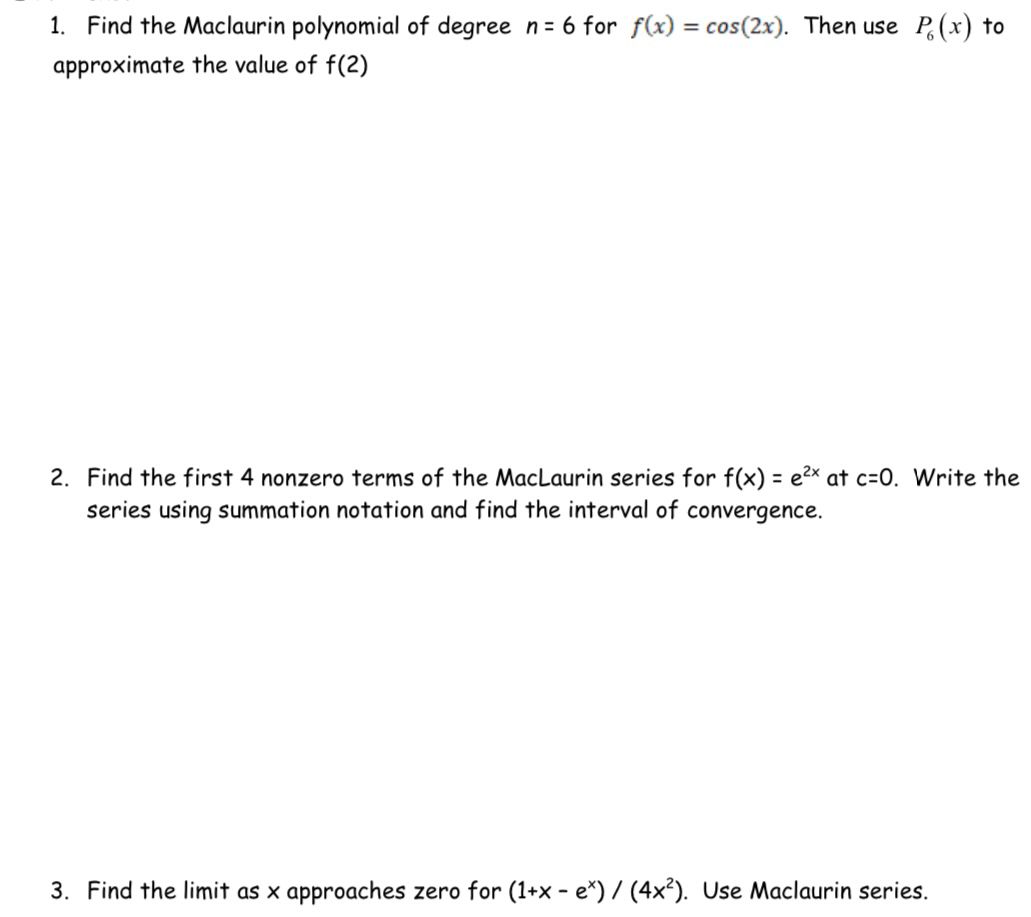
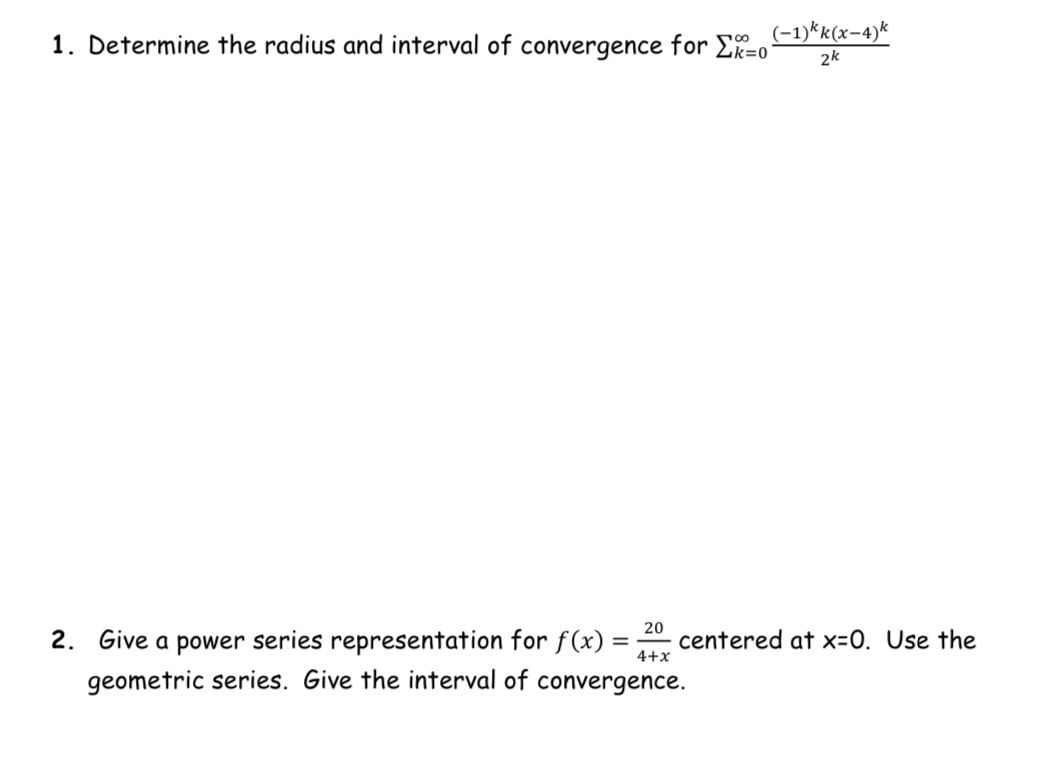
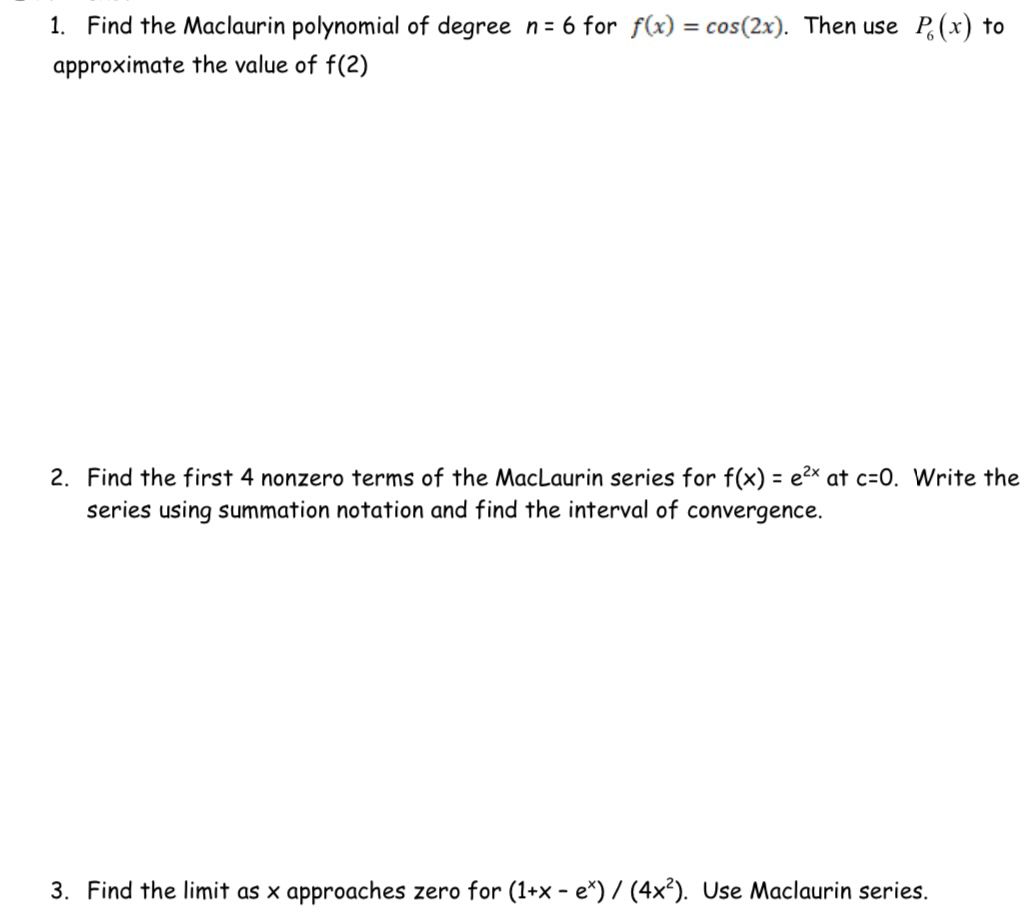
1. Determine the radius and interval of convergence for E.= (- 1) k k (x-4)k 2k 2. Give a power series representation for f (x) =- centered at x=0. Use the geometric series. Give the interval of convergence.1. Determine the radius and interval of convergence for E.= (- 1) k k (x-4)k 2k 2. Give a power series representation for f (x) =- centered at x=0. Use the geometric series. Give the interval of convergence.1. Find the Maclaurin polynomial of degree n = 6 for f(x) = cos(2x). Then use P, (x) to approximate the value of f(2) 2. Find the first 4 nonzero terms of the MacLaurin series for f(x) = ex at c=0. Write the series using summation notation and find the interval of convergence. 3. Find the limit as x approaches zero for (1+x - e*) / (4x2). Use Maclaurin series.1. Find the Maclaurin polynomial of degree n = 6 for f(x) = cos(2x). Then use P, (x) to approximate the value of f(2) 2. Find the first 4 nonzero terms of the MacLaurin series for f(x) = ex at c=0. Write the series using summation notation and find the interval of convergence. 3. Find the limit as x approaches zero for (1+x - e*) / (4x2). Use Maclaurin series
Step by Step Solution
There are 3 Steps involved in it

Get step-by-step solutions from verified subject matter experts