







Question: 1. Determine True/False (No explanations needed). (151=15) (i) Linear Programming analysis for construction projects is in essence an optimization procedure. (ii) Critical path method for
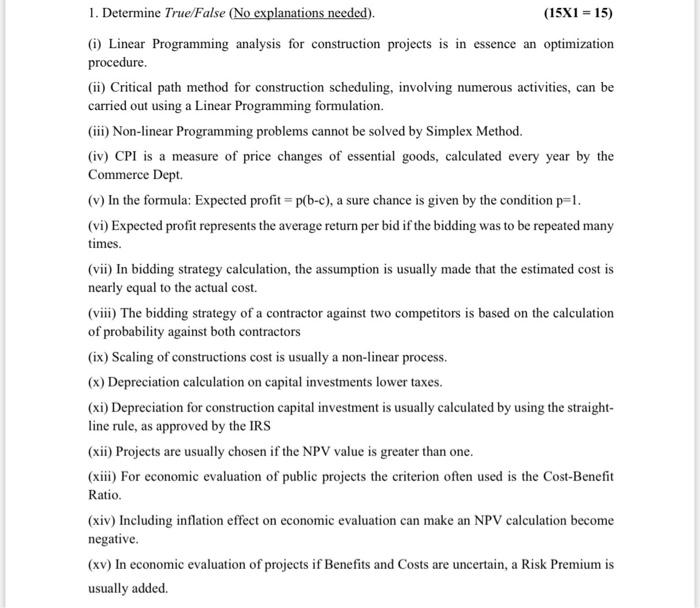
1. Determine True/False (No explanations needed). (151=15) (i) Linear Programming analysis for construction projects is in essence an optimization procedure. (ii) Critical path method for construction scheduling, involving numerous activities, can be carried out using a Linear Programming formulation. (iii) Non-linear Programming problems cannot be solved by Simplex Method. (iv) CPI is a measure of price changes of essential goods, calculated every year by the Commerce Dept. (v) In the formula: Expected profit =p(bc), a sure chance is given by the condition p=1. (vi) Expected profit represents the average return per bid if the bidding was to be repeated many times. (vii) In bidding strategy calculation, the assumption is usually made that the estimated cost is nearly equal to the actual cost. (viii) The bidding strategy of a contractor against two competitors is based on the calculation of probability against both contractors (ix) Scaling of constructions cost is usually a non-linear process. (x) Depreciation calculation on capital investments lower taxes. (xi) Depreciation for construction capital investment is usually calculated by using the straightline rule, as approved by the IRS (xii) Projects are usually chosen if the NPV value is greater than one. (xiii) For economic evaluation of public projects the criterion often used is the Cost-Benefit Ratio. (xiv) Including inflation effect on economic evaluation can make an NPV calculation become negative. (xv) In economic evaluation of projects if Benefits and Costs are uncertain, a Risk Premium is usually added
Step by Step Solution
There are 3 Steps involved in it

Get step-by-step solutions from verified subject matter experts
 Study Help