


Question: 1. Determine whether or not the cylinder can be modeled as an infinite fin -- (use experimental observations to support conclusions made). 2. Find the
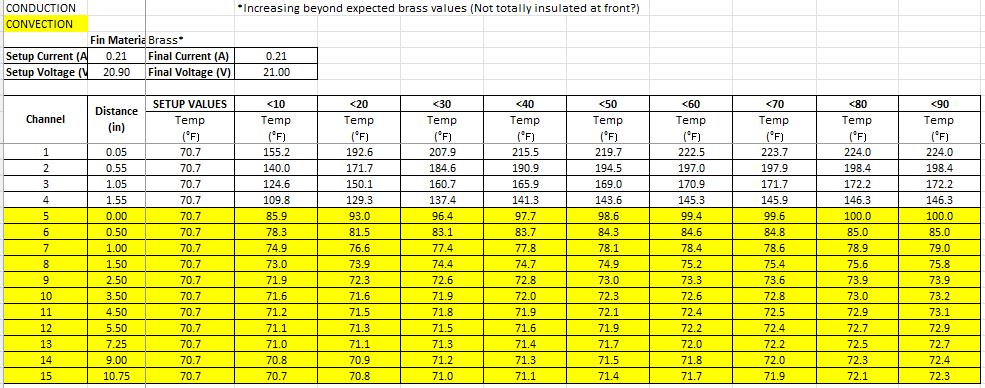
CONDUCTION CONVECTION *Increasing beyond expected brass values (Not totally insulated at front?)


  1. 1. Determine whether or not the cylinder can be modeled as an infinite fin -- (use experimental observations to support conclusions made).
  2. 2. Find the temperature slope (DT/Dx) for the first 4 TCs and compute heat conduction through the fin stem [q = - k A (DT/Dx)].
  3. 3. Compare the thermal flux "q" result obtained in Step 2 with the electrical power consumed by the power supply to make heat. Is there a difference? Explain the reason.
  4. 4. Plot the natural logarithm of dimensionless temperature ratio "q" versus position x.
  5. 5. Calculate the convective heat transfer coefficient "h".
  6. 6. Based on the computed h value, evaluate the fin heat transfer rate from Equation 5.
  7. 7. Compare this value with the data obtained in Step 2 and the electrical power consumption used to create the heat at the power supply; explain the differences.

CONDUCTION CONVECTION *Increasing beyond expected brass values (Not totally insulated at front?) Fin Materia Brass Setup Current (A Setup Voltage (V 0.21 20.90 Final Current (A) Final Voltage (V) 0.21 21.00 SETUP VALUES

Step by Step Solution

There are 3 Steps involved in it

1 Expert Approved Answer
Step: 1 Unlock blur-text-image
Question Has Been Solved by an Expert!

Get step-by-step solutions from verified subject matter experts

Step: 2 Unlock
Step: 3 Unlock

Students Have Also Explored These Related Mechanical Engineering Questions!