







Question: 1. Determine whether the given series converges or diverges. E(-1)n+1 In(n) In ( n 3 ) n=3 2. Determine whether the given series Converges Absolutely,
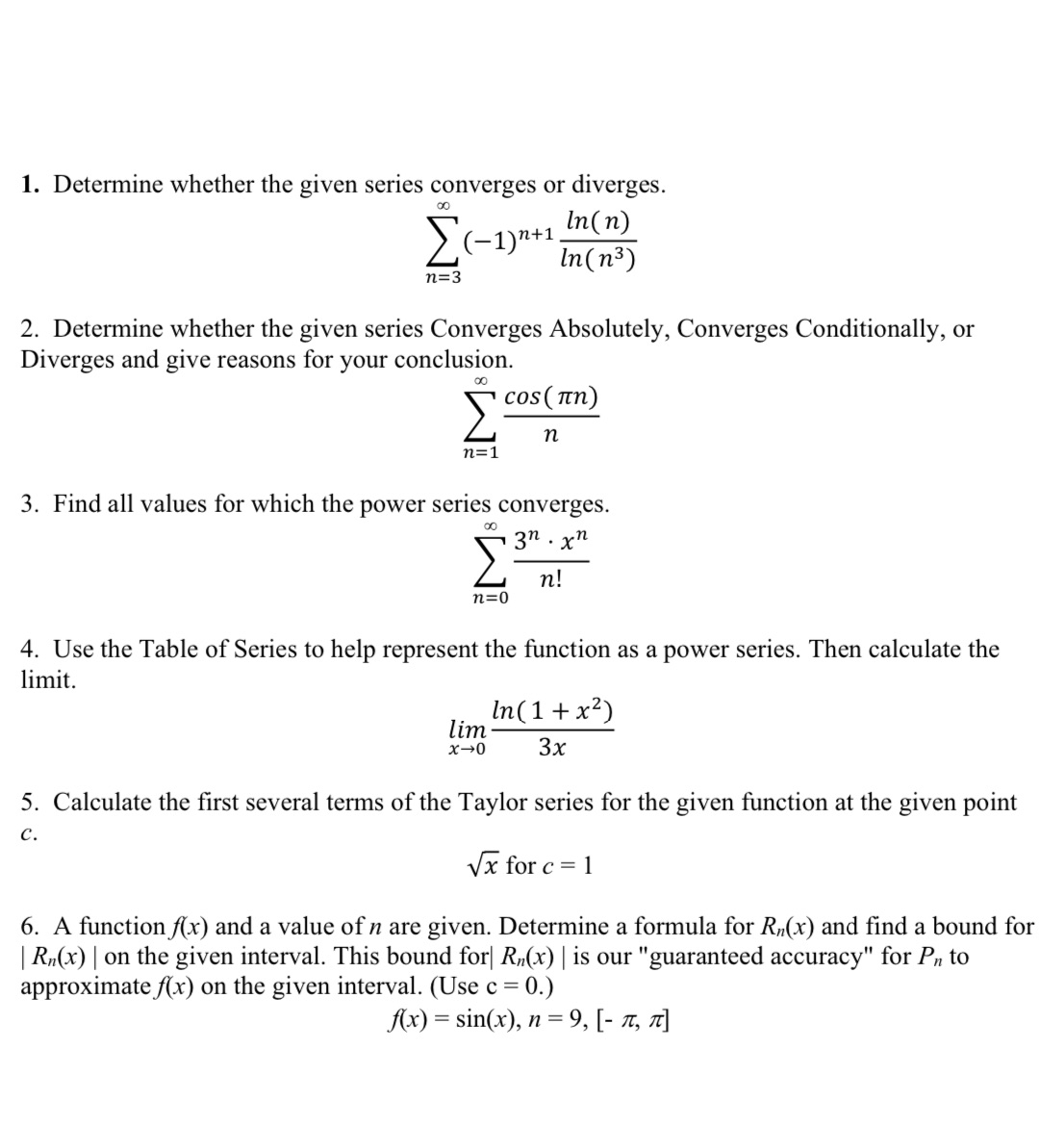
1. Determine whether the given series converges or diverges. E(-1)n+1 In(n) In ( n 3 ) n=3 2. Determine whether the given series Converges Absolutely, Converges Conditionally, or Diverges and give reasons for your conclusion. COS ( In) n n=1 3. Find all values for which the power series converges. 3n . xn n! n=0 4. Use the Table of Series to help represent the function as a power series. Then calculate the limit. In( 1 + x2) lim x-0 3x 5. Calculate the first several terms of the Taylor series for the given function at the given point C. Vx for c = 1 6. A function f(x) and a value of n are given. Determine a formula for Rn(x) and find a bound for Rn(x) | on the given interval. This bound for| Rn(x) | is our "guaranteed accuracy" for Pn to approximate f(x) on the given interval. (Use c = 0.) f(x) = sin(x), n = 9, [- n, n]
Step by Step Solution
There are 3 Steps involved in it

Get step-by-step solutions from verified subject matter experts
 Study Help