



Question: 1 Differences in Political Systems 7 . 1 4 Read the overview below and complete the activities tha 1 Differences in Political Systems 7 .
Differences in Political Systems
Read the overview below and complete the activities tha
Differences in Political Systems
Read the overview below and complete the activities that follow.
points
Political systems, the systems of government in nations, differ from country to country. It is important to understand the nature of different political systems and develop an awareness of and appreciation for the significance of national differences.
eBook
Political systems are assessed according to two dimensions. The first is the degree to which they emphasize collectivism as opposed to individualism. The second is the degree to which they are democratic or totalitarian. These dimensions are interrelated and may share certain characteristics.
References
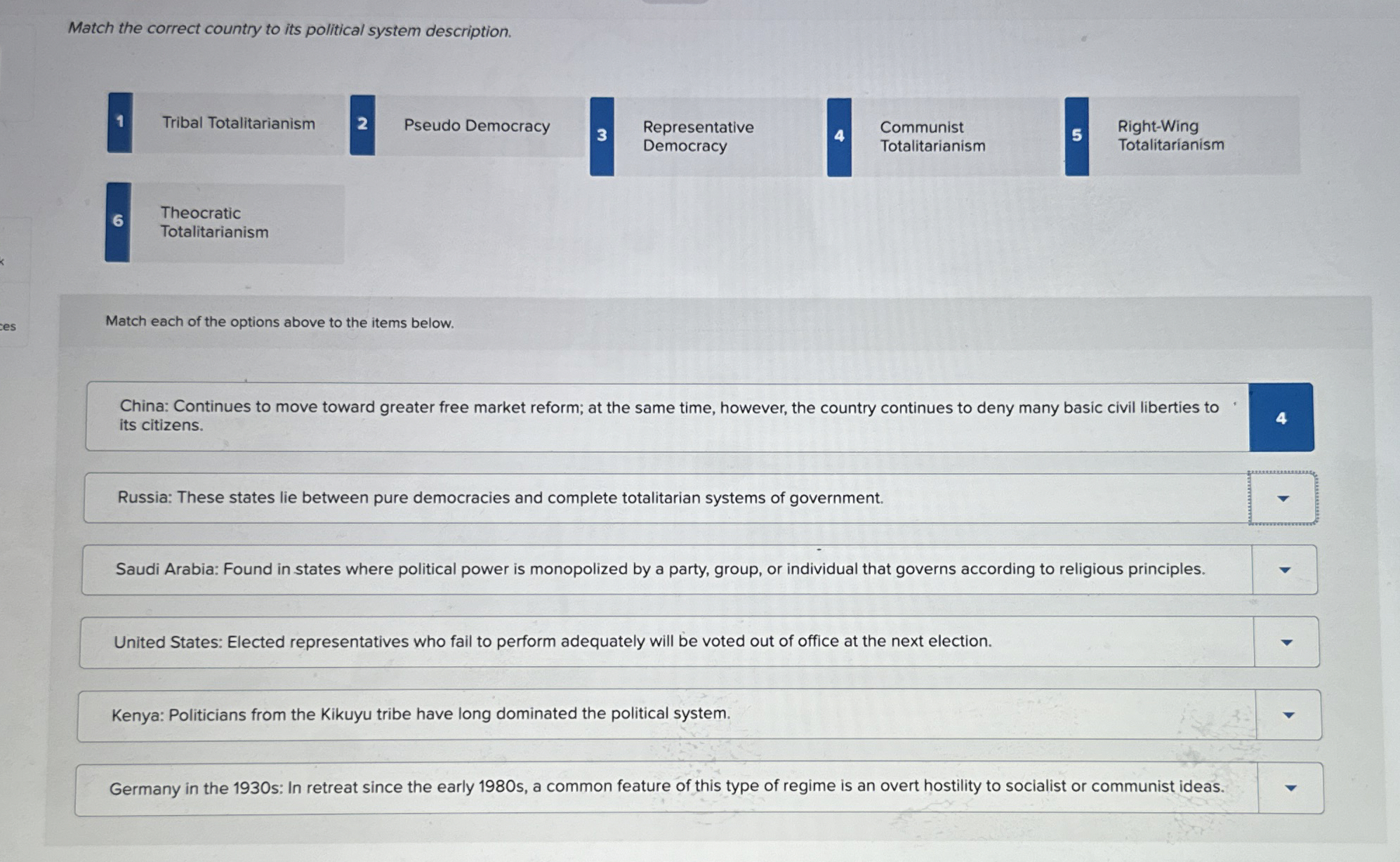
Match the correct country to its political system description.
Tribal Totalitarianism
Representative Democracy
Communist Totalitarianism
Match the correct country to its political system description.
Tribal Totalitarianism
Pseudo Democracy
Representative
Communist
RightWing
Democracy
Totalitarianism
Totalitarianism
Theocratic
Totalitarianism
Match each of the options above to the items below.
China: Continues to move toward greater free market reform; at the same time, however, the country continues to deny many basic civil liberties to its citizens.
Russia: These states lie between pure democracies and complete totalitarian systems of government.
Saudi Arabia: Found in states where political power is monopolized by a party, group, or individual that governs according to religious principles.
United States: Elected representatives who fail to perform adequately will be voted out of office at the next election.
Kenya: Politicians from the Kikuyu tribe have long dominated the political system.
Germany in the s: In retreat since the early s a common feature of this type of regime is an overt hostility to socialist or communist ideas.
Political systems, the systems of government in nations, differ from country to country. It is important to understand the nature of different political systems and develop an awareness of and appreciation for the significance of national differences.
eBook
Political systems are assessed according to two dimensions. The first is the degree to which they emphasize collectivism as opposed to individualism. The second is the degree to which they are democratic or totalitarian. These dimensions are interrelated and may share certain characteristics.
References
Match the correct country to its political system description.
Tribal Totalitarianism
Representative Democracy
Communist Totalitarianism
Match each of the options above to the items below.
China: Continues to move toward greater free market reform; at the same time, however, the country continues to deny many basic civil liberties to its citizens.
Russia: These states lie between pure democracies and complete totalitarian systems of government.
Saudi Arabia: Found in states where political power is monopolized by a party, group, or individual that governs according to religious principles.
United States: Elected representatives who fail to perform adequately will be voted out of office at the next election.
Kenya: Politicians from the Kikuyu tribe have long dominated the political system.
Germany in the s: In retreat since the early s a common feature of this type of regime is an overt hostility to socialist or communist ideas.
Step by Step Solution
There are 3 Steps involved in it
1 Expert Approved Answer
Step: 1 Unlock

Question Has Been Solved by an Expert!
Get step-by-step solutions from verified subject matter experts
Step: 2 Unlock
Step: 3 Unlock