







Question: 1. Diffraction 2. Population inversion 3. mass-to-charge ratio 4. Absorbance 5. Precursor ion 6. Monochromator 7. Base peak 8. Triplet state 9. Fluorescence 10. Refractive
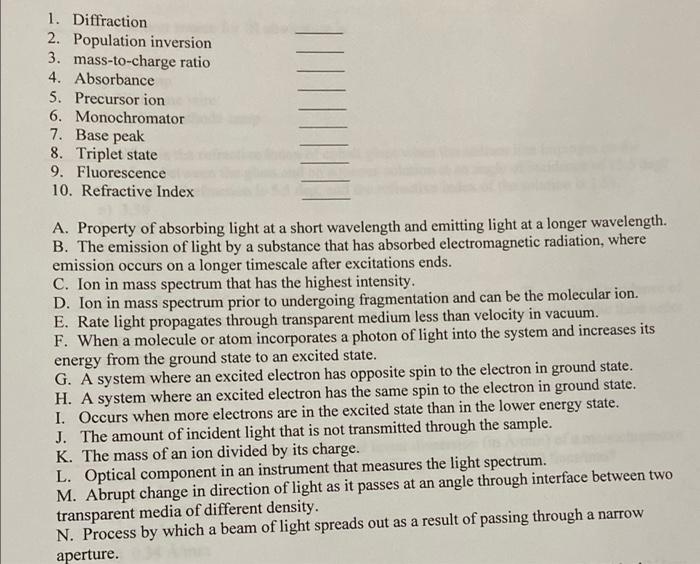
1. Diffraction 2. Population inversion 3. mass-to-charge ratio 4. Absorbance 5. Precursor ion 6. Monochromator 7. Base peak 8. Triplet state 9. Fluorescence 10. Refractive Index A. Property of absorbing light at a short wavelength and emitting light at a longer wavelength. B. The emission of light by a substance that has absorbed electromagnetic radiation, where emission occurs on a longer timescale after excitations ends. C. Ion in mass spectrum that has the highest intensity. D. Ion in mass spectrum prior to undergoing fragmentation and can be the molecular ion. E. Rate light propagates through transparent medium less than velocity in vacuum. F. When a molecule or atom incorporates a photon of light into the system and increases its energy from the ground state to an excited state. G. A system where an excited electron has opposite spin to the electron in ground state. H. A system where an excited electron has the same spin to the electron in ground state. I. Occurs when more electrons are in the excited state than in the lower energy state. J. The amount of incident light that is not transmitted through the sample. K. The mass of an ion divided by its charge. L. Optical component in an instrument that measures the light spectrum. M. Abrupt change in direction of light as it passes at an angle through interface between two transparent media of different density. N. Process by which a beam of light spreads out as a result of passing through a narrow aperture
Step by Step Solution
There are 3 Steps involved in it

Get step-by-step solutions from verified subject matter experts
 Study Help