







Question: 1 Direct Numerical Simulation ( DNS ) Direct numerical simulation, unlike RANS simulation ( Reynolds Averaged Navier Strokes ) or LES ( Large Eddy Simulation
Direct Numerical Simulation DNS
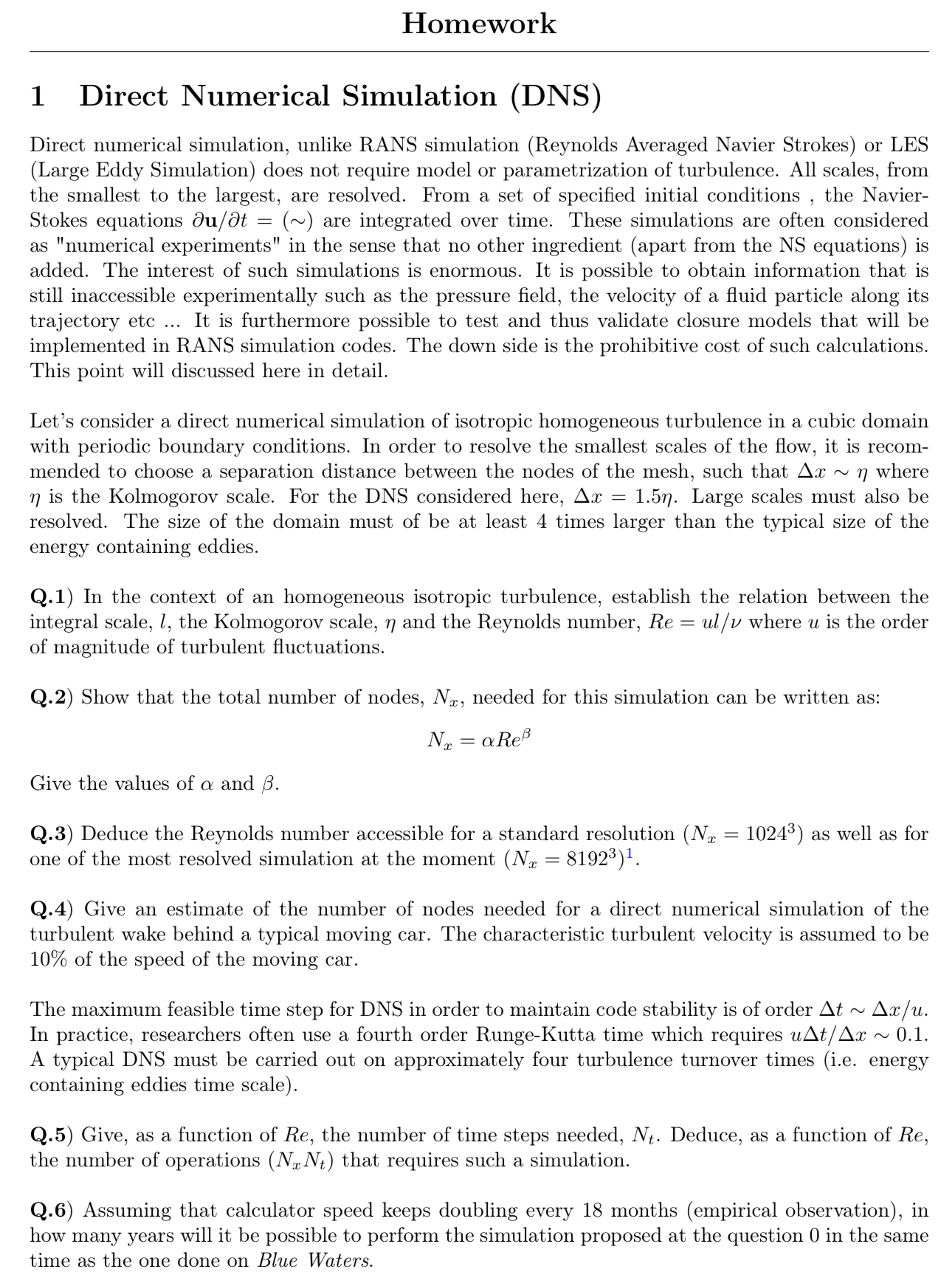
Direct numerical simulation, unlike RANS simulation Reynolds Averaged Navier Strokes or LES Large Eddy Simulation does not require model or parametrization of turbulence. All scales, from the smallest to the largest, are resolved. From a set of specified initial conditions, the NavierStokes equations delelt are integrated over time. These simulations are often considered as "numerical experiments" in the sense that no other ingredient apart from the NS equations is added. The interest of such simulations is enormous. It is possible to obtain information that is still inaccessible experimentally such as the pressure field, the velocity of a fluid particle along its trajectory etc It is furthermore possible to test and thus validate closure models that will be implemented in RANS simulation codes. The down side is the prohibitive cost of such calculations. This point will discussed here in detail.
Let's consider a direct numerical simulation of isotropic homogeneous turbulence in a cubic domain with periodic boundary conditions. In order to resolve the smallest scales of the flow, it is recommended to choose a separation distance between the nodes of the mesh, such that where is the Kolmogorov scale. For the DNS considered here, Large scales must also be resolved. The size of the domain must of be at least times larger than the typical size of the energy containing eddies.
Q In the context of an homogeneous isotropic turbulence, establish the relation between the integral scale, the Kolmogorov scale, and the Reynolds number,
where is the order of magnitude of turbulent fluctuations.
Q Show that the total number of nodes, needed for this simulation can be written as:
Give the values of and
Q Deduce the Reynolds number accessible for a standard resolution as well as for one of the most resolved simulation at the moment
Q Give an estimate of the number of nodes needed for a direct numerical simulation of the turbulent wake behind a typical moving car. The characteristic turbulent velocity is assumed to be of the speed of the moving car.
The maximum feasible time step for DNS in order to maintain code stability is of order In practice, researchers often use a fourth order RungeKutta time which requires A typical DNS must be carried out on approximately four turbulence turnover times ie energy containing eddies time scale
Q Give, as a function of the number of time steps needed, Deduce, as a function of the number of operations that requires such a simulation.
Q Assuming that calculator speed keeps doubling every months empirical observation in how many years will it be possible to perform the simulation proposed at the question in the same time as the one done on Blue Waters.
Step by Step Solution
There are 3 Steps involved in it
1 Expert Approved Answer
Step: 1 Unlock

Question Has Been Solved by an Expert!
Get step-by-step solutions from verified subject matter experts
Step: 2 Unlock
Step: 3 Unlock
 Study Help