







Question: 1) Does linear hashing always split the bucket that overflows? yeso 2)What is the value (in binary) of next pointer? Make sure that you write
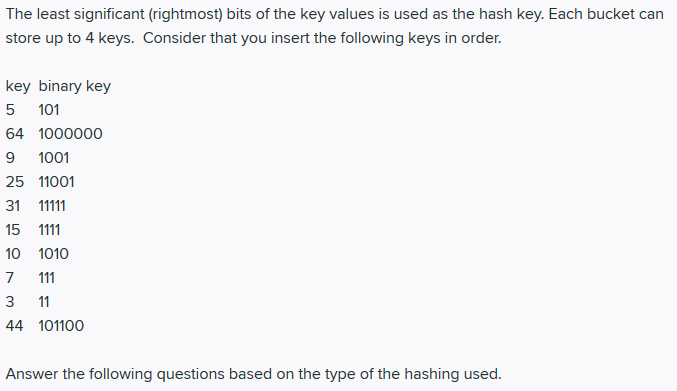
1) Does linear hashing always split the bucket that overflows? yeso
2)What is the value (in binary) of next pointer? Make sure that you write the required number of bits in the representation.
3)What is the largest new key (in decimal) less than 25 whose insertion cause a split? The new key is different from the given ones.
4)What is the global depth?
5)Do all data buckets have a local depth of 2? yeso
6)What is the largest new key (in decimal) less than 44 whose insertion cause the directory to double in size? The new key is different from the given ones.
If you can answer ASAP I will really appreciate it :)
The least significant (rightmost) bits of the key values is used as the hash key. Each bucket can store up to 4 keys. Consider that you insert the following keys in order. key binary key 5 101 64 1000000 9 1001 25 11001 31 11111 15 1111 101010 7 111 3 11 44 101100 Answer the following questions based on the type of the hashing used
Step by Step Solution
There are 3 Steps involved in it

Get step-by-step solutions from verified subject matter experts
 Study Help