







Question: 1. Draw the 11-entry hash table that results from using the hash function, h(i)-(3i + 5) mod 11, to hash the keys [12, 44, 13,
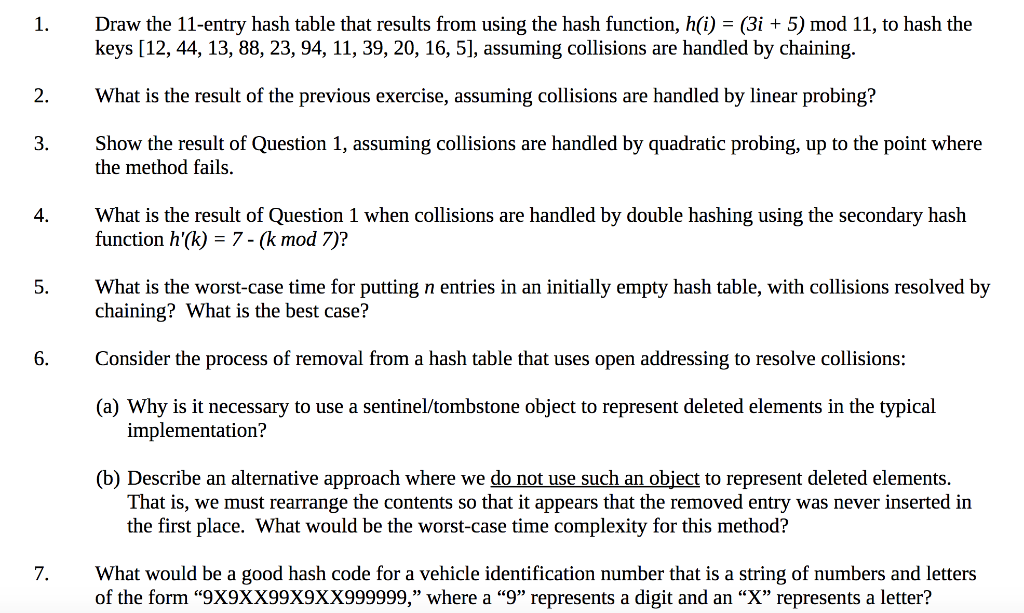
1. Draw the 11-entry hash table that results from using the hash function, h(i)-(3i + 5) mod 11, to hash the keys [12, 44, 13, 88, 23, 94, 11, 39, 20, 16, 5], assuming collisions are handled by chaining. What is the result of the previous exercise, assuming collisions are handled by linear probing? Show the result of Question 1, assuming collisions are handled by quadratic probing, up to the point where 2. 3. the method fails. 4 What is the result of Question 1 when collisions are handled by double hashing using the secondary hash function h'(k) - 7-(kmod 7)? 5. What is the worst-case time for putting n entries in an initially empty hash table, with collisions resolved by chaining? What is the best case? Consider the process of removal from a hash table that uses open addressing to resolve collisions: (a) Why is it necessary to use a sentinel/tombstone object to represent deleted elements in the typical 6. implementation? (b) Describe an alternative approach where we do not use such an object to represent deleted elements. That is, we must rearrange the contents so that it appears that the removed entry was never inserted in the first place. What would be the worst-case time complexity for this method? 7 What would be a good hash code for a vehicle identification number that is a string of numbers and letters of the form "9X9XX99X9XX999999," where a "9" represents a digit and an "X" represents a letter
Step by Step Solution
There are 3 Steps involved in it

Get step-by-step solutions from verified subject matter experts
 Study Help