







Question: 1. DSC is a very important method for measuring thermo properties of materials. Please answer the following questions related to DSC measurements. (Total 50 pts)
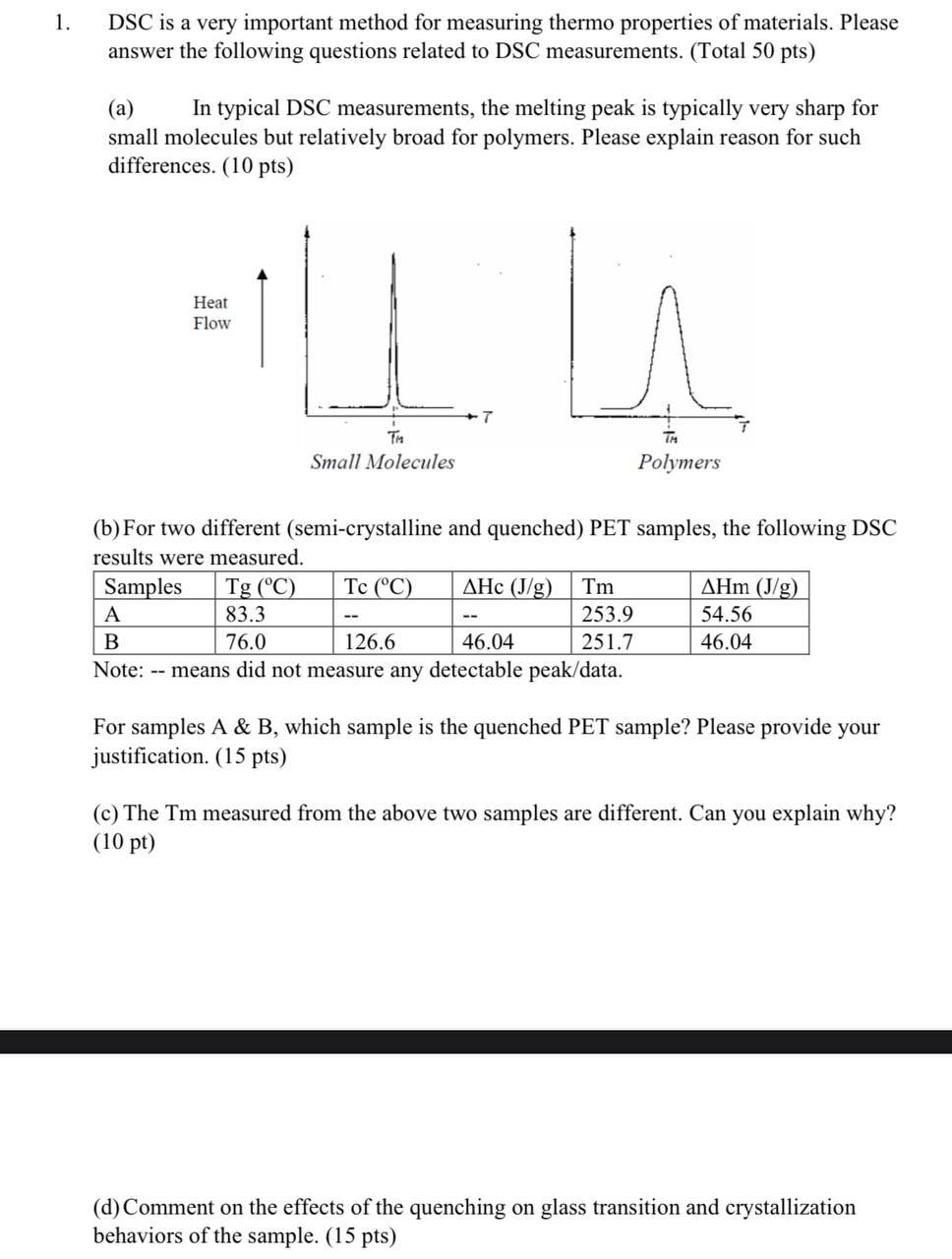
1. DSC is a very important method for measuring thermo properties of materials. Please answer the following questions related to DSC measurements. (Total 50 pts) (a) In typical DSC measurements, the melting peak is typically very sharp for small molecules but relatively broad for polymers. Please explain reason for such differences. (10 pts) Heat Flow Small Molecules Polymers (b) For two different (semi-crystalline and quenched) PET samples, the following DSC results were measured. Samples Tg (C) Tc (C) AHC (J/g) Tm AHm (J/g) A 83.3 253.9 54.56 B 76.0 126.6 46.04 251.7 46.04 Note: -- means did not measure any detectable peak/data. For samples A & B, which sample is the quenched PET sample? Please provide your justification. (15 pts) (c) The Tm measured from the above two samples are different. Can you explain why? (10 pt) (d) Comment on the effects of the quenching on glass transition and crystallization behaviors of the sample. (15 pts) 1. DSC is a very important method for measuring thermo properties of materials. Please answer the following questions related to DSC measurements. (Total 50 pts) (a) In typical DSC measurements, the melting peak is typically very sharp for small molecules but relatively broad for polymers. Please explain reason for such differences. (10 pts) Heat Flow Small Molecules Polymers (b) For two different (semi-crystalline and quenched) PET samples, the following DSC results were measured. Samples Tg (C) Tc (C) AHC (J/g) Tm AHm (J/g) A 83.3 253.9 54.56 B 76.0 126.6 46.04 251.7 46.04 Note: -- means did not measure any detectable peak/data. For samples A & B, which sample is the quenched PET sample? Please provide your justification. (15 pts) (c) The Tm measured from the above two samples are different. Can you explain why? (10 pt) (d) Comment on the effects of the quenching on glass transition and crystallization behaviors of the sample. (15 pts)
Step by Step Solution
There are 3 Steps involved in it

Get step-by-step solutions from verified subject matter experts
 Study Help