







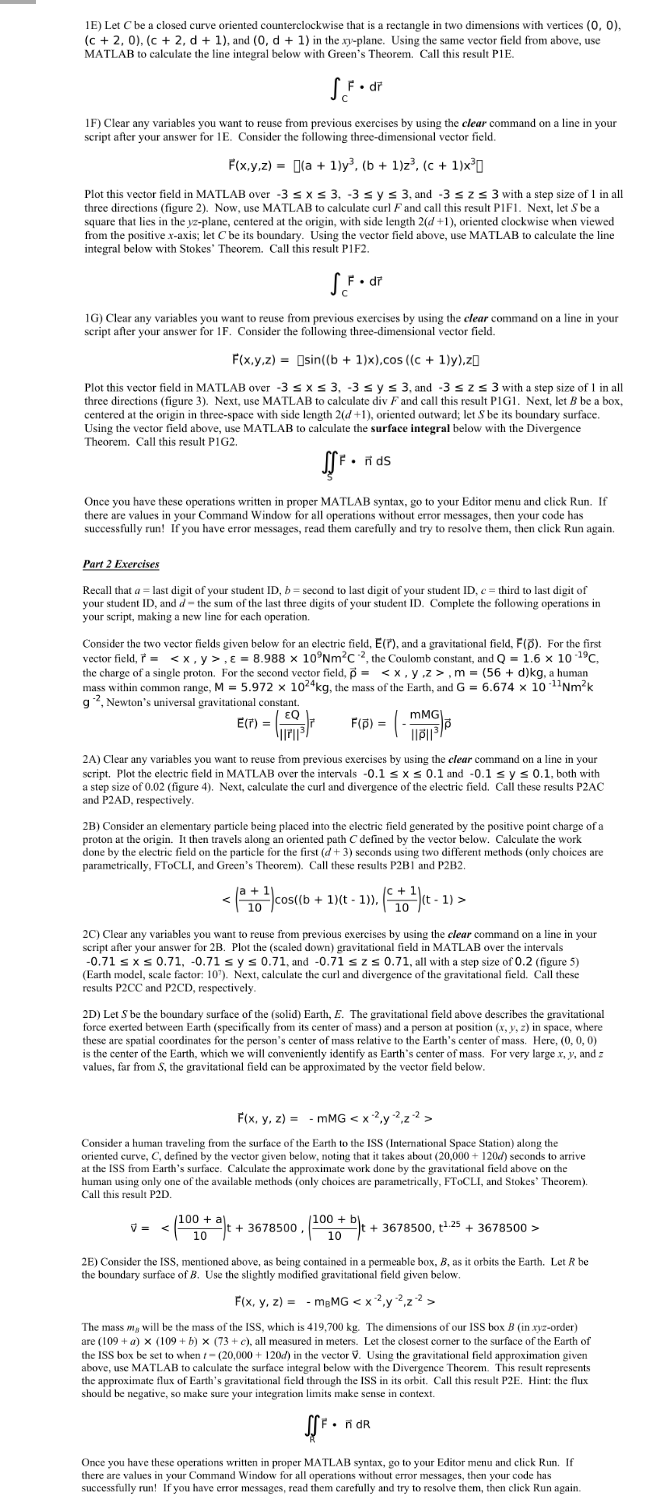
Question: 1 E ) Let C be a closed curve oriented counterclockwise that is a rectangle in two dimensions with vertices ( 0 , 0 )
E Let be a closed curve oriented counterclockwise that is a rectangle in two dimensions with vertices
and in the plane. Using the same vector field from above, use
MATLAB to calculate the line integral below with Green's Theorem. Call this result PE
vec
F Clear any variables you want to reuse from previous exercises by using the clear command on a line in your
script after your answer for IE Consider the following threedimensional vector field.
Plot this vector field in MATLAB over and with a step size of in all
three directions figure Now, use MATLAB to calculate curl and call this result PIF Next, let be a
square that lies in the plane, centered at the origin, with side length oriented clockwise when viewed
from the positive axis; let be its boundary. Using the vector field above, use MATLAB to calculate the line
integral below with Stokes' Theorem. Call this result PF
G Clear any variables you want to reuse from previous exercises by using the clear command on a line in your
script after your answer for IF Consider the following threedimensional vector field.
Plot this vector field in MATLAB over and with a step size of in all
three directions figure Next, use MATLAB to calculate div and call this result PG Next, let be a box,
centered at the origin in threespace with side length oriented outward; let be its boundary surface,
Using the vector field above, use MATLAB to calculate the surface integral below with the Divergence
Theorem. Call this result PG
Once you have these operations written in proper MATLAB syntax, go to your Editor menu and click Run. If
there are values in your Command Window for all operations without error messages, then your code has
successfully run! If you have error messages, read them carefully and try to resolve them, then click Run again.
Part Exercises
Recall that last digit of your student ID second to last digit of your student ID third to last digit of
your student ID and the sum of the last three digits of your student ID Complete the following operations in
your script, making a new line for each operation.
Consider the two vector fields given below for an electric field, and a gravitational field, vec For the first
vector field, vec:: the Coulomb constant, and
the charge of a single proton. For the second vector field, vec:: a human
mass within common range, the mass of the Earth, and
Newton's universal gravitational constant.
A Clear any variables you want to reuse from previous exercises by using the clear command on a line in your
script. Plot the electric field in MATLAB over the intervals and both with
a step size of figure Next, calculate the curl and divergence of the electric field. Call these results PAC
and respectively.
B Consider an elementary particle being placed into the electric field generated by the positive point charge of a
proton at the origin. It then travels along an oriented path defined by the vector below. Calculate the work
done by the electric field on the particle for the first seconds using two differ
Step by Step Solution
There are 3 Steps involved in it
1 Expert Approved Answer
Step: 1 Unlock

Question Has Been Solved by an Expert!
Get step-by-step solutions from verified subject matter experts
Step: 2 Unlock
Step: 3 Unlock
 Study Help