







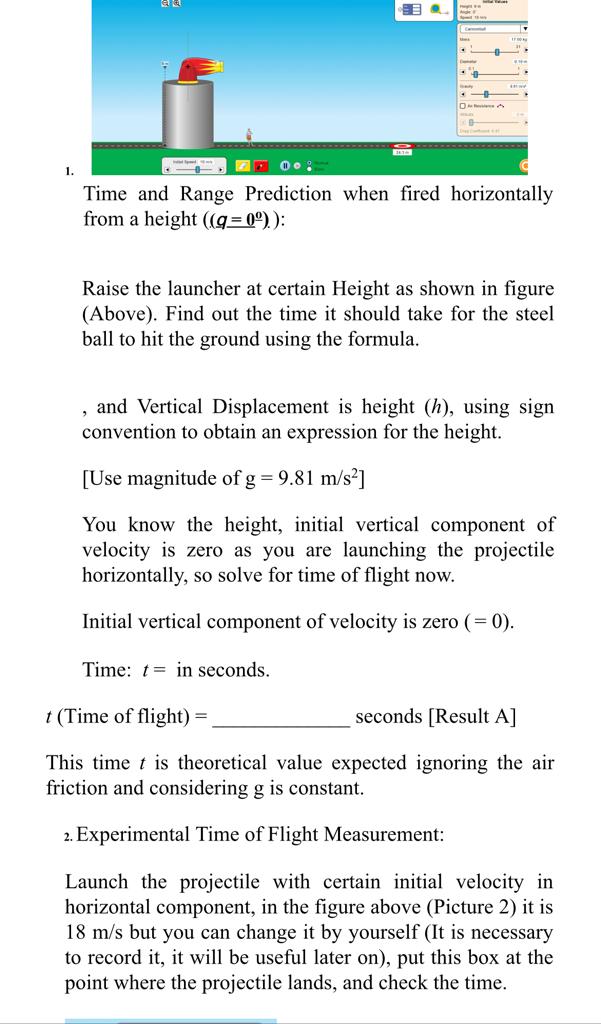
Question: 1. EH 5 '7'- - , Time and Range Prediction when red horizontally from a height ($111191): Raise the launcher at certain Height as shown
![expression for the height. [Use magnitude of g = 9.81 W52] You](https://dsd5zvtm8ll6.cloudfront.net/si.experts.images/questions/2024/09/66f6fc1f15d91_43066f6fc1edd781.jpg)
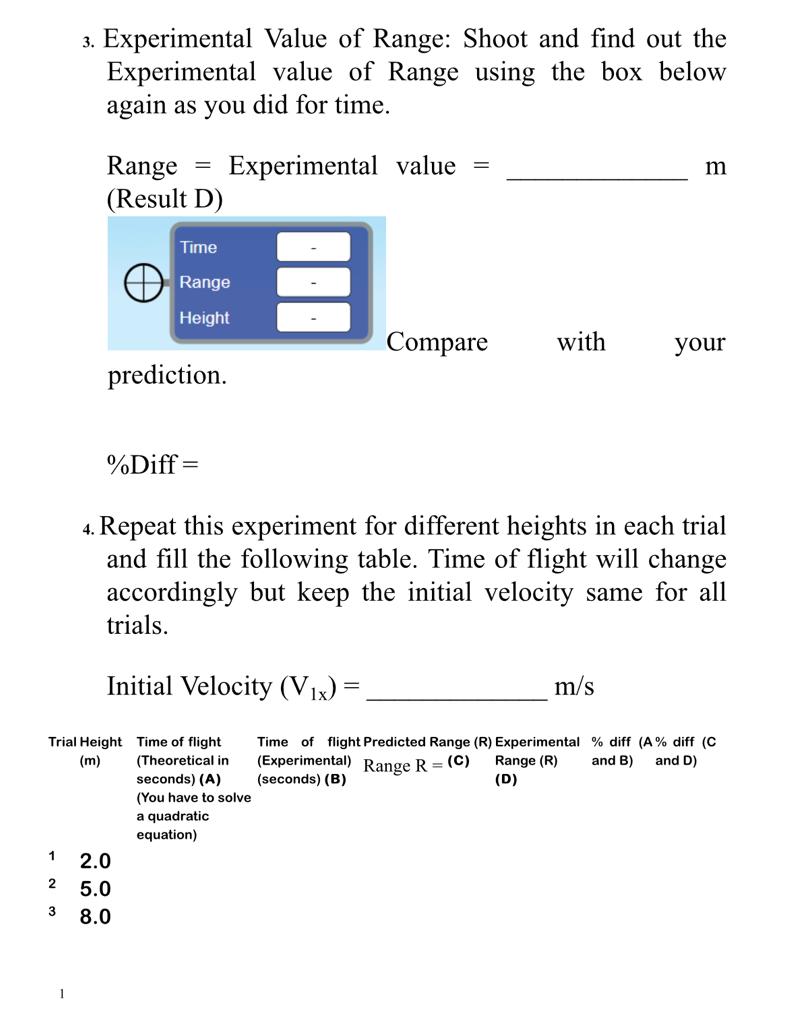
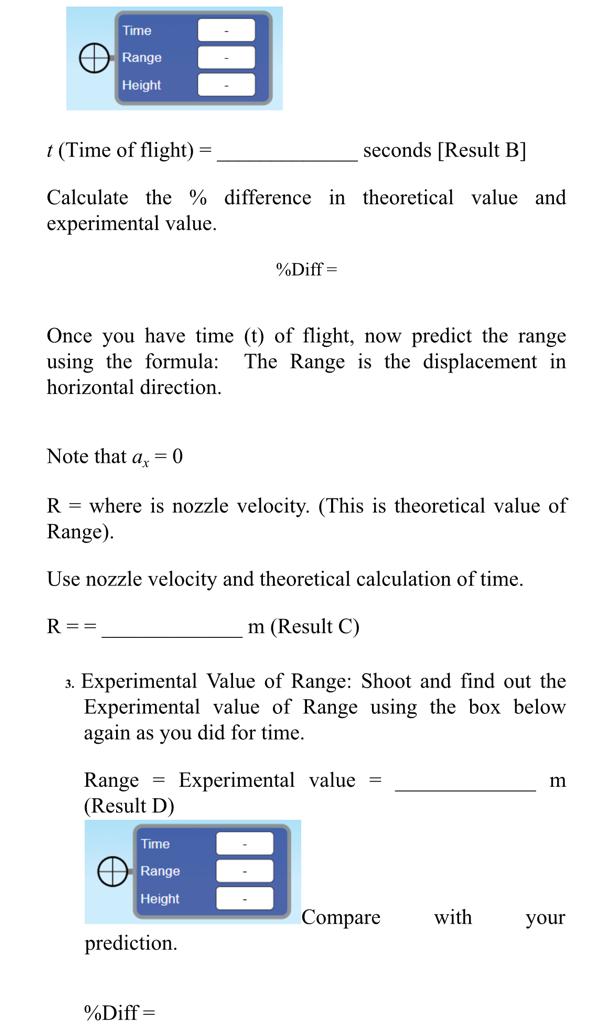
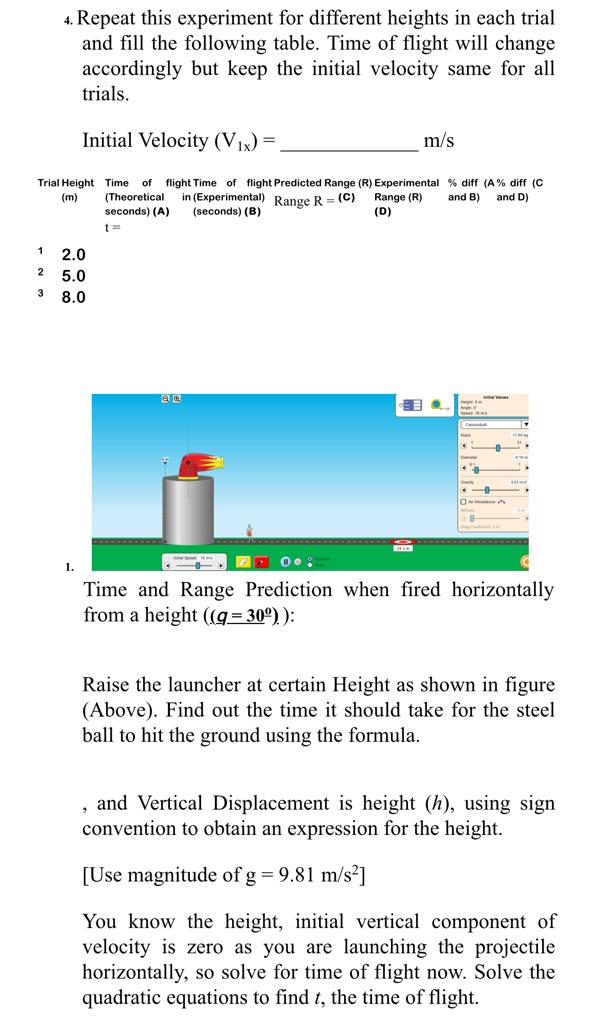
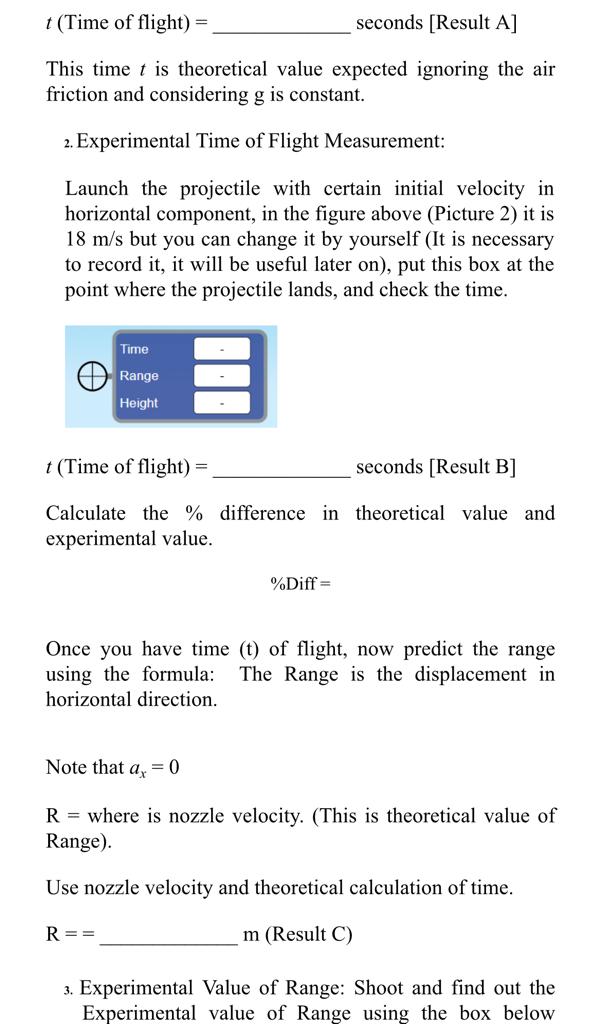
1. EH 5 '7'\"- - , Time and Range Prediction when red horizontally from a height ($111191): Raise the launcher at certain Height as shown in gure (Above). Find out the time it should take for the steel ball to hit the ground using the formula. , and Vertical Displacement is height (h), using sign convention to obtain an expression for the height. [Use magnitude of g = 9.81 W52] You know the height, initial vertical component of velocity is zero as you are launching the projectile horizontally, so solve for time of ight now. Initial vertical component of velocity is zero ( = 0). Time: t= in seconds. I (Time of ight) = seconds [Result A] This time t is theoretical value expected ignoring the air friction and considering g is constant. 2. Experimental Time of Flight Measurement: Launch the projectile with certain initial velocity in horizontal component, in the gure above (Picture 2) it is 13 mfs but you can change it by yourself (It is necessary to record it, it will be useful later on), put this box at the point where the projectile lands, and check the time. 3. Experimental Value of Range: Shoot and find out the Experimental value of Range using the box below again as you did for time. Range = Experimental value = m (Result D) Time Range Height Compare with your prediction. % Diff = 4. Repeat this experiment for different heights in each trial and fill the following table. Time of flight will change accordingly but keep the initial velocity same for all trials. Initial Velocity (Vix) = m/s Trial Height Time of flight Time of flight Predicted Range (R) Experimental % diff (A% diff (C (m) Theoretical in (Experimental) Range R = (C) Range (R) and B) and D) seconds) (A) (seconds) (B) (D) (You have to solve a quadratic equation) 1 2.0 2 5.0 3 8.0Time Range Height t (Time of flight) = seconds [Result B] Calculate the % difference in theoretical value and experimental value. %Diff = Once you have time (t) of flight, now predict the range using the formula: The Range is the displacement in horizontal direction. Note that a, = 0 R = where is nozzle velocity. (This is theoretical value of Range). Use nozzle velocity and theoretical calculation of time. R = = m (Result C) 3. Experimental Value of Range: Shoot and find out the Experimental value of Range using the box below again as you did for time. Range = Experimental value = m (Result D) Time Range Height Compare with your prediction. % Diff =4. Repeat this experiment for different heights in each trial and fill the following table. Time of flight will change accordingly but keep the initial velocity same for all trials. Initial Velocity (Vix) = m/s Trial Height Time of flight Time of flight Predicted Range (R) Experimental % diff (A % diff (C (m) (Theoretical in (Experimental) Range R = (C) Range (R) and B) and D) seconds) (A) (seconds) (B) (D) 1= 1 2.0 2 5.0 3 8.0 Time and Range Prediction when fired horizontally from a height ((q = 309) ): Raise the launcher at certain Height as shown in figure (Above). Find out the time it should take for the steel ball to hit the ground using the formula. , and Vertical Displacement is height (h), using sign convention to obtain an expression for the height. [Use magnitude of g = 9.81 m/s2] You know the height, initial vertical component of velocity is zero as you are launching the projectile horizontally, so solve for time of flight now. Solve the quadratic equations to find t, the time of flight.t (Time of flight) = seconds [Result A] This time t is theoretical value expected ignoring the air friction and considering g is constant. 2. Experimental Time of Flight Measurement: Launch the projectile with certain initial velocity in horizontal component, in the figure above (Picture 2) it is 18 m/s but you can change it by yourself (It is necessary to record it, it will be useful later on), put this box at the point where the projectile lands, and check the time. Time Range Height t (Time of flight) = seconds [Result B] Calculate the % difference in theoretical value and experimental value. % Diff = Once you have time (t) of flight, now predict the range using the formula: The Range is the displacement in horizontal direction. Note that a, = 0 R = where is nozzle velocity. (This is theoretical value of Range). Use nozzle velocity and theoretical calculation of time. R= = m (Result C) 3. Experimental Value of Range: Shoot and find out the Experimental value of Range using the box belowNAME LAB 2: PROJECTILE MOTION DATE: Objective: To be familiar with projectile motion, and the relationship between projectile angle, initial velocity, the range and the height of the projectile. Picture 6 Procedure Picture 2 Click on the link below to become familiar with the controls for this projectile simulation. projectilemotionguid e.pdf To actually run this simulation or experiment you will use the following link below: https://phet.colorado.edu/sims/html/projectile- motion/latest/projectile-motion_en.html Part I: Projectile Launched Horizontally: (q = 09) Objectives: In this part, you are going to predict that the time of flight of a ball launched horizontally. You will also predict and observe experimentally the range of the ball. Theory: For a projectile motion, the horizontal and vertical motions are independent. In the vertical direction, the projectile accelerates downward as gravity pulls on it. But in the horizontal direction, there is no acceleration and the horizontal component of the velocity is constant if friction is neglected. PROCEDURE: Click on the Lab window. Deselect Air Resistance. Air resistance will remain zero for this experiment. Mass and diameter of the cannonball will also remain fixed at default values. Projectile Motion Vectors Drain Lab
Step by Step Solution
There are 3 Steps involved in it

Get step-by-step solutions from verified subject matter experts
 Study Help