



Question: 1. Electric field lines Start on a negative charge and end on a positive charge. b. Form closed loops c. End on a negative charge
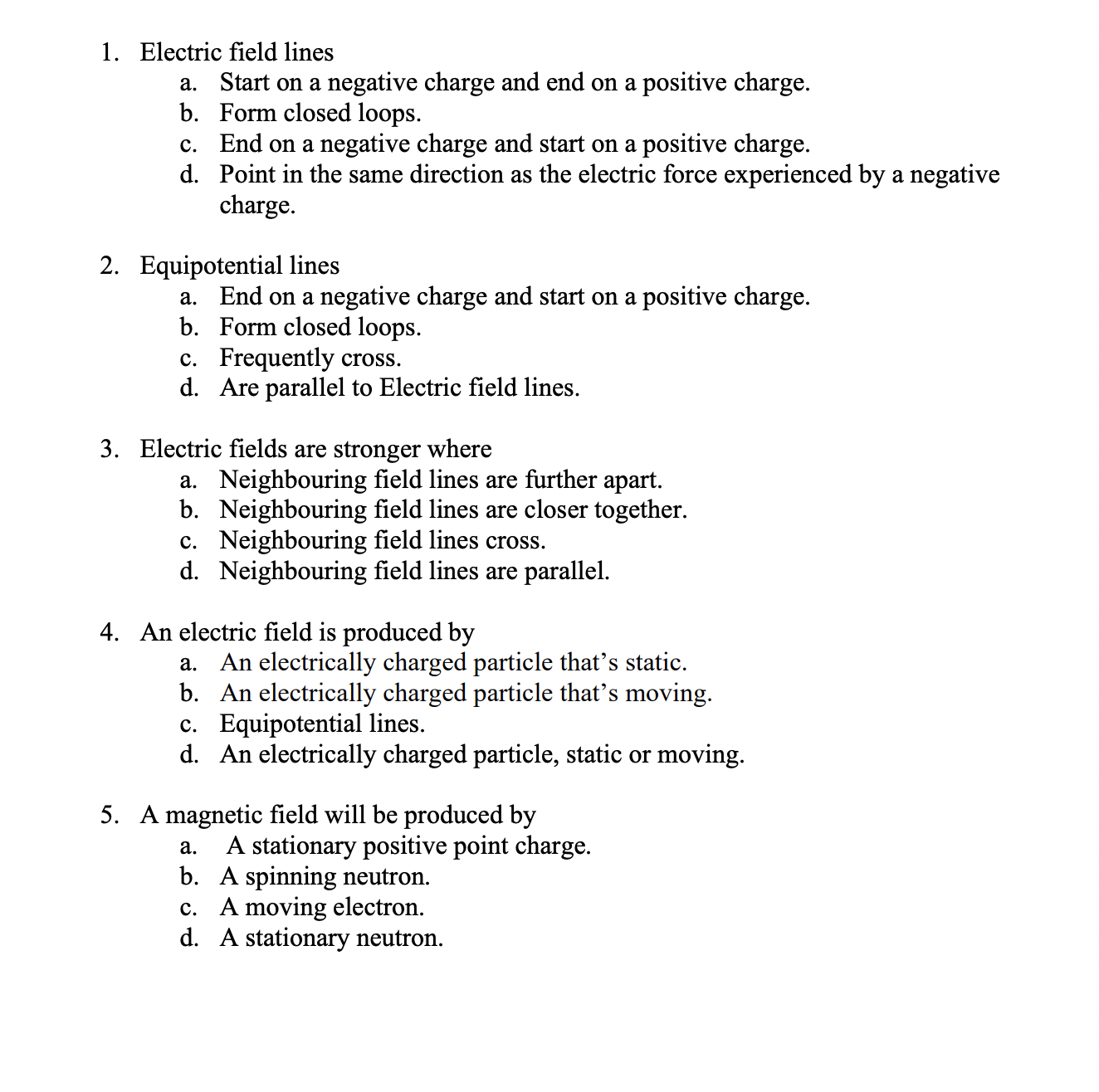
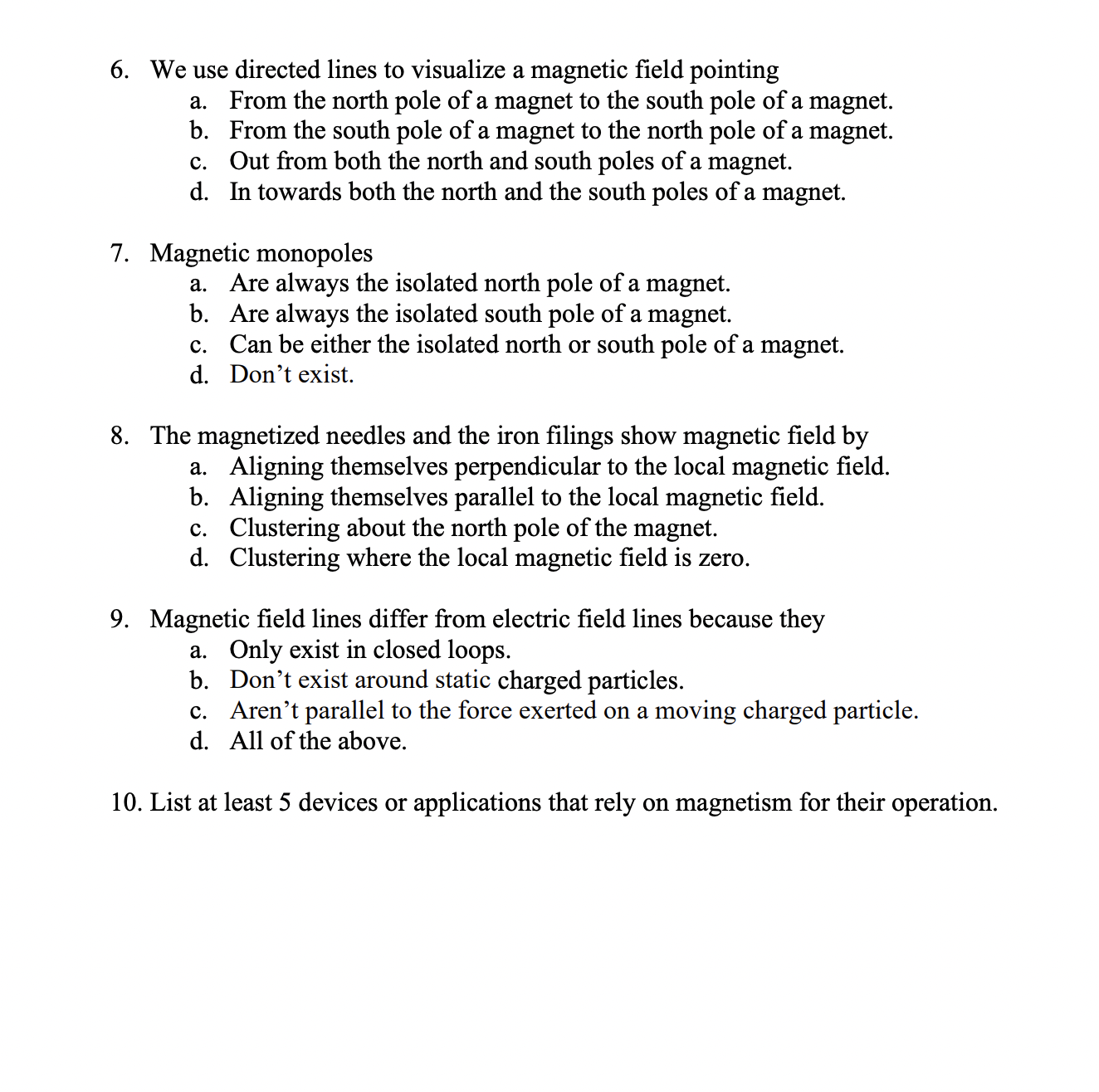
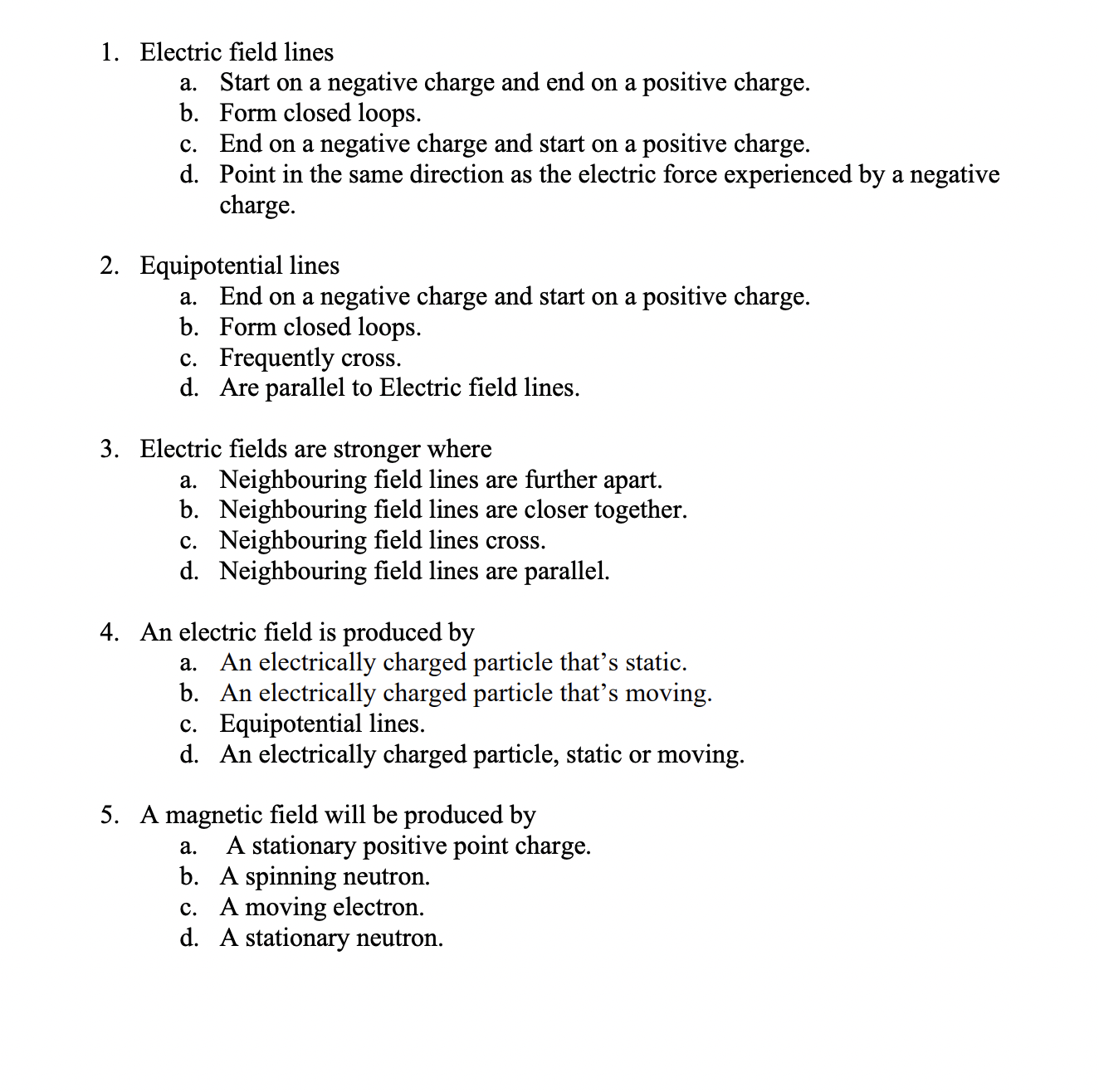
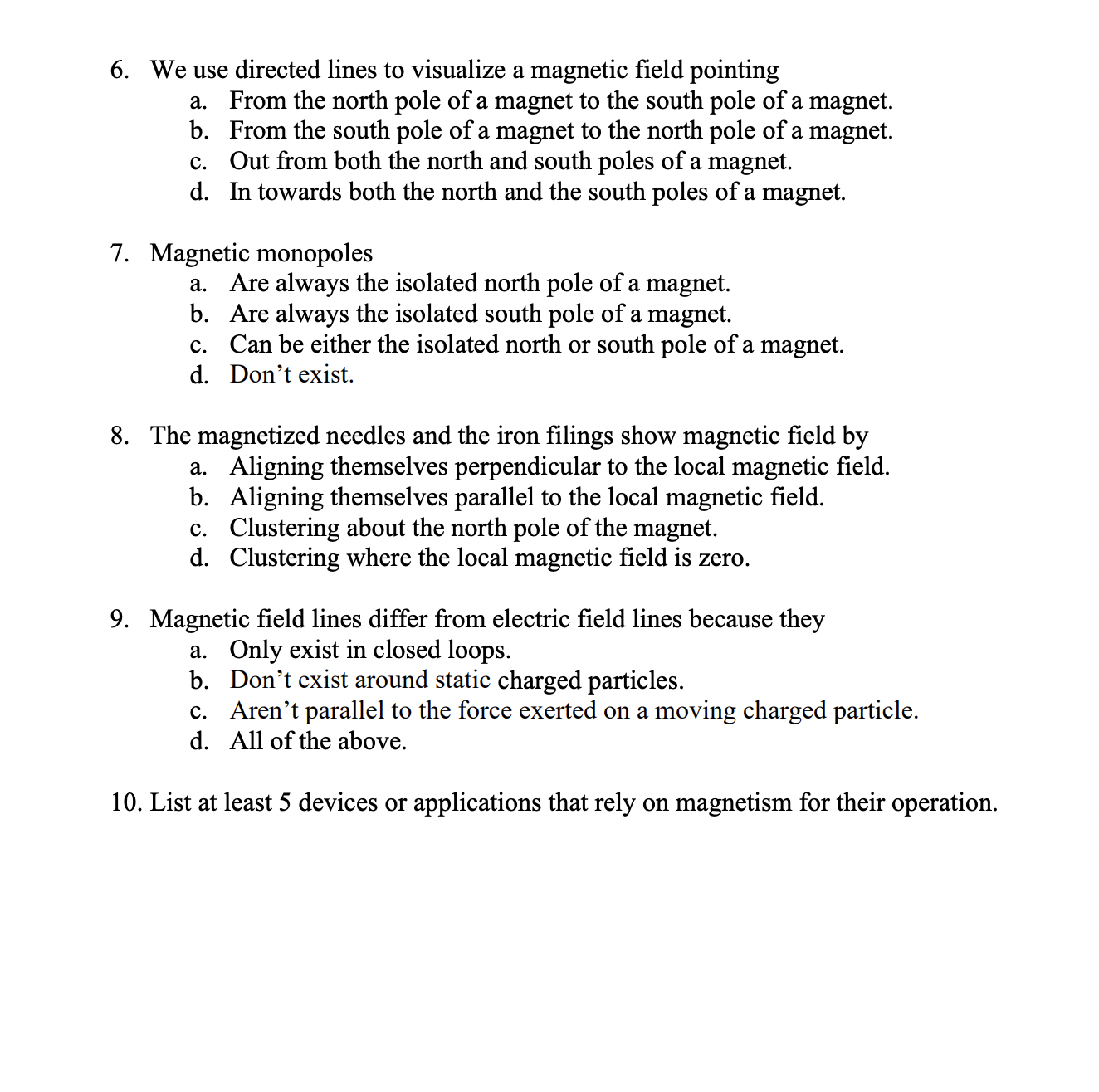
1. Electric field lines Start on a negative charge and end on a positive charge. b. Form closed loops c. End on a negative charge and start on a positive charge. d. Point in the same direction as the electric force experienced by a negative charge. 2. Equipotential lines a. End on a negative charge and start on a positive charge. b. Form closed loops. c. Frequently cross. d. Are parallel to Electric field lines. 3. Electric fields are stronger where a. Neighbouring field lines are further apart. b. Neighbouring field lines are closer together. c. Neighbouring field lines cross. d. Neighbouring field lines are parallel. 4. An electric field is produced by a. An electrically charged particle that's static. b. An electrically charged particle that's moving. c. Equipotential lines. d. An electrically charged particle, static or moving. 5. A magnetic field will be produced by a. A stationary positive point charge. b. A spinning neutron. c. A moving electron. d. A stationary neutron.6. We use directed lines to visualize a magnetic field pointing a. From the north pole of a magnet to the south pole of a magnet. b. From the south pole of a magnet to the north pole of a magnet. c. Out from both the north and south poles of a magnet. d. In towards both the north and the south poles of a magnet. 7. Magnetic monopoles a. Are always the isolated north pole of a magnet. b. Are always the isolated south pole of a magnet. c. Can be either the isolated north or south pole of a magnet. d. Don't exist. 8. The magnetized needles and the iron filings show magnetic field by a. Aligning themselves perpendicular to the local magnetic field. b. Aligning themselves parallel to the local magnetic field. c. Clustering about the north pole of the magnet d. Clustering where the local magnetic field is zero. 9. Magnetic field lines differ from electric field lines because they a. Only exist in closed loops. b. Don't exist around static charged particles. c. Aren't parallel to the force exerted on a moving charged particle. d. All of the above. 10. List at least 5 devices or applications that rely on magnetism for their operation
Step by Step Solution
There are 3 Steps involved in it

Get step-by-step solutions from verified subject matter experts