Question: 1. Extend the two-period markdown model in Section 10.1.1 to three periods. That is, assume that the price-response function is d(p) = 1,000 - 100p,
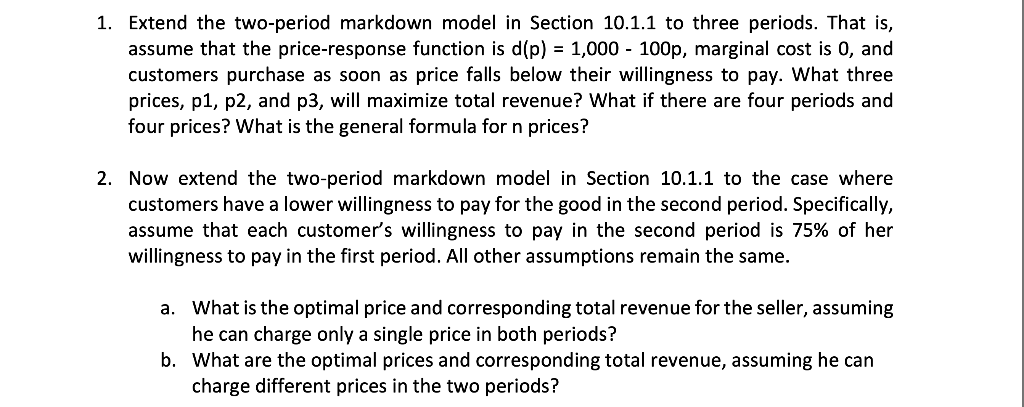
1. Extend the two-period markdown model in Section 10.1.1 to three periods. That is, assume that the price-response function is d(p) = 1,000 - 100p, marginal cost is 0, and customers purchase as soon as price falls below their willingness to pay. What three prices, p1, p2, and p3, will maximize total revenue? What if there are four periods and four prices? What is the general formula for n prices? 2. Now extend the two-period markdown model in Section 10.1.1 to the case where customers have a lower willingness to pay for the good in the second period. Specifically, assume that each customer's willingness to pay in the second period is 75% of her willingness to pay in the first period. All other assumptions remain the same. a. What is the optimal price and corresponding total revenue for the seller, assuming he can charge only a single price in both periods? b. What are the optimal prices and corresponding total revenue, assuming he can charge different prices in the two periods? 1. Extend the two-period markdown model in Section 10.1.1 to three periods. That is, assume that the price-response function is d(p) = 1,000 - 100p, marginal cost is 0, and customers purchase as soon as price falls below their willingness to pay. What three prices, p1, p2, and p3, will maximize total revenue? What if there are four periods and four prices? What is the general formula for n prices? 2. Now extend the two-period markdown model in Section 10.1.1 to the case where customers have a lower willingness to pay for the good in the second period. Specifically, assume that each customer's willingness to pay in the second period is 75% of her willingness to pay in the first period. All other assumptions remain the same. a. What is the optimal price and corresponding total revenue for the seller, assuming he can charge only a single price in both periods? b. What are the optimal prices and corresponding total revenue, assuming he can charge different prices in the two periods









 Study Help