



Question: 1. Find an example of a small business using open innovation practices to address the challenges they have faced during the Covid-19 pandemic. Identify which
1. Find an example of a small business using open innovation practices to address the challenges they have faced during the Covid-19 pandemic. Identify which type of innovation network they are using based on the network types identified in table 10.2 of the textbook. What are the advantages the firm seeks to achieve with the open innovation network model that they are using?
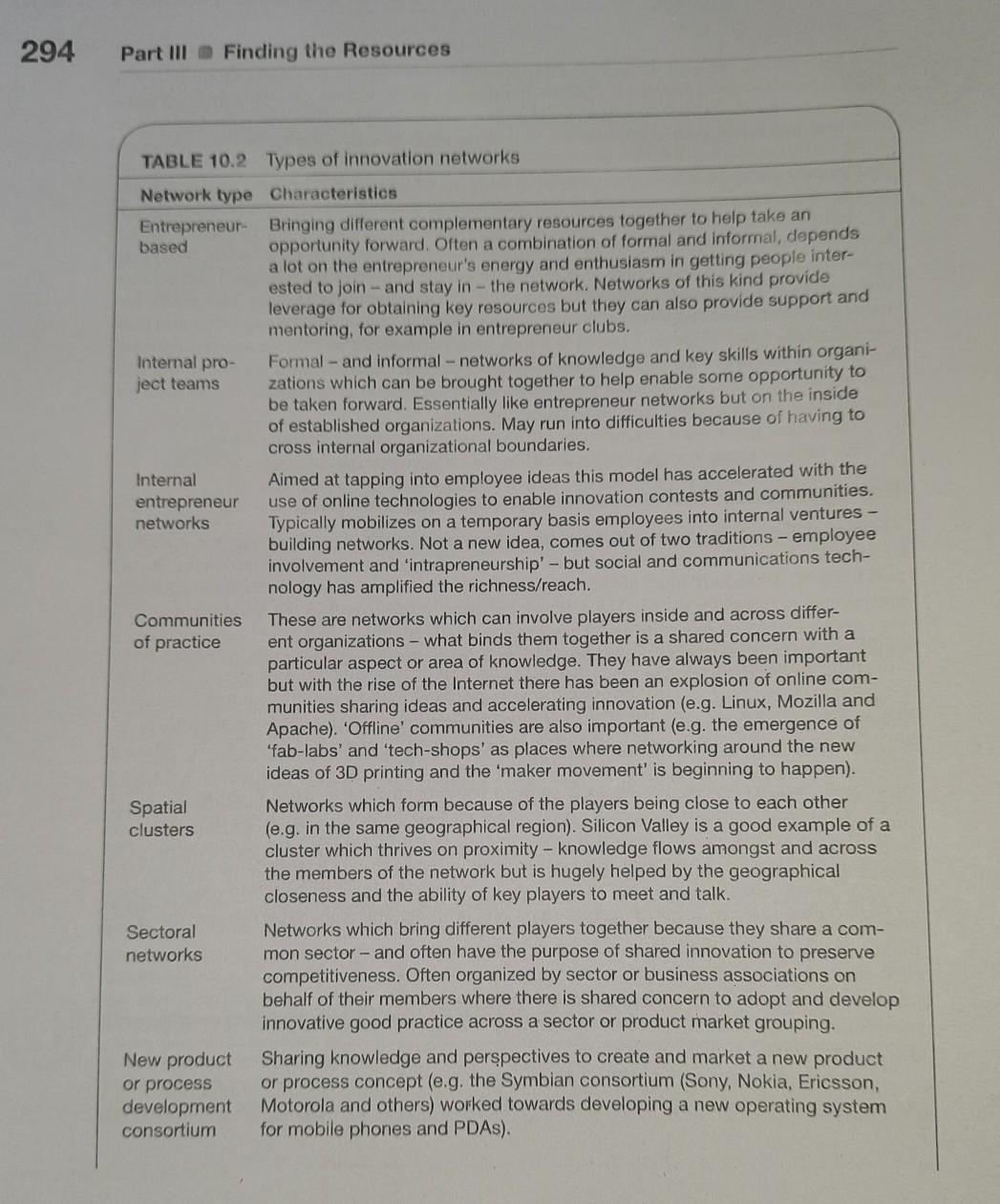
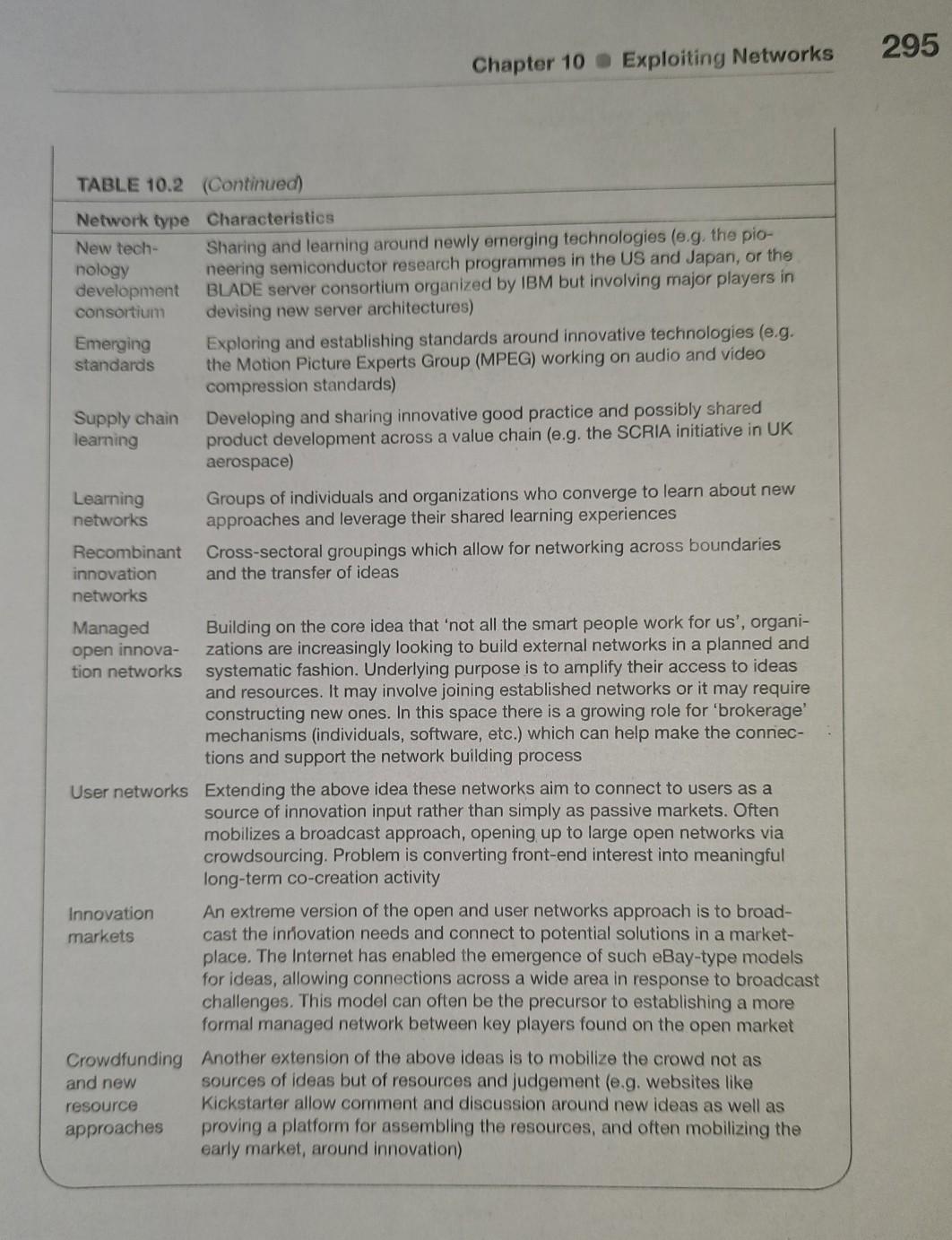
294 Part Ill Finding the Resources TABLE 10.2 Types of innovation networks Network type Characteristics Entrepreneur Bringing different complementary resources together to help take an based opportunity forward. Often a combination of formal and informal, depends a lot on the entrepreneur's energy and enthusiasm in getting people inter- ested to join - and stay in the network Networks of this kind provide leverage for obtaining key resources but they can also provide support and mentoring, for example in entrepreneur clubs. Internal pro- Formal - and informal - networks of knowledge and key skills within organi- ject teams zations which can be brought together to help enable some opportunity to be taken forward. Essentially like entrepreneur networks but on the inside of established organizations. May run into difficulties because of having to cross internal organizational boundaries. Internal Aimed at tapping into employee ideas this model has accelerated with the entrepreneur use of online technologies to enable innovation contests and communities. networks Typically mobilizes on a temporary basis employees into internal ventures - building networks. Not a new idea, comes out of two traditions -employee involvement and 'intrapreneurship' - but social and communications tech- nology has amplified the richness/reach. Communities These are networks which can involve players inside and across differ- of practice ent organizations - what binds them together is a shared concern with a particular aspect or area of knowledge. They have always been important but with the rise of the Internet there has been an explosion of online com- munities sharing ideas and accelerating innovation (e.g. Linux, Mozilla and Apache). 'Offline' communities are also important(e.g. the emergence of 'fab-labs' and 'tech-shops' as places where networking around the new ideas of 3D printing and the maker movement' is beginning to happen). Spatial Networks which form because of the players being close to each other clusters (e.g. in the same geographical region). Silicon Valley is a good example of a cluster which thrives on proximity - knowledge flows amongst and across the members of the network but is hugely helped by the geographical closeness and the ability of key players to meet and talk. Sectoral Networks which bring different players together because they share a com- networks mon sector - and often have the purpose of shared innovation to preserve competitiveness. Often organized by sector or business associations on behalf of their members where there is shared concern to adopt and develop innovative good practice across a sector or product market grouping. New product Sharing knowledge and perspectives to create and market a new product or process or process concept (e.g. the Symbian consortium (Sony, Nokia, Ericsson, development Motorola and others) worked towards developing a new operating system consortium for mobile phones and PDAs). 295 Chapter 10 Exploiting Networks TABLE 10.2 (Continued) Network type Characteristics New tech- Sharing and learning around newly emerging technologies (eg, the pio- nology neering semiconductor research programmes in the US and Japan, or the development BLADE server consortium organized by IBM but involving major players in consortium devising new server architectures) Emerging Exploring and establishing standards around innovative technologies (e.g. standards the Motion Picture Experts Group (MPEG) working on audio and video compression standards) Supply chain Developing and sharing innovative good practice and possibly shared learning product development across a value chain (e.g. the SCRIA initiative in UK aerospace) Learning Groups of individuals and organizations who converge to learn about new networks approaches and leverage their shared learning experiences Recombinant Cross-sectoral groupings which allow for networking across boundaries innovation and the transfer of ideas networks Managed Building on the core idea that 'not all the smart people work for us', organi- open innova- zations are increasingly looking to build external networks in a planned and tion networks systematic fashion. Underlying purpose is to amplify their access to ideas and resources. It may involve joining established networks or it may require constructing new ones. In this space there is a growing role for 'brokerage mechanisms (individuals, software, etc.) which can help make the connec- tions and support the network building process User networks Extending the above idea these networks aim to connect to users as a source of innovation input rather than simply as passive markets. Often mobilizes a broadcast approach, opening up to large open networks via crowdsourcing. Problem is converting front-end interest into meaningful long-term co-creation activity Innovation An extreme version of the open and user networks approach is to broad- markets cast the innovation needs and connect to potential solutions in a market- place. The Internet has enabled the emergence of such eBay-type models for ideas, allowing connections across a wide area in response to broadcast challenges. This model can often be the precursor to establishing a more formal managed network between key players found on the open market Crowdfunding Another extension of the above ideas is to mobilize the crowd not as and new sources of ideas but of resources and judgement (e.g. websites like resource Kickstarter allow comment and discussion around new ideas as well as approaches proving a platform for assembling the resources, and often mobilizing the early market, around innovation)
Step by Step Solution
There are 3 Steps involved in it
1 Expert Approved Answer
Step: 1 Unlock

Question Has Been Solved by an Expert!
Get step-by-step solutions from verified subject matter experts
Step: 2 Unlock
Step: 3 Unlock