







Question: 1. Find the dual to the linear program. (7 points) min 4x1 - x2 + 2x3 s.t. x + x 5 2x1+x2 7 2x2
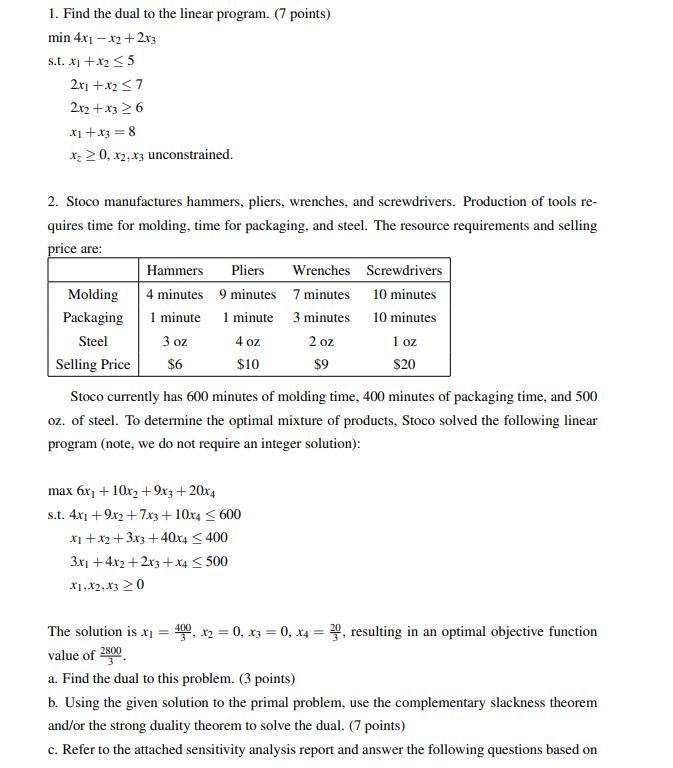
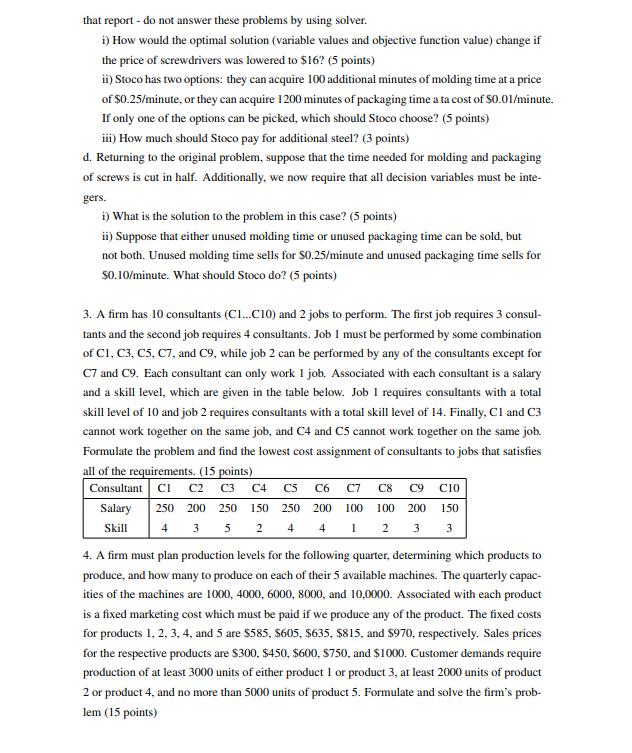
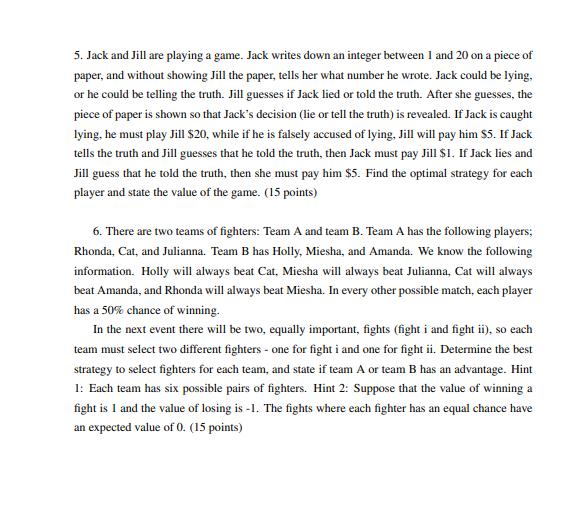
1. Find the dual to the linear program. (7 points) min 4x1 - x2 + 2x3 s.t. x + x 5 2x1+x2 7 2x2 + x3 26 x1 + x3 = 8 x20, X2, X3 unconstrained. 2. Stoco manufactures hammers, pliers, wrenches, and screwdrivers. Production of tools re- quires time for molding, time for packaging, and steel. The resource requirements and selling price are: Molding Packaging Steel Selling Price Hammers Pliers 4 minutes 1 minute 3 oz $6 9 minutes 1 minute 4 oz $10 max 6x + 10x +9x3+20x4 s.t. 4x1 +9x2 +7x3+10x4 600 Wrenches 7 minutes 3 minutes 2 oz $9 Stoco currently has 600 minutes of molding time, 400 minutes of packaging time, and 500 oz. of steel. To determine the optimal mixture of products, Stoco solved the following linear program (note, we do not require an integer solution): x1+x2+3x3+40x4400 3x1 +4x2+2x3+x4 500 X1, X2, X3 20 Screwdrivers 10 minutes 10 minutes 1 oz $20 The solution is x = 400, x2=0, x3=0, x4=20, resulting in an optimal objective function value of 2800 a. Find the dual to this problem. (3 points) b. Using the given solution to the primal problem, use the complementary slackness theorem and/or the strong duality theorem to solve the dual. (7 points) c. Refer to the attached sensitivity analysis report and answer the following questions based on that report - do not answer these problems by using solver. i) How would the optimal solution (variable values and objective function value) change if the price of screwdrivers was lowered to $16? (5 points) ii) Stoco has two options: they can acquire 100 additional minutes of molding time at a price of $0.25/minute, or they can acquire 1200 minutes of packaging time a ta cost of $0.01/minute. If only one of the options can be picked, which should Stoco choose? (5 points) iii) How much should Stoco pay for additional steel? (3 points) d. Returning to the original problem, suppose that the time needed for molding and packaging of screws is cut in half. Additionally, we now require that all decision variables must be inte- gers. i) What is the solution to the problem in this case? (5 points) ii) Suppose that either unused molding time or unused packaging time can be sold, but not both. Unused molding time sells for $0.25/minute and unused packaging time sells for $0.10/minute. What should Stoco do? (5 points) 3. A firm has 10 consultants (C1...C10) and 2 jobs to perform. The first job requires 3 consul- tants and the second job requires 4 consultants. Job I must be performed by some combination of C1, C3, C5, C7, and C9, while job 2 can be performed by any of the consultants except for C7 and C9. Each consultant can only work 1 job. Associated with each consultant is a salary and a skill level, which are given in the table below. Job 1 requires consultants with a total skill level of 10 and job 2 requires consultants with a total skill level of 14. Finally, Cl and C3 cannot work together on the same job, and C4 and C5 cannot work together on the same job. Formulate the problem and find the lowest cost assignment of consultants to jobs that satisfies all of the requirements. (15 points) Consultant C1 C2 C3 C4 C5 C6 C7 C8 C9 CIO Salary 250 200 250 150 250 200 100 100 200 150 Skill 4 3 52 4 4 1 2 3 3 4. A firm must plan production levels for the following quarter, determining which products to produce, and how many to produce on each of their 5 available machines. The quarterly capac- ities of the machines are 1000, 4000, 6000, 8000, and 10,0000. Associated with each product is a fixed marketing cost which must be paid if we produce any of the product. The fixed costs for products 1, 2, 3, 4, and 5 are $585, $605, $635, $815, and $970, respectively. Sales prices for the respective products are $300, $450, $600, $750, and $1000. Customer demands require production of at least 3000 units of either product 1 or product 3, at least 2000 units of product 2 or product 4, and no more than 5000 units of product 5. Formulate and solve the firm's prob- lem (15 points) 5. Jack and Jill are playing a game. Jack writes down an integer between 1 and 20 on a piece of paper, and without showing Jill the paper, tells her what number he wrote. Jack could be lying. or he could be telling the truth. Jill guesses if Jack lied or told the truth. After she guesses, the piece of paper is shown so that Jack's decision (lie or tell the truth) is revealed. If Jack is caught lying, he must play Jill $20, while if he is falsely accused of lying, Jill will pay him $5. If Jack tells the truth and Jill guesses that he told the truth, then Jack must pay Jill $1. If Jack lies and Jill guess that he told the truth, then she must pay him $5. Find the optimal strategy for each player and state the value of the game. (15 points) 6. There are two teams of fighters: Team A and team B. Team A has the following players; Rhonda, Cat, and Julianna. Team B has Holly, Miesha, and Amanda. We know the following information. Holly will always beat Cat, Miesha will always beat Julianna, Cat will always beat Amanda, and Rhonda will always beat Miesha. In every other possible match, each player has a 50% chance of winning. In the next event there will be two, equally important, fights (fight i and fight ii), so each team must select two different fighters - one for fight i and one for fight ii. Determine the best strategy to select fighters for each team, and state if team A or team B has an advantage. Hint 1: Each team has six possible pairs of fighters. Hint 2: Suppose that the value of winning a fight is I and the value of losing is -1. The fights where each fighter has an equal chance have an expected value of 0. (15 points)
Step by Step Solution
3.42 Rating (158 Votes )
There are 3 Steps involved in it
The image youve provided contains several questions on different topics that are typically found in ... View full answer

Get step-by-step solutions from verified subject matter experts
 Study Help