







Question: 1. Find the limit -+34x-5 = (a) does not exist (b) 1 (c) 2 (d) 3 (e) 4 18. Find the limit lim $2-9 =
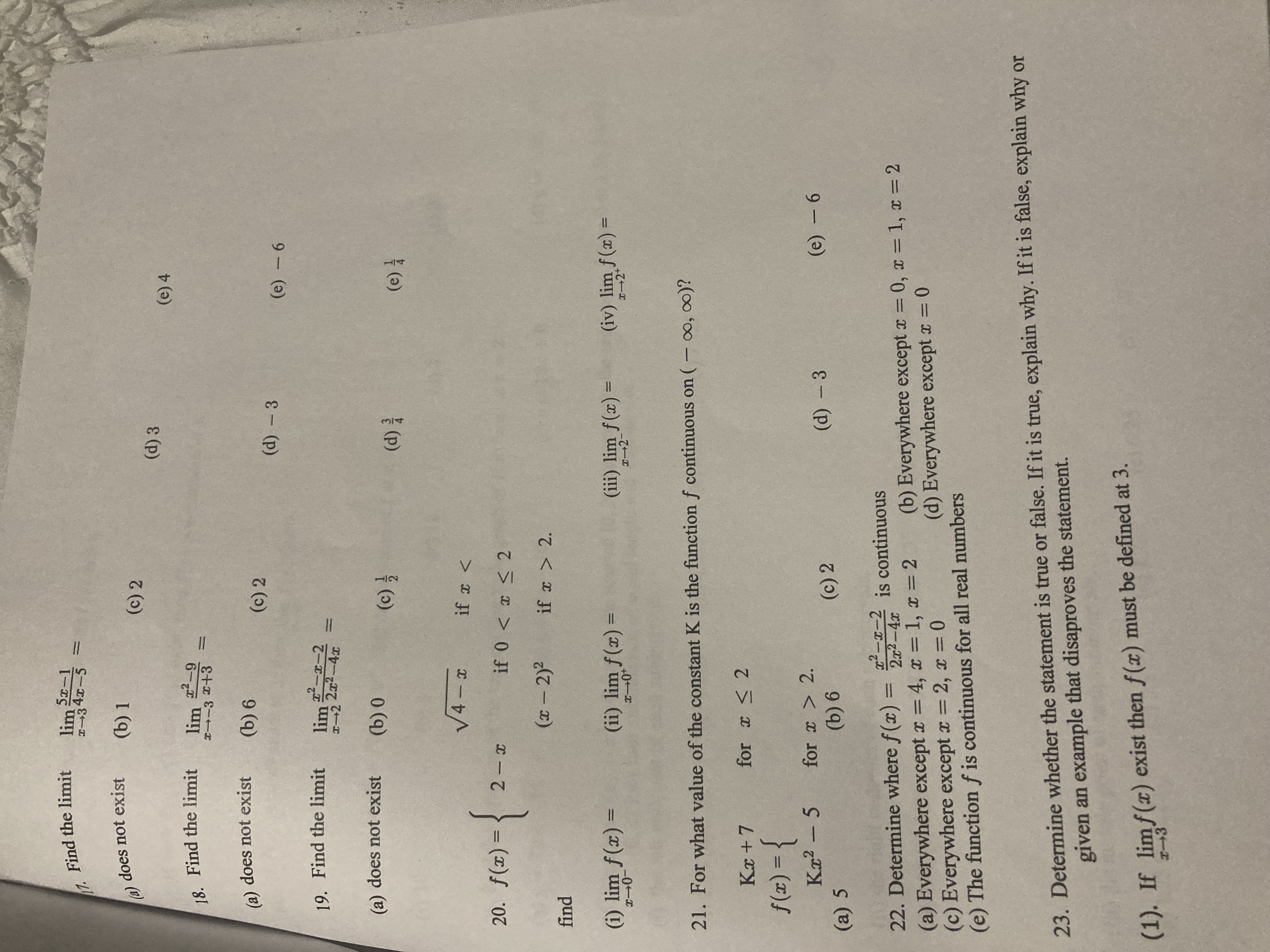
1. Find the limit -+34x-5 = (a) does not exist (b) 1 (c) 2 (d) 3 (e) 4 18. Find the limit lim $2-9 = (a) does not exist (b) 6 (c) 2 (d) - 3 (e) - 6 19. Find the limit lim $2-x-2 C +2 2x2-4x = (a) does not exist ( b) 0 (c) ; (d) (e) V4 - x if x 2. (i) lim f (x) = (ii) lim f (x) = I-+0+ (iii) lim f(x) = (iv) lim f (x) = I-+2- I-+ 2+ 21. For what value of the constant K is the function f continuous on ( - 0o, co)? Kx + 7 for x - 2 f (z) = Kx2 - 5 for x > 2. (a) 5 ( b) 6 (c) 2 (d) - 3 (e) - 6 22. Determine where f (x) = 2x2-4x 1 -1-2 is continuous (a) Everywhere except x = 4, x = 1, x = 2 (b) Everywhere except x = 0, x = 1, x =2 (c) Everywhere except x = 2, x = 0 (d) Everywhere except x = 0 (e) The function f is continuous for all real numbers 23. Determine whether the statement is true or false. If it is true, explain why. If it is false, explain why or given an example that disaproves the statement. (1). If lim f(x) exist then f(x) must be defined at 3
Step by Step Solution
There are 3 Steps involved in it

Get step-by-step solutions from verified subject matter experts
 Study Help