







Question: 1 Find the solutions for the problems by using the Euler-Lagrange differential equation and the boundary conditions, if given. I = f(y + 4xy')dx =
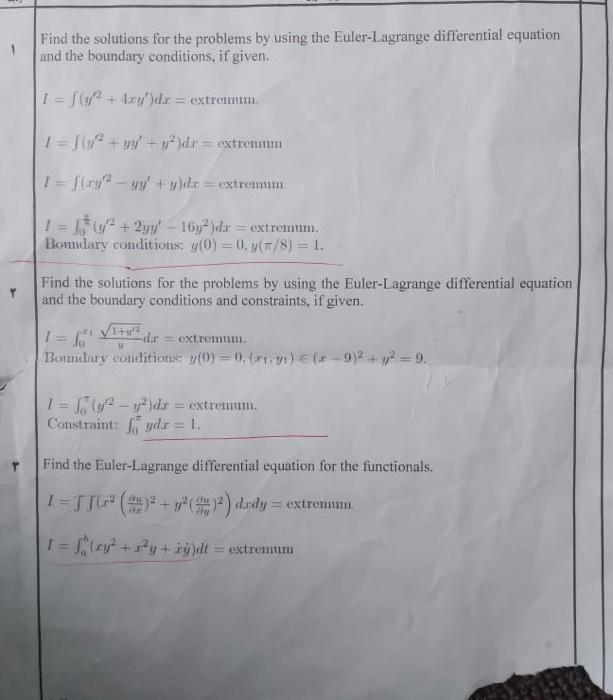
Find the solutions for the problems by using the Euler-Lagrange differential equation and the boundary conditions, if given. I=(y2+4xy)dx=extrenum.I=(y2+yy+y2)dr=extremumI=(xy2yy+y)dx=extremum I=052(y2+2yy16y2)dx=extremum. Boundary conditions: y(0)=0,y(/8)=1. Find the solutions for the problems by using the Euler-Lagrange differential equation and the boundary conditions and constraints, if given. l=0x1N1+y2dr=extremuu. Boundary conditions; y(0)=0,(x1,y1)(x9)2+y2=9. I=0(y2y2)dx=extremuu. Constraint: 0ydx=1 Find the Euler-Lagrange differential equation for the functionals. I=(r2(xu)2+y2(yu)2)dxdy=extrenumuI=ab(xy2+x2y+xy)dt=extremum
Step by Step Solution
There are 3 Steps involved in it

Get step-by-step solutions from verified subject matter experts
 Study Help