







Question: 1. Finite Difference Methods (40 points) In this problem we will consider the system of two conductors at different potentials shown below 100 V -1
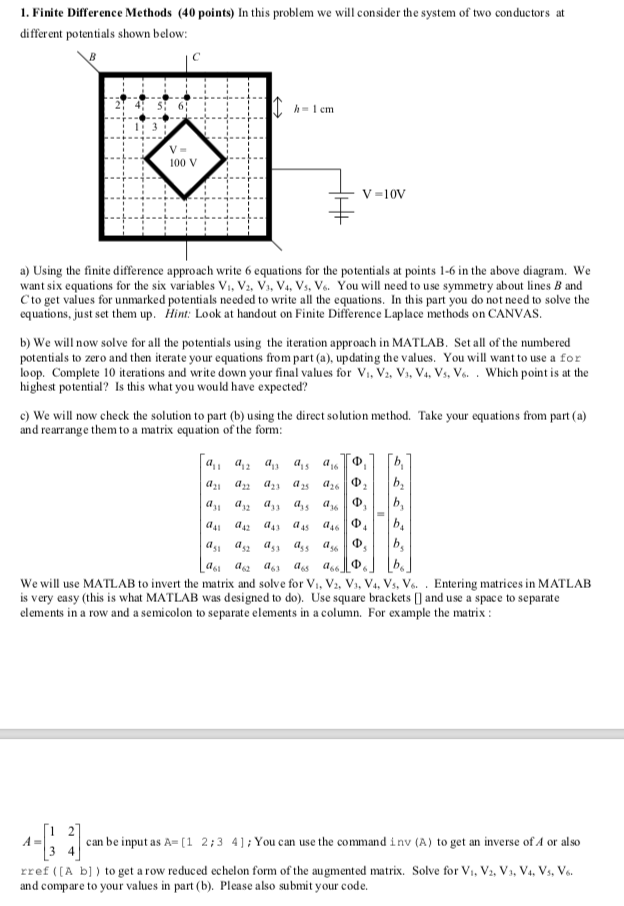
1. Finite Difference Methods (40 points) In this problem we will consider the system of two conductors at different potentials shown below 100 V -1 V-10V a) Using the finite difference approach write 6 equations for the potentials at points 1-6 in the above diagram. We want six equations for the six variables Vi, V2. Vi. V4, Vs. Ve. You will need to use symmetry about lines B and Cto get values for unmarked potentials needed to write all the equations. In this part you do not need to solve the equations, just set them up. Hint: Look at handout on Finite Difference Laplace methods on CANVAS b) We will now solve for al the potentials using the iteration approach in MATLAB. Set all of the numbered potentials to zero and then iterate your equations from part (a), updating the values. You will want to use a for loop. Complete 10 iterations and write down your final values for Vi. V2. Vi. Vi. Vs. V. . Which point is at the highest potential? Is this what you would have expected? c We will now check the solution to part (b) using the direct solution method. Take your equations from part (a) and rearrange them to a matrix equation of the form We will use MATLAB to invert the matrix and solve for Vi. V2. Vi. V4. Vs. V . Entering matrices in MATLAB is very easy (this is what MATLAB was designed to do). Use square brackets and use a space to separate elements in a row and a semicolon to separate elements in a column. For example the matrix can be input as A-[1 2:3 41; You can use the command inv (A) to get an inverse of A or also rref (A b]) to get a row reduced echelon form of the augmented matrix. Solve for Vi. V2. V>. Vi. Vs. V and compare to your values in part (b). Please also submit your code. 1. Finite Difference Methods (40 points) In this problem we will consider the system of two conductors at different potentials shown below 100 V -1 V-10V a) Using the finite difference approach write 6 equations for the potentials at points 1-6 in the above diagram. We want six equations for the six variables Vi, V2. Vi. V4, Vs. Ve. You will need to use symmetry about lines B and Cto get values for unmarked potentials needed to write all the equations. In this part you do not need to solve the equations, just set them up. Hint: Look at handout on Finite Difference Laplace methods on CANVAS b) We will now solve for al the potentials using the iteration approach in MATLAB. Set all of the numbered potentials to zero and then iterate your equations from part (a), updating the values. You will want to use a for loop. Complete 10 iterations and write down your final values for Vi. V2. Vi. Vi. Vs. V. . Which point is at the highest potential? Is this what you would have expected? c We will now check the solution to part (b) using the direct solution method. Take your equations from part (a) and rearrange them to a matrix equation of the form We will use MATLAB to invert the matrix and solve for Vi. V2. Vi. V4. Vs. V . Entering matrices in MATLAB is very easy (this is what MATLAB was designed to do). Use square brackets and use a space to separate elements in a row and a semicolon to separate elements in a column. For example the matrix can be input as A-[1 2:3 41; You can use the command inv (A) to get an inverse of A or also rref (A b]) to get a row reduced echelon form of the augmented matrix. Solve for Vi. V2. V>. Vi. Vs. V and compare to your values in part (b). Please also submit your code
Step by Step Solution
There are 3 Steps involved in it

Get step-by-step solutions from verified subject matter experts
 Study Help