







Question: 1. First, we examine a monopolistic rm. The rm faces a market described by the {inverse} demand function pizy} = A B + y, where
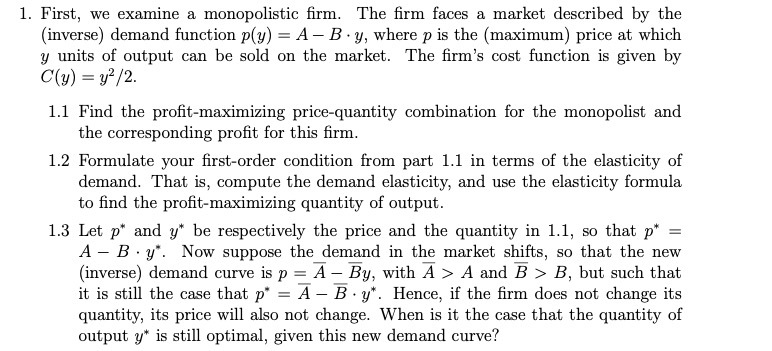
1. First, we examine a monopolistic rm. The rm faces a market described by the {inverse} demand function pizy} = A B + y, where p is the {maximum} price at which 3; units of output can be sold on the market. The rm's cost function is given by 0(a) = 3:23\"?- 1.1 Find the prot-masdmizing price-quantity,r combination for the monopolist and the corresponding prot for this rm. 1.2 Formulate your rst-order condition 'om part 1.1 in terms of the elasticity of demand. That is, compute the demand elasticity, and use the elasticity formula to nd the prot-maximizing quantity of output. 1.3 Let pr\" and y'\" be respectively the price and the quantity,r in 1.1, so that p'" = A B - 11". Now suppose the demand in the market shifts, so that the new (inverse) demand curve is p = A y, with A l: A and E :3: B, but such that it is still the case that p" = A E + y*. Hence, if the rm does not change its quantity, its price will also not change. When is it the case that the quantity of output y'\" is still optimal, given this new demand curve
Step by Step Solution
There are 3 Steps involved in it

Get step-by-step solutions from verified subject matter experts
 Study Help