







Question: 1. For any smooth function z = f(r, y), show that d' z is in a quadratic form. Thus, show that d'z = X'HX, where
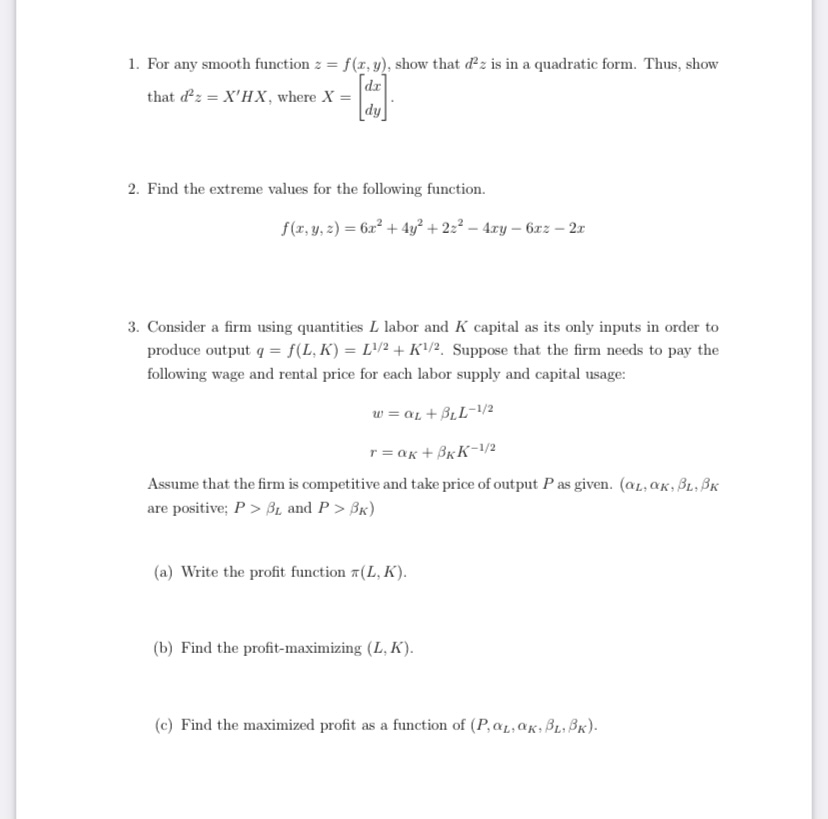
1. For any smooth function z = f(r, y), show that d' z is in a quadratic form. Thus, show that d'z = X'HX, where X = dx dy 2. Find the extreme values for the following function. f(x, y, z) = 6x2 + 4y? + 223 - Ary - 612 - 2x 3. Consider a firm using quantities L labor and K capital as its only inputs in order to produce output q = f(L, K) = L1/2 + K1/2. Suppose that the firm needs to pay the following wage and rental price for each labor supply and capital usage: w = at + BLL-1/2 r = ak + BKK-1/2 Assume that the firm is competitive and take price of output P as given. (aL, OK, BL; BK are positive; P > BL and P > BK) (a) Write the profit function * (L, K). (b) Find the profit-maximizing (L, K). (c) Find the maximized profit as a function of (P, OL, OK, BL, BK)
Step by Step Solution
There are 3 Steps involved in it

Get step-by-step solutions from verified subject matter experts
 Study Help