







Question: 1: For each function f and value x = c, use the definition of the derivative to calculate the exact value of the slope of
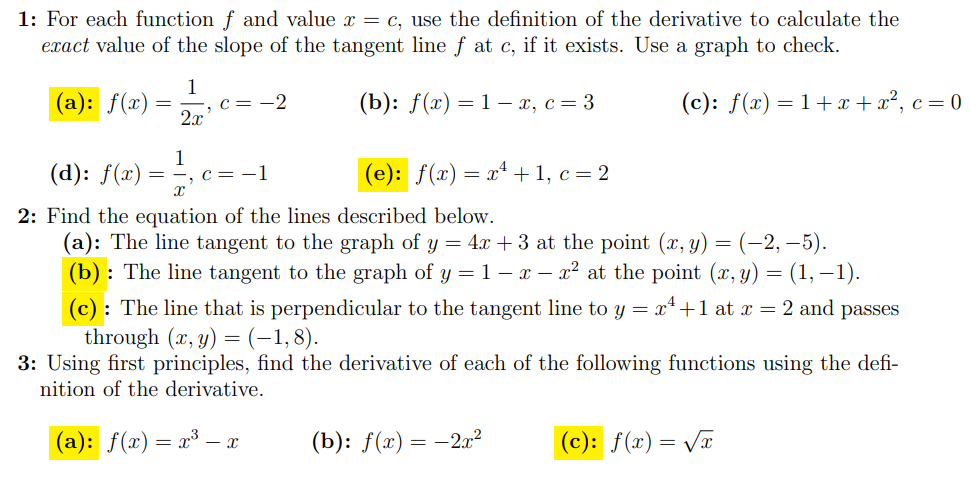
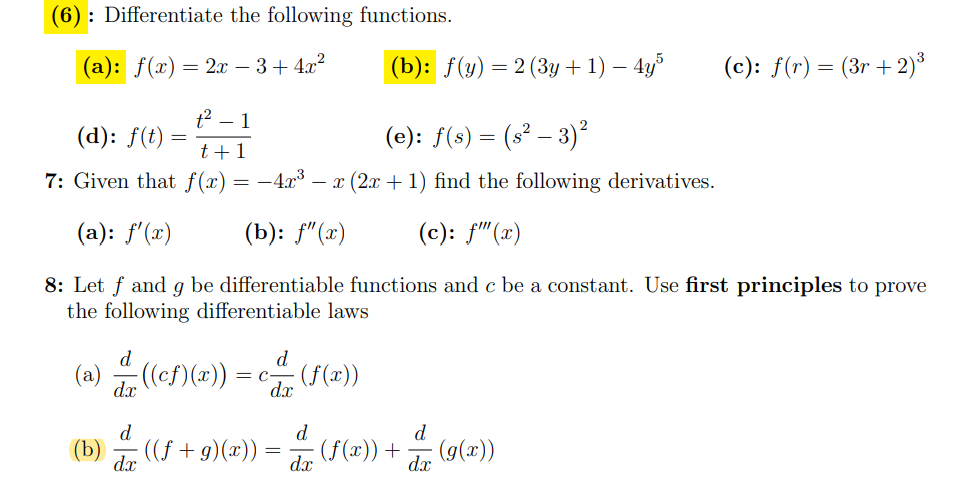
1: For each function f and value x = c, use the definition of the derivative to calculate the exact value of the slope of the tangent line f at c, if it exists. Use a graph to check. (a): f(x) = 2.x C = -2 (b): f(x) =1-x, c= 3 (c): f(x) = 1+x+x, c=0 (d): f(x) = -, c=-1 (e): f(x) = x* +1, c=2 2: Find the equation of the lines described below. (a): The line tangent to the graph of y = 4x + 3 at the point (x, y) = (-2, -5). (b) : The line tangent to the graph of y = 1 - x - x2 at the point (x, y) = (1, -1). (c) : The line that is perpendicular to the tangent line to y = x* +1 at x = 2 and passes through (x, y) = (-1, 8). 3: Using first principles, find the derivative of each of the following functions using the defi- nition of the derivative. (a): f(x) =13 -x (b): f(x) = -2x2 (c): f(x) = Vx(6) : Differentiate the following functions. (a): f(x) = 2x - 3+ 4x2 (b): f(y) = 2(3y + 1) - 4y (c): f(r) = (3r +2)3 (d): f(t) = t2 - 1 t+1 (e): f(s) = ($2 -3)2 7: Given that f(x) = -4x3 - x (2x + 1) find the following derivatives. (a): f'(x) (b): f"(2) (c): f" (x) 8: Let f and g be differentiable functions and c be a constant. Use first principles to prove the following differentiable laws (a) dx ((cf) (x) ) = c dx (f (x)) d d (b) ( (f + g ) (20 ) ) = d dx dx (f(z) ) + dx (g(x))
Step by Step Solution
There are 3 Steps involved in it

Get step-by-step solutions from verified subject matter experts
 Study Help