







Question: 1. For this question, we assume two lambda terms: W=xy.xyy and I=z.z. (c) Consider the following two Haskell function definitions: encode n= False fx=f(x+1) i.
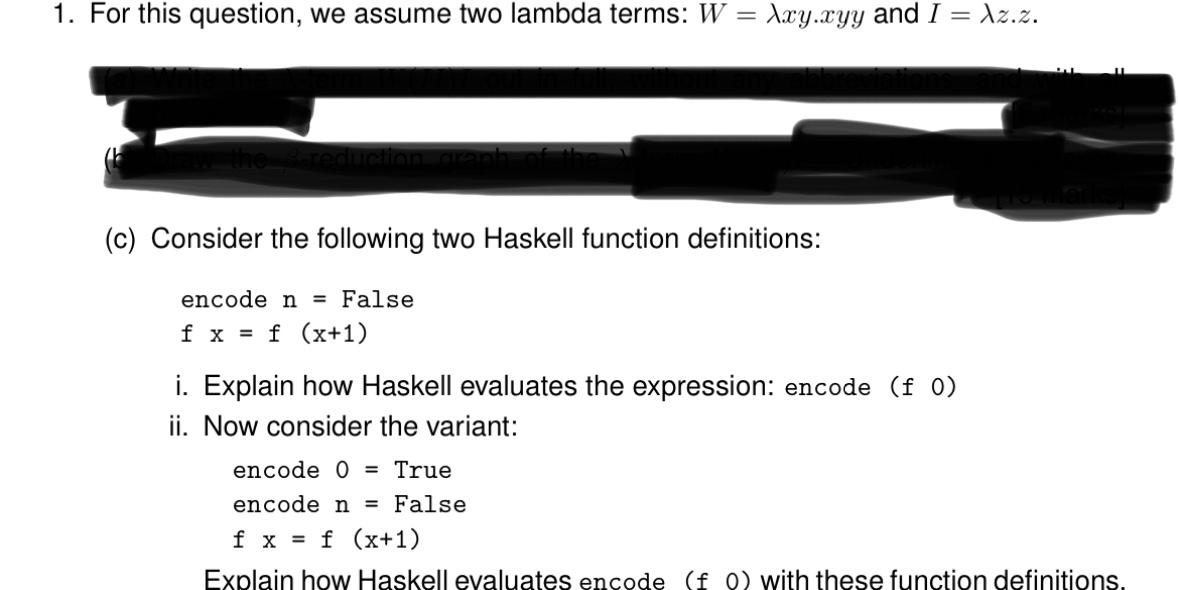
1. For this question, we assume two lambda terms: W=xy.xyy and I=z.z. (c) Consider the following two Haskell function definitions: encode n= False fx=f(x+1) i. Explain how Haskell evaluates the expression: encode ( (f0) ii. Now consider the variant: encode 0= True encode n= False fx=f(x+1)
Step by Step Solution
There are 3 Steps involved in it
1 Expert Approved Answer
Step: 1 Unlock

Question Has Been Solved by an Expert!
Get step-by-step solutions from verified subject matter experts
Step: 2 Unlock
Step: 3 Unlock
 Study Help