







Question: 1. From either a news source or a governmental website (reported within the last year), explore some of the data that show how we interact
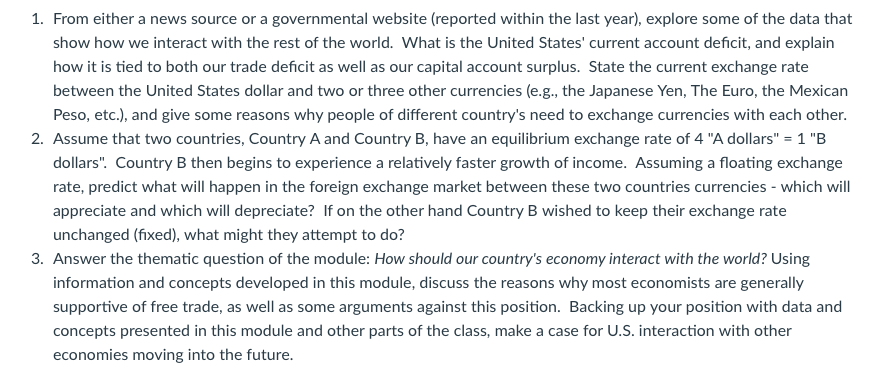
1. From either a news source or a governmental website (reported within the last year), explore some of the data that show how we interact with the rest of the world. What is the United States' current account deficit, and explain how it is tied to both our trade deficit as well as our capital account surplus. State the current exchange rate between the United States dollar and two or three other currencies (e.g., the Japanese Yen, The Euro, the Mexican Peso, etc.), and give some reasons why people of different country's need to exchange currencies with each other 2. Assume that two countries, Country A and Country B, have an equilibrium exchange rate of 4 "A dollars"-1 "B dollars". Country B then begins to experience a relatively faster growth of income. Assuming a floating exchange rate, predict what will happen in the foreign exchange market between these two countries currencies - which will appreciate and which will depreciate? If on the other hand Country B wished to keep their exchange rate unchanged (fixed), what might they attempt to do? 3. Answer the thematic question of the module: How should our country's economy interact with the world? Using information and concepts developed in this module, discuss the reasons why most economists are generally supportive of free trade, as well as some arguments against this position. Backing up your position with data and concepts presented in this module and other parts of the class, make a case for U.S. interaction with other economies moving into the future 1. From either a news source or a governmental website (reported within the last year), explore some of the data that show how we interact with the rest of the world. What is the United States' current account deficit, and explain how it is tied to both our trade deficit as well as our capital account surplus. State the current exchange rate between the United States dollar and two or three other currencies (e.g., the Japanese Yen, The Euro, the Mexican Peso, etc.), and give some reasons why people of different country's need to exchange currencies with each other 2. Assume that two countries, Country A and Country B, have an equilibrium exchange rate of 4 "A dollars"-1 "B dollars". Country B then begins to experience a relatively faster growth of income. Assuming a floating exchange rate, predict what will happen in the foreign exchange market between these two countries currencies - which will appreciate and which will depreciate? If on the other hand Country B wished to keep their exchange rate unchanged (fixed), what might they attempt to do? 3. Answer the thematic question of the module: How should our country's economy interact with the world? Using information and concepts developed in this module, discuss the reasons why most economists are generally supportive of free trade, as well as some arguments against this position. Backing up your position with data and concepts presented in this module and other parts of the class, make a case for U.S. interaction with other economies moving into the future
Step by Step Solution
There are 3 Steps involved in it

Get step-by-step solutions from verified subject matter experts
 Study Help