







Question: 1: Generate 10000 random numbers using the LCM method. Feel free to use any programming language or software package. (Tip: Python, R or Excel may
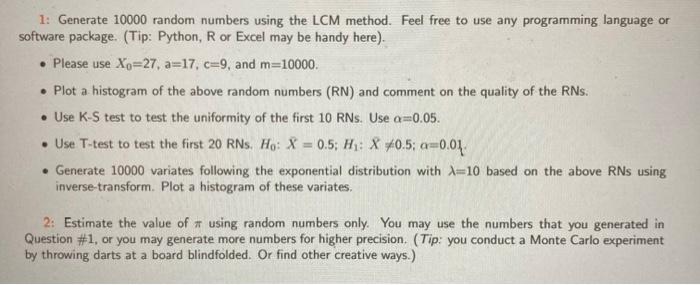
1: Generate 10000 random numbers using the LCM method. Feel free to use any programming language or software package. (Tip: Python, R or Excel may be handy here). . Please use Xo=27. a=17, c=9, and m=10000. Plot a histogram of the above random numbers (RN) and comment on the quality of the RNs. Use K-S test to test the uniformity of the first 10 RNs. Use o=0.05. Use T-test to test the first 20 RNs. Ho: X = 0.5; H: X 40.5; o=0.01 . Generate 10000 variates following the exponential distribution with X=10 based on the above RNs using inverse-transform. Plot a histogram of these variates. 2: Estimate the value of using random numbers only. You may use the numbers that you generated in Question #1, or you may generate more numbers for higher precision. (Tip: you conduct a Monte Carlo experiment by throwing darts at a board blindfolded. Or find other creative ways.) 1: Generate 10000 random numbers using the LCM method. Feel free to use any programming language or software package. (Tip: Python, R or Excel may be handy here). . Please use Xo=27. a=17, c=9, and m=10000. Plot a histogram of the above random numbers (RN) and comment on the quality of the RNs. Use K-S test to test the uniformity of the first 10 RNs. Use o=0.05. Use T-test to test the first 20 RNs. Ho: X = 0.5; H: X 40.5; o=0.01 . Generate 10000 variates following the exponential distribution with X=10 based on the above RNs using inverse-transform. Plot a histogram of these variates. 2: Estimate the value of using random numbers only. You may use the numbers that you generated in Question #1, or you may generate more numbers for higher precision. (Tip: you conduct a Monte Carlo experiment by throwing darts at a board blindfolded. Or find other creative ways.)
Step by Step Solution
There are 3 Steps involved in it

Get step-by-step solutions from verified subject matter experts
 Study Help