







Question: 1. Given a function f (3.)), use Taylor approximations to derive a second order approximation to f(:t:0) is given by fH($0) = fth) 31) +
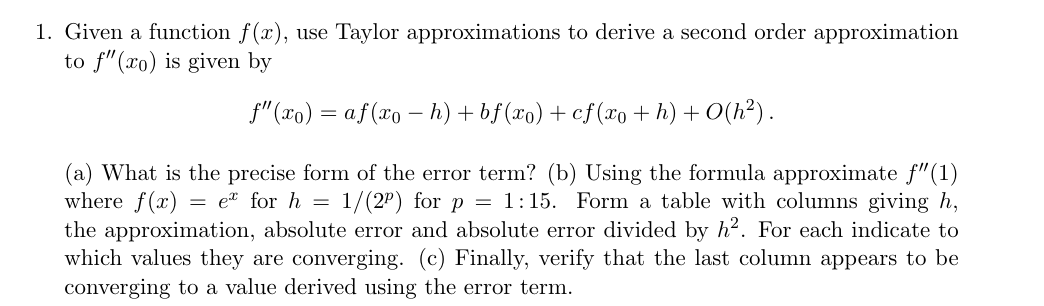
1. Given a function f (3.)), use Taylor approximations to derive a second order approximation to f\"(:t:0) is given by fH($0) = fth) 31) + bf(930) + Cmo + h) + 0052)- (a) What is the precise form of the error term? (b) Using the formula approximate f\"(1) Where f(:r) = em for h = Map) for p = 1:15. Form a table with columns giving h, the approximation, absolute error and absolute error divided by h2. For each indicate to which values they are converging. (c) Finally, verify that the last column appears to be converging to a value derived using the error term
Step by Step Solution
There are 3 Steps involved in it
1 Expert Approved Answer
Step: 1 Unlock

Question Has Been Solved by an Expert!
Get step-by-step solutions from verified subject matter experts
Step: 2 Unlock
Step: 3 Unlock
 Study Help