







Question: 1. Given only CSA(7, 3)'s and CSA(3, 2)'s for reducing partial products of a 6-bit by 5-bit multiplier, show a design with the fewest CSA's
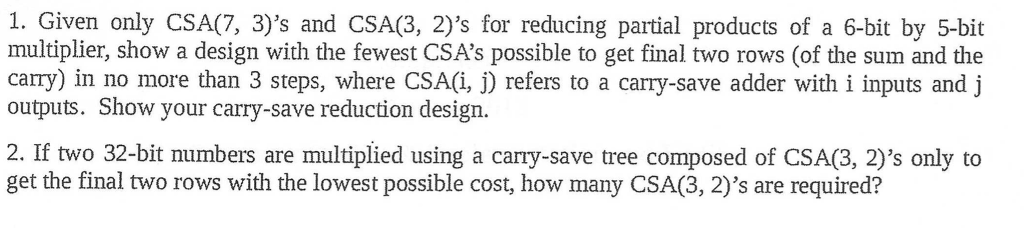
1. Given only CSA(7, 3)'s and CSA(3, 2)'s for reducing partial products of a 6-bit by 5-bit multiplier, show a design with the fewest CSA's possible to get final two rows (of the sum and the carry) in no more than 3 steps, where CSA(i, j) refers to a carry-save adder with i inputs and j outputs. Show your carry-save reduction design. 2. If two 32-bit numbers are multiplied using a carry-save tree composed of CSA(3, 2)'s only to get the final two rows with the lowest possible cost, how many CSA(3, 2)'s are required? 1. Given only CSA(7, 3)'s and CSA(3, 2)'s for reducing partial products of a 6-bit by 5-bit multiplier, show a design with the fewest CSA's possible to get final two rows (of the sum and the carry) in no more than 3 steps, where CSA(i, j) refers to a carry-save adder with i inputs and j outputs. Show your carry-save reduction design. 2. If two 32-bit numbers are multiplied using a carry-save tree composed of CSA(3, 2)'s only to get the final two rows with the lowest possible cost, how many CSA(3, 2)'s are required
Step by Step Solution
There are 3 Steps involved in it

Get step-by-step solutions from verified subject matter experts
 Study Help