





Question: 1. Given P(A U B) = 0.9, P(An B) = 0.3, and P(A) = 0.5, find P(A | B) and P(B | A). 2. When
1. Given P(A U B) = 0.9, P(An B) = 0.3, and P(A)
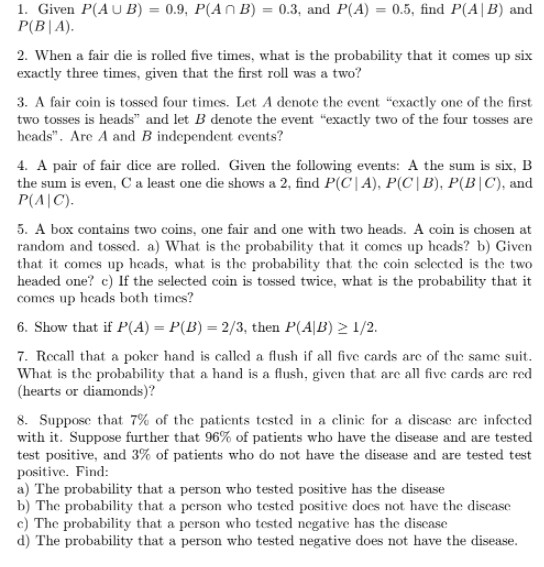
1. Given P(A U B) = 0.9, P(An B) = 0.3, and P(A) = 0.5, find P(A | B) and P(B | A). 2. When a fair die is rolled five times, what is the probability that it comes up six exactly three times, given that the first roll was a two? 3. A fair coin is tossed four times. Let A denote the event "exactly one of the first two tosses is heads" and let # denote the event "exactly two of the four tosses are heads". Are A and B independent events? 4. A pair of fair dice are rolled. Given the following events: A the sum is six, B the sum is even, C a least one die shows a 2, find P(C| A), P(C | B), P(B | C), and P(A | C). 5. A box contains two coins, one fair and one with two heads. A coin is chosen at random and tossed. a) What is the probability that it comes up heads? b) Given that it comes up heads, what is the probability that the coin selected is the two headed one? c) If the selected coin is tossed twice, what is the probability that it comes up heads both times? 6. Show that if P(A) - P(B) - 2/3. then P(A|B) > 1/2. 7. Recall that a poker hand is called a flush if all five cards are of the same suit. What is the probability that a hand is a flush, given that are all five cards are red (hearts or diamonds)? 8. Suppose that 7% of the patients tested in a clinic for a disease are infected with it. Suppose further that 96% of patients who have the disease and are tested test positive, and 3% of patients who do not have the disease and are tested test positive. Find: a) The probability that a person who tested positive has the disease b) The probability that a person who tested positive does not have the disease c) The probability that a person who tested negative has the disease d) The probability that a person who tested negative does not have the disease

Step by Step Solution

There are 3 Steps involved in it

1 Expert Approved Answer
Step: 1 Unlock blur-text-image
Question Has Been Solved by an Expert!

Get step-by-step solutions from verified subject matter experts

Step: 2 Unlock
Step: 3 Unlock

Students Have Also Explored These Related Mathematics Questions!