







Question: 1. Given the alphabet {0, 1}, {0, 1}* is defined to be all the strings that can be obtained by concatenating zero or more
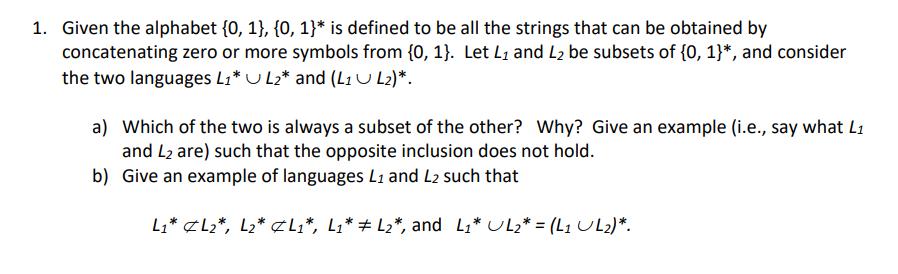
1. Given the alphabet {0, 1}, {0, 1}* is defined to be all the strings that can be obtained by concatenating zero or more symbols from {0, 1}. Let L1 and L2 be subsets of {0, 1}*, and consider the two languages L* UL2* and (L1 L2)*. a) Which of the two is always a subset of the other? Why? Give an example (i.e., say what L1 and L2 are) such that the opposite inclusion does not hold. b) Give an example of languages L1 and L2 such that L1* L2*, L2* L*, L* L2*, and L* UL2* = (L1 UL2)*.
Step by Step Solution
There are 3 Steps involved in it
a The language L1L2 is always a subset of L1 L2 To understand why lets consider the definitions of the two languages L1 L2 represents all the strings ... View full answer

Get step-by-step solutions from verified subject matter experts
 Study Help