







Question: 1) Given the below functions for supply and demand: Supply:P = ln (Q3 3) Demand: P = 22e-arctan (QD) a) Find the total welfare using
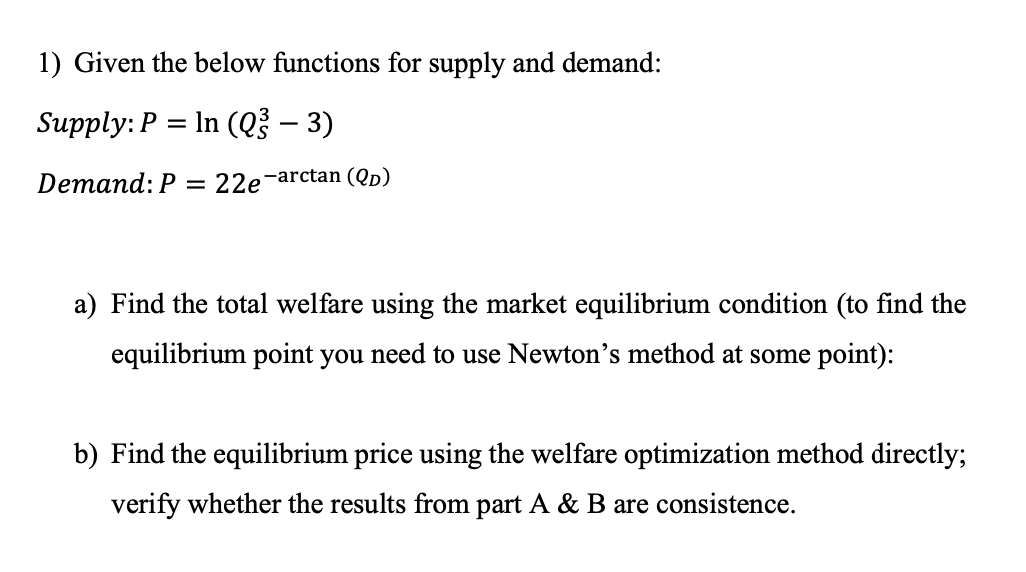
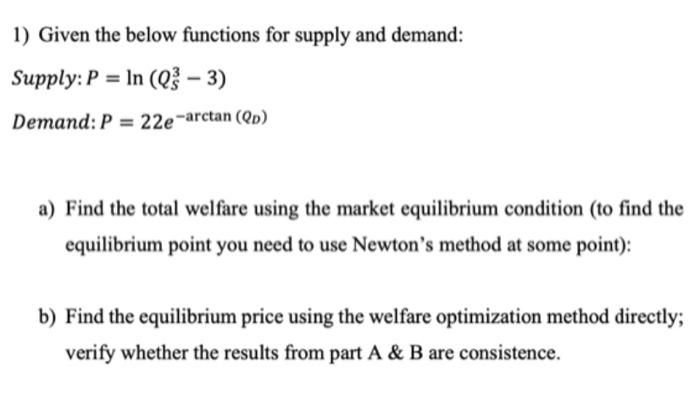
1) Given the below functions for supply and demand: Supply:P = ln (Q3 3) Demand: P = 22e-arctan (QD) a) Find the total welfare using the market equilibrium condition (to find the equilibrium point you need to use Newton's method at some point): b) Find the equilibrium price using the welfare optimization method directly; verify whether the results from part A & B are consistence. 1) Given the below functions for supply and demand: Supply: P = In (Q3 - 3) Demand: P = 22e-arctan (QD) a) Find the total welfare using the market equilibrium condition (to find the equilibrium point you need to use Newton's method at some point): b) Find the equilibrium price using the welfare optimization method directly; verify whether the results from part A & B are consistence. 1) Given the below functions for supply and demand: Supply:P = ln (Q3 3) Demand: P = 22e-arctan (QD) a) Find the total welfare using the market equilibrium condition (to find the equilibrium point you need to use Newton's method at some point): b) Find the equilibrium price using the welfare optimization method directly; verify whether the results from part A & B are consistence. 1) Given the below functions for supply and demand: Supply: P = In (Q3 - 3) Demand: P = 22e-arctan (QD) a) Find the total welfare using the market equilibrium condition (to find the equilibrium point you need to use Newton's method at some point): b) Find the equilibrium price using the welfare optimization method directly; verify whether the results from part A & B are consistence
Step by Step Solution
There are 3 Steps involved in it

Get step-by-step solutions from verified subject matter experts
 Study Help